
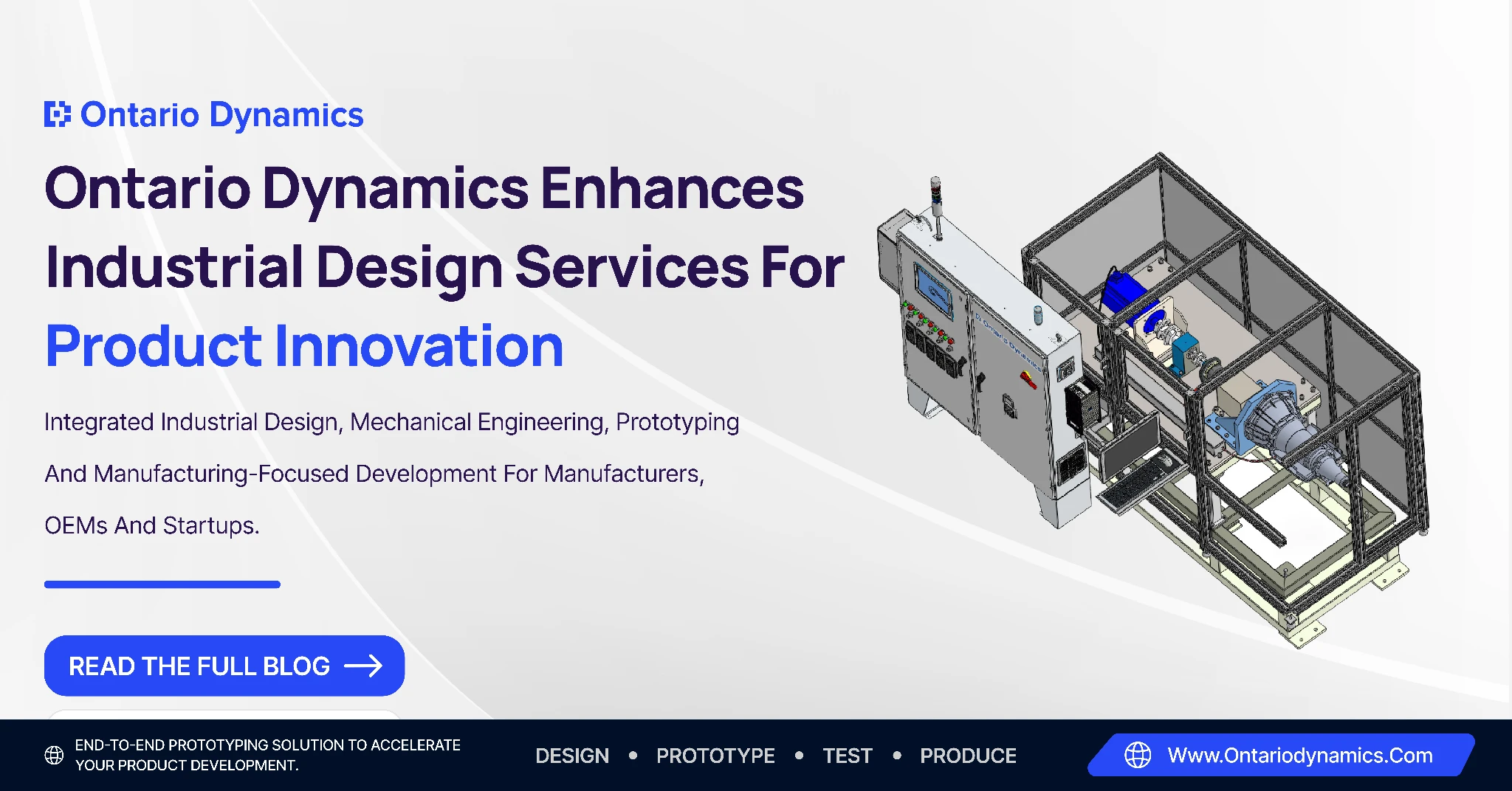
TORONTO, Ontario, — Ontario Dynamics, a Canadian product and equipment development company, is highlighting its Industrial Design Services for manufacturers, original equipment manufacturers (OEMs), startups and engineering teams developing functional, manufacturing-ready products. The company’s approach combines product research, concept development, 3D computer-aided design (CAD), mechanical engineering, prototyping and design for manufacturability (DFM). By connecting early-stage product ideas with practical engineering and production requirements, the services help development teams evaluate designs, identify technical challenges and prepare products for manufacturing.
The integrated approach brings together Industrial Design, Product Design Services, Product Development Services, and Engineering Design Services within a structured development process. It addresses important considerations such as product functionality, usability, material selection, mechanical performance, assembly requirements and production feasibility. This approach is particularly relevant for businesses seeking to convert initial concepts into physical products while managing engineering complexity and manufacturing constraints.
Integrating Industrial Design With Product Innovation
Industrial design plays an important role in transforming product concepts into solutions that balance appearance, functionality, usability and production requirements.
Manufacturers must consider more than visual design when developing physical products. Mechanical strength, assembly methods, component accessibility, material characteristics and operating environments can influence overall product performance.
Early design decisions also affect manufacturing complexity, production costs and the ability to modify products during later development stages.
Industrial Design Services provide a structured framework for examining these factors before major manufacturing commitments are made.
The process integrates design exploration with mechanical engineering considerations, allowing development teams to review potential challenges involving component geometry, manufacturing tolerances and product assembly.
For startups, such assessments can clarify technical requirements before investing in production tooling. For established manufacturers, design reviews can support product improvements and the development of new industrial components.
The objective is to create practical designs that satisfy intended product functions while remaining compatible with suitable manufacturing processes.
Product Concept Development and Design Exploration
Product development begins with understanding the intended application, target users, technical requirements and expected operating conditions.
During concept development, designers and engineers explore alternative product configurations, shapes, materials and mechanical arrangements.
Initial sketches, conceptual models and engineering discussions help evaluate whether proposed solutions meet functional and commercial objectives.
A product’s intended manufacturing process must also be considered during this phase. Certain geometric features or assembly configurations may introduce unnecessary production complexity.
Evaluating these concerns early creates opportunities to refine concepts before detailed engineering begins.
Industrial Design Services support this evaluation by connecting product appearance and user experience with mechanical feasibility and practical production considerations.
Concept reviews can also establish development priorities, identify areas requiring additional technical investigation and guide subsequent CAD modeling activities.
Mechanical Design and 3D CAD Development
Once a product concept has been selected, detailed mechanical design converts preliminary ideas into defined components and assemblies.
Three-dimensional CAD models help engineers evaluate product dimensions, part relationships, mechanical clearances and assembly configurations.
Digital models also provide a foundation for technical drawings, prototype fabrication and communication with manufacturing suppliers.
Mechanical engineering assessments may examine structural requirements, anticipated loads, material properties and component interactions.
Where appropriate, finite element analysis can support preliminary investigations into stress distribution, deformation and other mechanical responses under specified conditions.
These simulations provide engineering estimates that may require confirmation through physical testing and prototype evaluation.
Accurate CAD documentation helps reduce uncertainty by clearly communicating design intent, dimensional requirements and component interfaces.
Combining mechanical design with industrial design also supports products that require functional housings, protective enclosures, mounting structures or interconnected mechanical assemblies.
Prototyping and Functional Product Validation
Prototyping provides an opportunity to examine product concepts in physical form before larger manufacturing investments.
Depending on project objectives, prototypes can support dimensional checks, assembly evaluation, ergonomic reviews and functional assessments.
Physical models may reveal issues that are difficult to identify through digital modeling alone, including unexpected component interference, accessibility limitations or unsuitable assembly arrangements.
Engineers can use these observations to investigate necessary design modifications and compare alternative configurations.
Industrial Design Services incorporate prototype planning and design refinement into the broader development process.
Testing and validation activities may also examine mechanical strength, component fit, material behavior and performance under selected operating conditions.
The testing approach depends on product complexity, intended use and specific engineering requirements.
Prototype findings help inform design decisions before manufacturing documentation is finalized, although additional validation may be necessary for safety-critical or highly regulated applications.
Design for Manufacturability and Production Preparation
Design for manufacturability, commonly called DFM, evaluates how efficiently and practically a product can be produced.
A product may function successfully during prototyping but still require changes to support consistent manufacturing.
DFM reviews examine material availability, production methods, tolerances, tooling requirements, component complexity and assembly operations.
Engineers may recommend simplifying geometric features, reducing unnecessary components or adjusting fastening arrangements when supported by project requirements.
Design for assembly considerations also evaluate how components will be positioned, connected, inspected and maintained.
Industrial Design Services that incorporate DFM help identify manufacturing challenges before final production decisions.
Preparing manufacturing documentation is another important part of this process. Technical drawings, material information, CAD files and assembly instructions provide suppliers with information necessary for fabrication.
Clear documentation supports communication between engineering teams, production personnel and manufacturing partners.
Early consideration of manufacturability can help minimize avoidable redesign, although actual production outcomes depend on supplier capabilities and project-specific conditions.
Industrial Design Applications Across Manufacturing Sectors
Industrial product development requirements vary across industries, making application-specific engineering important.
Automotive and transportation products may require precisely fitted housings, brackets, mechanical interfaces and structural components.
Industrial machinery applications frequently involve equipment enclosures, mechanical assemblies, mounting systems and components designed for repeated operation.
Electronics and electrical products may need protective housings that consider component accessibility, thermal management and manufacturing constraints.
Agricultural equipment can introduce additional requirements involving vibration, moisture, dust exposure and service accessibility.
Consumer and commercial products often require a balance between appearance, ergonomics, functionality and production costs.
Custom fixtures, jigs and support tools may also need mechanical design to accommodate particular development or manufacturing activities.
Engineering Design Services help address these different requirements through technical assessments, suitable material choices and manufacturing-oriented design decisions.
Each project requires an approach based on intended use, operating conditions and relevant product specifications.
Connecting Engineering Design With Product Development
Product innovation frequently involves coordinating multiple disciplines throughout development.
Industrial designers may focus on user interaction, appearance and product form, while mechanical engineers evaluate structural behavior, assembly requirements and component functionality.
Manufacturing specialists contribute information about fabrication methods, tooling limitations, supplier capabilities and production requirements.
Integrating these perspectives creates opportunities to identify conflicting requirements earlier in the design process.
Product Development Services connect initial design decisions with prototype evaluation, engineering refinement and production preparation.
This coordinated approach is particularly valuable for products containing multiple interacting mechanical components or assemblies with demanding dimensional requirements.
Technical reviews can also help stakeholders assess proposed design modifications using information gathered from engineering analysis, prototype observations and manufacturing evaluations.
A documented development process provides an additional reference for future product revisions and supplier discussions.
Supporting Manufacturers, OEMs and Startups
Manufacturers, OEMs and emerging product companies often face different development challenges.
Established manufacturers may need to improve existing equipment, address assembly concerns or introduce updated product configurations.
OEMs may require mechanical components that integrate with established systems while satisfying specific technical and production requirements.
Startups may need engineering support to translate early concepts into functional prototypes and technically documented product designs.
In each situation, the development process benefits from clear design objectives, technical review and consideration of manufacturing feasibility.
Industrial Design Services help connect these priorities through coordinated concept development, mechanical design and prototype assessment.
The resulting engineering information can support product decisions while helping stakeholders understand the technical work required before manufacturing.
Conclusion: Advancing Practical Product Innovation
Developing manufacturing-ready products requires coordination between creative design, mechanical engineering, prototype evaluation and production planning.
As product requirements become more complex, integrated design processes remain important for identifying technical constraints and assessing practical manufacturing options.
The company’sIndustrial Design Firm capabilities bring together concept development, CAD modeling, prototyping support, design refinement and manufacturing preparation.
For manufacturers, OEMs and startups, this approach provides a structured foundation for evaluating product functionality, engineering feasibility and production readiness while supporting informed product development decisions.
About Ontario Dynamics
Ontario Dynamics is a Toronto-based Canadian product and equipment development company providing industrial design, mechanical engineering, product prototyping, equipment development and engineering validation solutions. With more than 15 years of relevant engineering experience, the company supports manufacturers, OEMs and product developers through concept development, CAD modeling, product design refinement, design for manufacturability and manufacturing documentation.
Media Contact
Name: Ontario Dynamics Team
Position: Media & General Inquiries
Company: Ontario Dynamics
Email: [email protected]
Phone: +1 647-615-6057
Location: Toronto, Ontario, Canada
###
About the Author