


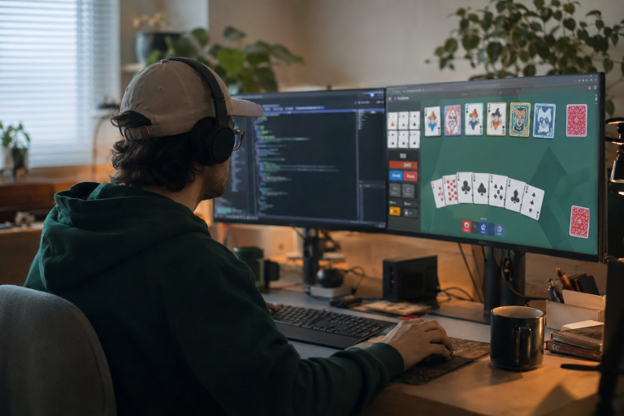
Canada’s gaming industry generates billions of dollars a year, and what’s more interesting is that some of Canada’s most interesting games in recent years are coming from much smaller teams.
A great example is Balatro. The poker-inspired game went from being a small independent project to a global hit, selling more than five million copies. The country’s AAA studios are still much bigger, but independent developers have built a reputation for producing games that get noticed.
The same appetite for digital entertainment can be seen in Ontario’s regulated iGaming market. Eligible players have access to modern gambling games through online casino Ontario platforms. ToonieBet, for example, offers 3,000+ games, including slots, table games, and live dealers. Many of those games came from indie developers.
So, where does Canada’s indie game scene stand today? And why are these smaller developers getting so much attention?
The Current State of Canada’s Online Game Industry
According to the Entertainment Software Association of Canada’s Canada’s Video Game Industry report, revenue grew from roughly $2 billion in 2013 to $7 billion in 2022.
If we’re talking about revenue, employees and development budgets, AAA and foreign-owned studios have the upper hand in Canada. That’s hardly surprising. Major studios can have hundreds or even thousands of people working across development, art, sound, marketing, and other departments.
The same report found that 42 foreign-owned firms generated $4 billion in 2022, compared with $3 billion across more than 1,600 Canadian-owned companies.
When it comes to the number of companies and awards, indie studios dominate. Nearly 78% of Canadian video game companies employ fewer than five people, and small, Canadian-owned studios were responsible for almost all of the sector’s growth over the past decade. Indie games have also come out on top at Canadian and international award shows for two years in a row.
There’s no doubt AAA studios bring in more revenue, but indie developers are growing faster in number.
Why Canada’s Online Indie Games’ Reputation Keeps Growing
There are a few reasons this keeps happening.
A one-person studio just won Game of the Year
It would be difficult to talk about Canadian indie gaming in 2026 without mentioning Balatro. It’s a poker-inspired deck-building roguelike built by a single anonymous developer working under the name LocalThunk.
Balatro won four awards at the 2025 Canadian Game Awards, including Game of the Year, Best Game Design, Best Debut Indie Game, and Best Debut Studio. The game has sold more than five million copies since its 2024 launch, according to figures reported by the developer, all without a marketing budget that could rival a AAA release, all without a marketing budget that could rival a AAA release.
Canadian indies aren’t stuck in one genre
Balatro may be the biggest recent example, but it isn’t alone. Vancouver-based Hinterland created The Long Dark, a survival game that has built a large international audience. Montreal-based Tribute Games has also gotten pretty popular with titles like Shredder’s Revenge.
Then there is 1000xRESIST, which took home Best Art Direction at the 2025 Canadian Game Awards. These games have very little in common in terms of gameplay, which is actually part of the point. Canadian indie developers aren’t following one particular formula. They’re making survival games, strategy games, narrative adventures, platformers, and everything in between.
Small teams can afford to try new things
This is probably one of the biggest advantages of independent development. AAA publishers have a lot riding on a major release. When millions of dollars are involved, there isn’t much room to take a gamble on an idea that might not appeal to a large audience.
An indie developer doesn’t have the same expectations. That can lead to unusual concepts becoming games that would probably never get approved if they were meant to be $100 million blockbusters.
Ontario is the epicentre
Ontario is also where Canada’s video game culture meets one of the country’s most developed regulated iGaming markets. A site like ToonieBet works with hundreds of providers to produce its library of 3,000+ casino games. Many of those providers rely on indie game developers that are familiar with Ontario regulations.
That diversity and a solid infrastructure for both casino and sports betting across multiple leagues ensured ToonieBet received ample recognition. The brand was also nominated in four categories at the 2025 EGR Operator Awards, including Casino Product of the Year and North American Operator of the Year.
What’s to Come for Canadian Indie Games
Canada’s gaming industry still has plenty of room to grow. The market is projected to expand at roughly 12.5% annually through 2030, while developers continue looking for ways to make games with smaller teams and more accessible technology.
The pattern that produced Balatro, one developer, no marketing budget, an idea too odd for a boardroom, is unlikely to repeat often. But the conditions that allowed it exist across the country, and that is what makes the next few years worth watching.
About the Author