Municipal elections are October 26 in Ontario. To help voters make an informed decision here in Cornwall, the editorial board of The Seeker has put together 10 questions for candidates seeking a seat at the municipal council table, whether as Councillor or as Mayor. To ensure fairness, the same questions were sent to every candidate. We sent a total of 10 and they had the option to answer all of them, or pick a minimum of 5. Their answers will be published in their entirety, in the order they are received. We will not edit, correct or modify any responses.
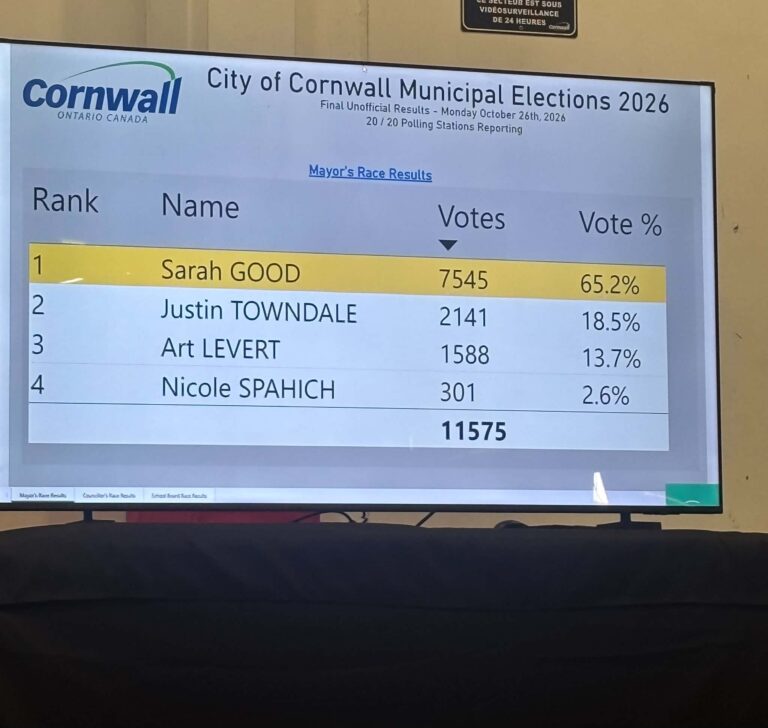
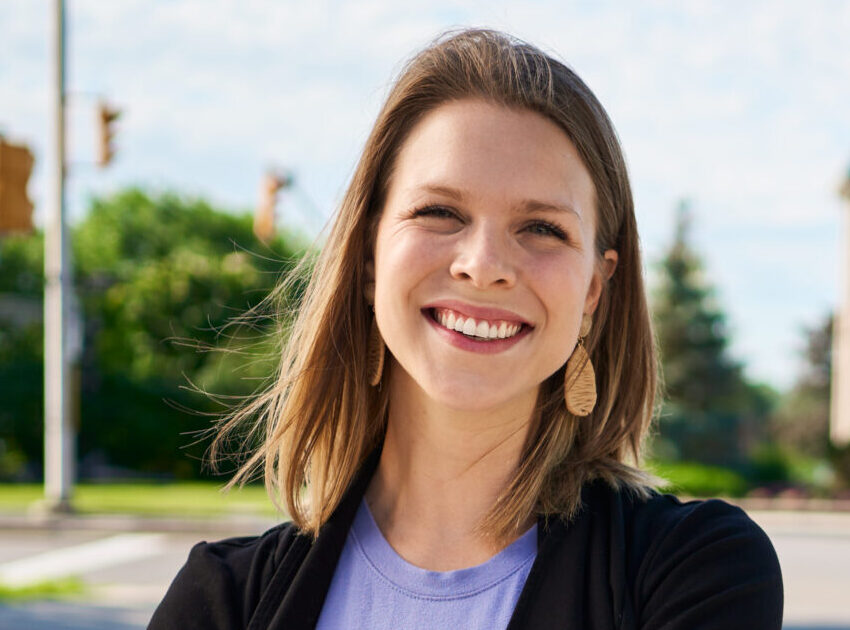
These are Sarah Good’s Answers. She is running for Mayor.
Who are you? Where are you from? What education do you have? What relevant experience do you have? (1 brief paragraph)
My name is Sarah Good. I am a sitting Cornwall City Councillor and I am running to serve as Mayor. Cornwall has always been home for me. Although I moved around throughout my early years, my family has deep roots here and Cornwall is always where I have returned. This is also the place where I started a family of my own.
I hold an Honours Bachelor’s degree in Geography from Carleton University and am currently completing my MBA through Carleton’s Sprott School of Business. Professionally, I have spent more than a decade working across health and social services in human resources, administration, community engagement and program coordination. Today, my consulting work focuses on strategic planning, leadership development, facilitation and community engagement.
As a City Councillor, I have spent the past four years working directly with residents, reviewing municipal budgets, questioning major expenditures and helping shape decisions about the services, infrastructure and future of our community. That experience has also shown me where I think City Hall can work better: planning further ahead, identifying problems earlier, communicating more clearly and following through on the decisions Council makes.
In The Seeker’s poll asking constituents about the most important issue facing them, a large majority of respondents answered “taxes/affordability”. What would you do as a Councillor/Mayor to make Cornwall more affordable, and what city services or spending, if any, would you be willing to reduce, change or eliminate to keep tax increases under control?
Affordability has to be considered in every major decision we make. Cornwall’s 2026 general tax levy increased by 5.41%, while overall water and wastewater billing increased by 6.81%. We cannot pretend those pressures are insignificant for residents.
I also do not think responsible budgeting means simply promising cuts without telling people what they would lose. My approach is to analyze what value residents are receiving for the money, whether the project is necessary now, what outside funding is available, what future costs it may avoid and whether the benefit justifies the price.
As Mayor, I would put much greater emphasis on prioritizing and sequencing major projects rather than trying to advance everything at once. I would aggressively pursue provincial and federal funding, look for duplication and unnecessary consulting or administrative costs, reconsider or defer projects where the value is not clear, and focus on growing our tax base through housing and economic development.
Over the past few years, many constituents have expressed concern that the city’s homelessness situation has significantly worsened. What would you do as a Councillor/Mayor to address this issue?
Cornwall has made considerable progress in how we respond to homelessness, and I think we should acknowledge that. The City has invested in transitional housing, outreach and longer-term housing projects rather than relying on emergency shelter.
My position has consistently been that residents deserve safe, usable public spaces, and people experiencing homelessness must still be treated with dignity. I supported rules around encampments, but I also asked where people would go when displaced. More recently, I brought forward a motion to work with the hospital, health team and community partners on supportive housing that connects stable housing with health, mental-health and social supports.
I think we need to get better at measuring what is working. It is useful to know how many encampments exist, but I am more interested in how many people are moving from an encampment into transitional or permanent housing, what helped them get there and what prevented others from doing the same. I am committed to action on reducing homelessness in Cornwall.
Why are you running for Mayor? What is the most important issue facing the City of Cornwall today?
I am running for Mayor because I believe Cornwall needs stronger, more collaborative and strategic leadership.
Over the past four years, I have learned a great deal about how municipal government works, as well as where it can work better. I have seen good ideas take years to come back to Council. For example, a motion I passed in 2023 asking Administration to study an additional tax on vacant buildings has still not returned with a final report.
The Mayor cannot personally manage every project or solve every problem. But the Mayor is there to work closely with the CAO to ensure that Administration is advancing Council’s priorities.
As Mayor, I will represent the City of Cornwall with pride both at home and away. I will lead this community with vision and care, build strong relationships with other governments and community partners, and work with businesses and residents to improve the way we work together, all while addressing the most pressing issue I hear from residents: keeping taxes reasonable and City services affordable.
Many constituents have expressed concerns about accountability and controversy surrounding the Council. What could you do as Mayor to improve transparency and accountability?
Transparency is more than putting Council agendas online. Residents should be able to understand what Council decided, how much something was expected to cost, what it is expected to cost now, when it should be completed and whether the work Council directed has actually happened.
I have tried to push for that kind of accountability throughout this term. I pushed for multi-year budgeting because Council needs to understand the longer-term consequences of the decisions we make today. I also pushed for more town halls, but they did not happen.
As Mayor, I would like to establish a plain-language public dashboard for major capital projects and Council priorities. Residents should be able to quickly see a project’s original approved budget, current forecast, outside funding, timeline, major risks, current status and the next decision coming to Council. If a project is delayed or its costs have changed significantly, that should be visible rather than buried in a lengthy report.
That is not about micromanaging staff or assigning blame. It is about Council setting clear expectations, receiving information early enough to act on it and making it easier for residents to understand what their government is doing with their money.
We constantly hear about the Art Centre and the water meters. Many residents have expressed the view that these were bad decisions on Council’s part. Both projects are being implemented, but they remain a sore spot for some voters. Would you consider revisiting or changing decisions made on those projects?
I think these two projects need to be separated because my record on them is quite different.
I opposed the $17.7-million water-meter contract. While I recognized that water meters can provide benefits through leak detection, conservation and fairer billing, I did not believe the cost was worth the benefit to residents. I was also concerned about how it might disadvantage people with young kids or dependents with disabilities.
I supported having an Arts Centre. However, before the construction tender was awarded, I moved a motion to pause the process so Council could explore whether we could get more from such a significant investment through a partnership with Akwesasne at the Portlands site. That proposal did not receive Council support. I then supported proceeding with the Arts Centre given the significant amount of work and fundraising that had already been invested in the project.
I do not think it would be responsible to spend even more taxpayer money to reverse either of these projects, which are both near completion. The responsibility now is to get the greatest possible value from what has already been committed.
What would you do to improve our relationship with Akwesasne? What does Truth and Reconciliation look like to you? Explain how Cornwall can take steps toward it.
Relationships are built by showing up, listening and remaining present over time. Cornwall should be working to understand what Akwesasne’s priorities are and where our municipality can meaningfully support them.
We now have a Truth and Reconciliation Action Plan, so the next challenge is implementation and monitoring. I want us to advance the areas that have already been identified, including re-establishing a regional roundtable with the Mohawk Council of Akwesasne, improving the way Indigenous perspectives are incorporated into municipal decision-making, and regularly reporting publicly on our progress. I also want us to meet the targets we have already set through the Action Plan, including the commitments tied to the United Nations Declaration on the Rights of Indigenous Peoples, and report openly on where we are meeting those targets and where work remains.
We also have a unique opportunity to pursue development with the Mohawk Council of Akwesasne on the co-owned Portlands property. It has now been a decade since the federal government made this historic land divestment, and it’s time to put a real plan into place that will benefit both communities and show respect for the Kanien’keháka culture.
Cornwall’s municipal government relies on experienced and qualified staff to deliver services to residents. What would you do as a Councillor/Mayor to ensure the city can attract, retain and support the best possible people in senior positions?
Good municipal government depends heavily on good people.
One of the motions I brought forward required more regular Human Resources reporting so Council could better understand staffing trends, training, sick time, requested positions and future workforce needs. You cannot address workforce problems effectively if you are not measuring them.
As Mayor, I would place greater emphasis on succession planning and leadership development so we are building internal talent instead of waiting until someone leaves to think about who comes next. We should promote from within where we have capable people ready to advance while remaining competitive enough to attract specialized expertise from outside when we need it.
Council’s role is governance and oversight, not day-to-day personnel management. But Council has a responsibility to contribute to a professional organizational culture. Staff need to be accountable, but they also need to feel safe to provide candid professional advice without worrying about repercussion.
Healthcare is primarily a provincial responsibility, but access to healthcare is a major concern for Cornwall residents. What can the City of Cornwall realistically do to help improve healthcare access, and would you make it a priority as a Councillor/Mayor?
Yes. Healthcare access would remain a priority for me. The City should do the things within our control to be an effective partner to the healthcare sector and advocate consistently for the provincial resources Cornwall needs.
I would continue our medical recruitment and scholarship incentives and build on the work already underway to modernize them. Council has also endorsed recommendations to broaden and strengthen existing programs, including looking at tiered incentives and expanding eligibility to nurse practitioners. I think we should keep using the tools that are producing results while adapting them to the healthcare workforce we need today.
We need to work with the hospital, primary-care providers, our Ontario Health Team, Akwesasne and neighbouring municipalities to make it easier for healthcare professionals to establish themselves here. That includes looking at practical barriers such as administrative burden, practice space, relocation support and opportunities for medical professionals to build long-term roots in the community.
There is also an important connection between healthcare and housing. My supportive-housing motion came from recognizing that some residents with complex needs repeatedly interact with hospitals, emergency services, shelters and other systems because no single service can address the whole problem.
Many residents are concerned about crime, vandalism, drug use and a general decline in their sense of safety. What can the city realistically do to address these concerns, and where should municipal responsibility end and provincial or federal responsibility begin?
Residents deserve to feel safe in their homes, neighbourhoods, parks and downtown, and I take those concerns seriously.
The City has direct responsibilities through policing, by-law enforcement, fire and emergency services, public-space design and community-safety planning. I strongly support maintaining Cornwall’s local police service. When Council considered commissioning an OPP costing study, I opposed it because I believe there is significant value in having a police service that knows our community, understands local problems and can develop partnerships and programs around those needs.
Police and enforcement are only part of the response. Many of the issues residents see on the street involve addiction, mental health, homelessness and the toxic drug supply. Those require coordination between policing, public health, healthcare, housing and community organizations.
Municipal government can improve public spaces, enforce local by-laws, support prevention, coordinate community-safety planning and make sure agencies are sharing information and measuring results.
My approach would be to combine strong local policing and appropriate enforcement with prevention, treatment advocacy, housing solutions and better coordination. Public safety and compassion are not competing objectives. Good policy needs to deal with the behaviour that is making residents feel unsafe while also addressing the conditions that are contributing to it.
About the Author