



Claims teams across North America handle everything from first notice of loss and adjuster assignments to reserves, payments, documentation, reporting, and communication with policyholders. As claim volumes grow and workflows become more complex, many insurers are replacing disconnected tools with platforms that can manage more of the claims process in one place.
The best choice depends on the organization. Large carriers may need a broad enterprise platform that connects claims with policy and billing systems. TPAs, MGAs, independent adjusting firms, and mid-sized insurers may place more value on flexible workflows, adjuster tools, integrations, and easier configuration.
For this list, we compared six claims management platforms used in the North American P&C market. All six are included among the systems profiled in Celent’s 2026 North America P&C Claims Systems report.
How Was This Ranking Put Together?
The platforms were reviewed based on publicly available product information, claims functionality, workflow configuration, adjuster tools, automation, integrations, scalability, and suitability for North American P&C operations.
Our shortlist includes:
- VCA – Best for flexible, claims-focused operations
- Guidewire ClaimCenter – Best for large enterprise P&C carriers
- Duck Creek Claims – Best for broader core modernization
- Origami Risk Claims Administration – Best for highly configurable claims processes
- Insurity Claims – Best for commercial and specialty P&C operations
- Snapsheet Claims – Best for digital-first claims workflows
Comparing the Top Claims Management Software
| Platform | Best For | Main Strength |
| VCA | Carriers, TPAs, MGAs, IA firms and self-insured organizations | Claims-focused workflows and adjuster tools |
| Guidewire ClaimCenter | Large P&C carriers | Enterprise scale and ecosystem |
| Duck Creek Claims | Mid-size and large insurers | Claims connected with broader core systems |
| Origami Risk | Carriers and organizations with complex workflows | High configurability |
| Insurance Claims | Commercial, personal and specialty P&C insurers | Configurable cloud-based claims operations |
| Snapsheet Claims | Carriers, MGAs, and TPAs | Digital workflows and automation |
1. VCA
How Does VCA Operate?
VCA delivers a claims-focused solution built to meet the needs of insurance organizations, including carriers, TPAs, MGAs, independent adjusting firms, captives, and self-insured entities.
Its platform brings claim assignments, documents, reserves, payments, correspondence, diaries, time and expense tracking, authority limits, reporting, and client requirements into one system. Teams can also configure fields, workflows, access levels, assignment restrictions, billing rates, and other rules around the way their organization handles claims.
Claims workflow management software VCA helps organizations manage different claim types and client requirements and automate key processes, including claim distribution, acknowledgements, alerts, and assignments, while ensuring adjusters have full access to the complete claim file. Payments, reserves, documents, notes, expenses, and claim activity can remain connected instead of being managed across several separate tools.
What Sets VCA Apart?
VCA’s main difference is its claims-first approach. Claims management is the central purpose of the platform rather than one module inside a much broader enterprise insurance suite.
That focus gives teams a fairly wide range of practical adjuster tools. VCA supports automated claim distribution, assignment mapping, document management, claim diaries, email integration, reserve and payment tracking, time and expense tracking, authority limits, templates, and configurable workflows and alerts.
It also supports different stages of the claims process, including customized FNOL, automated assignment and acknowledgement, investigation, claimant communication, settlement, and reporting. VCA has also introduced AI inside the claim file for functions such as claim summaries and document review, with the aim of helping adjusters find relevant information without replacing their judgment.
For organizations that mainly want to improve claims operations rather than replace every core insurance system, that narrower focus can be an advantage.
2. Guidewire Claim Center
How Does Guidewire ClaimCenter Operate?
Guidewire ClaimCenter is an enterprise claims management platform built for P&C insurers. It supports the claims lifecycle from intake through evaluation, financial management, settlement, and closure.
The platform includes policy lookup, workflow automation, analytics, claim handling tools, and embedded intelligence designed to give adjusters guidance while they work.
What Sets Guidewire Apart?
Guidewire’s biggest strength is scale.
ClaimCenter has more than 270 customers across over 30 countries, and Guidewire supports the platform with a large partner and consulting ecosystem. It can also be used alongside Guidewire’s other core insurance products, making it a natural consideration for carriers undertaking a wider technology transformation.
It is particularly well suited to large carriers with complex requirements, although that enterprise scope may be more than smaller claims organizations need.
3. Duck Creek Claims
How Do Duck Creek Claims Operate?
Duck Creek Claims provides end-to-end P&C claims management with tools for workflows, assignments, reserves, payments, vendor orchestration, automation, and decision support.
The platform includes preconfigured coverage types, tasks, and business rules, while allowing organizations to modify workflows as their needs change.
What Sets Duck Creek Apart?
Duck Creek is particularly strong when claims are only one part of a broader modernization project.
Its wider ecosystem includes policy, billing, payments, reinsurance, and other insurance products. The claims platform also emphasizes scale during high-volume events. Duck Creek reports more than 30 million claims processed through its OnDemand environment and says the platform has handled more than 60,000 claims per day during catastrophe events.
That combination makes it a strong option for larger insurers that need claims technology connected with other core operations.
4. Origami Risk Claims Administration
How Does Origami Risk Operate?
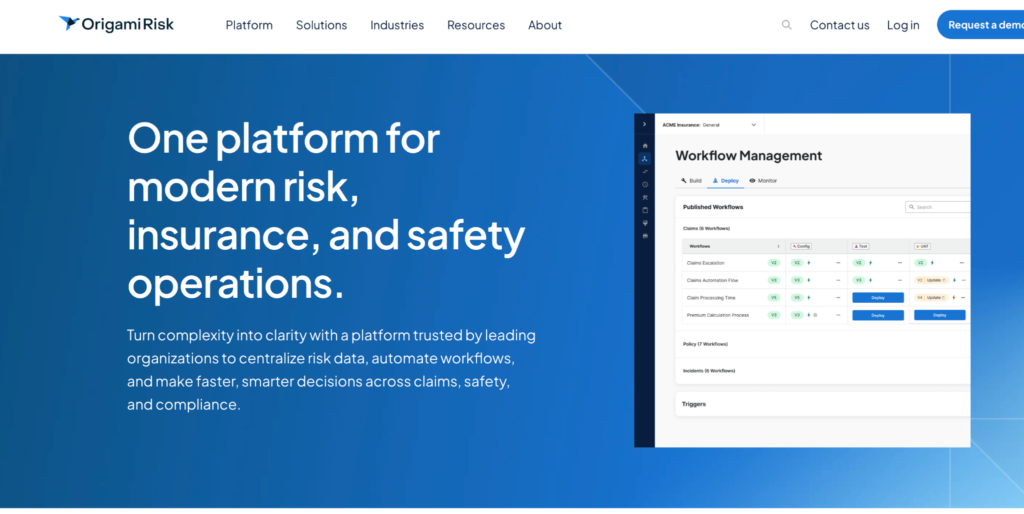
Origami Risk provides cloud-based claims administration covering the lifecycle from claim submission through closure.
Its capabilities include configurable FNOL, policy coverage verification, automated assignment, reserves, payments, recovery, fraud investigation, quality assurance, and reporting.
What Sets Origami Risk Apart?
Configurability is one of Origami Risk’s strongest features.
Organizations can create workflows around different lines of business and automation tasks such as claim routing, communications, financial approvals, and reserve-related actions. The platform also supports integrations with outside systems and configurable dashboards for claims teams and managers.
That makes Origami Risk worth considering for organizations where claims processes differ significantly across programs, clients, or coverage types.
5. Insurance Claims
How Does Insurity Operate?
Insurity provides cloud-based P&C software for insurers, brokers, and MGAs, with claims technology supporting both personal and commercial lines.
Its claims platform focuses on configurable workflows, automation, communication, adjuster collaboration, and integrations across the insurance process. Insurity says organizations can modify areas such as assignments, business rules, and automated correspondence without depending on lengthy development work.
What Sets Insurity Apart?
Insurity combines claims technology with a wider set of P&C systems and analytics products.
That can make it useful for insurers that want claims to connect with policy administration, billing, analytics, and specialty insurance operations. Its 2026 Borealis release also introduced updates aimed at reducing document-heavy workflows and fragmented claims data.
Insurance is therefore a strong consideration for commercial, specialty, and multiline insurers that need claims functionality within a wider insurance technology environment.
6. Snapsheet Claims
How Does Snapsheet Operate?
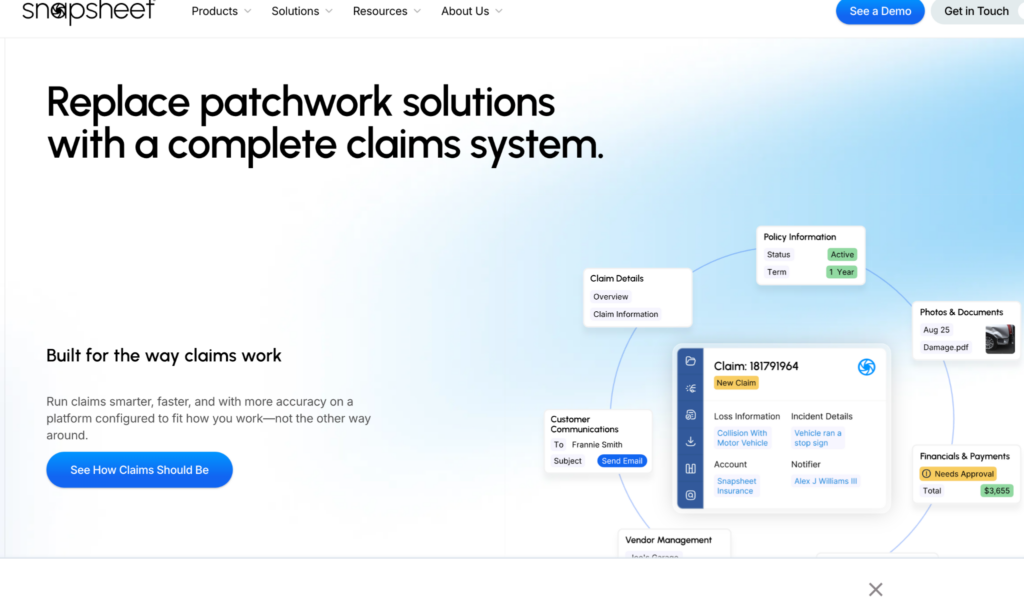
Snapsheet provides a cloud-based P&C claims platform for carriers, MGAs, and TPAs.
The system brings documents, communications, notes, vendors, payments, claim updates, and actions into one claim view. It also includes intelligent assignments, automated validation, alerts, and workflow automation.
What Sets Snapsheet Apart?
Snapsheet places a strong emphasis on digital workflows and automation.
Its platform supports no-code configuration, allowing claims teams to change processes without building every workflow from scratch. Snapsheet reports more than 10 million automated actions each month and says its platform supports more than $75 billion in premiums.
It can be a good fit for organizations that want to move away from disconnected systems and build more automated digital claims processes.
What Should P&C Organizations Look for in Claims Software?
Claims platforms can appear similar when comparing feature lists, so buyers should look at how each system handles their actual workflows.
Important areas to evaluate include claim assignment, reserve and payment controls, document management, workflow automation, reporting, integrations, user permissions, catastrophe scalability, and how easily teams can change rules when business requirements change.
Adjuster usability also matters. A platform may have extensive functionality, but it can still create unnecessary work if handlers have to move between several screens or systems to complete routine tasks.
Organizations should also consider the size of the implementation. Large carriers replacing claims, policy, and billing technology may benefit from enterprise platforms such as Guidewire or Duck Creek. Companies focused mainly on improving claims handling may prefer a system where claims workflows and adjuster tools are the main priority.
Final Thoughts
The right claims management software depends on the size of the organization, the complexity of its claims, and how much flexibility the team needs.
VCA is a strong option for carriers, TPAs, MGAs, and independent adjusting firms that want a claims-focused system with configurable workflows, adjuster tools, reporting, payments, document management, and integrations in one platform. It can be especially suitable for teams that want to improve claims operations without replacing their entire insurance technology stack.
Guidewire and Duck Creek are better suited to larger insurers looking for broader enterprise platforms. Origami Risk offers strong configuration options, Insurity works well for insurers that need claims connected with wider P&C systems, and Snapsheet is a good choice for digital-first workflow automation.
Before choosing a platform, claims teams should compare how each system handles their actual workflows, integrations, reporting needs, and day-to-day adjuster tasks.
About the Author