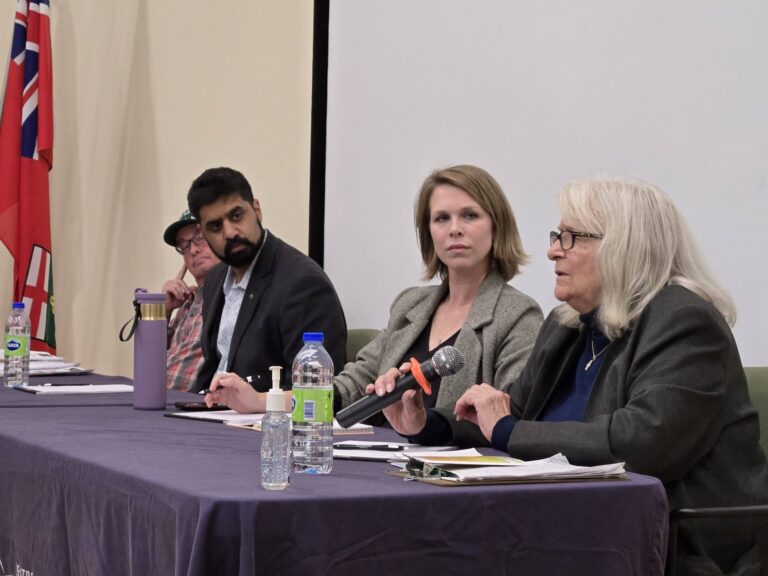
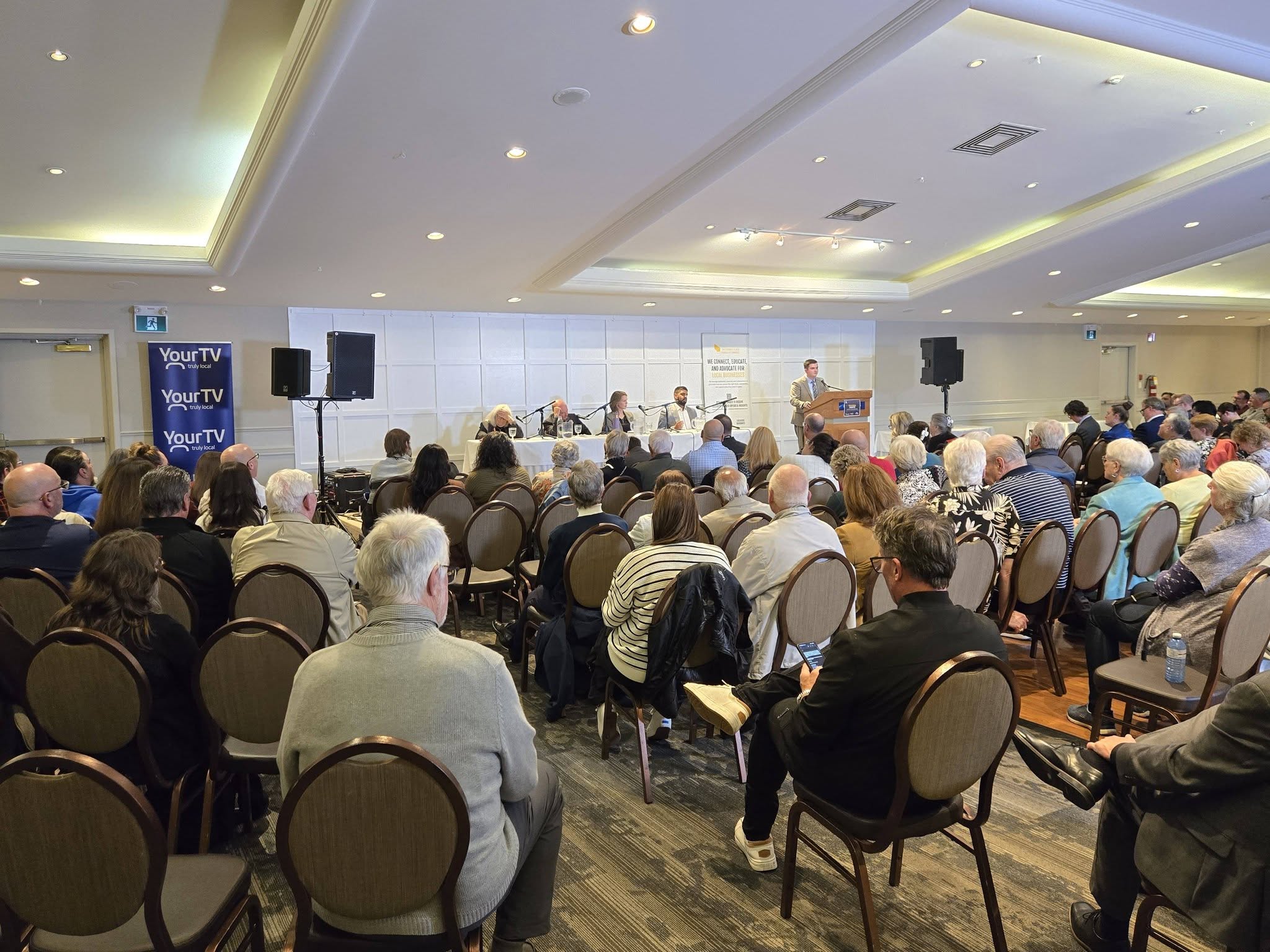
Crowd at one of several candidate forums
We are now two days past election night, and with the final results recently having been certified, we can now look to these results and have some valid takeaways about Cornwall’s electorate as well as the broader state of local politics. So today, I’ve decided to do just that! Here are 10 things that we’ve learned from the 2026 Cornwall Municipal Elections.
1. Cornwall… REALLY Doesn’t Like Incumbent Mayors
We saw it in 2014 when Leslie O’Shaughnessy defeated Mayor Bob Kilger. Just four years later, Bernadette Clement de-seated O’Shaughnessy. After Clement stepped down, Glen Grant was nominated as interim Mayor and chose to run for the seat of Mayor in 2022. He too was defeated, this time at the hands of Justin Towndale.
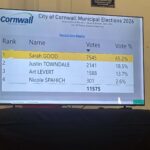
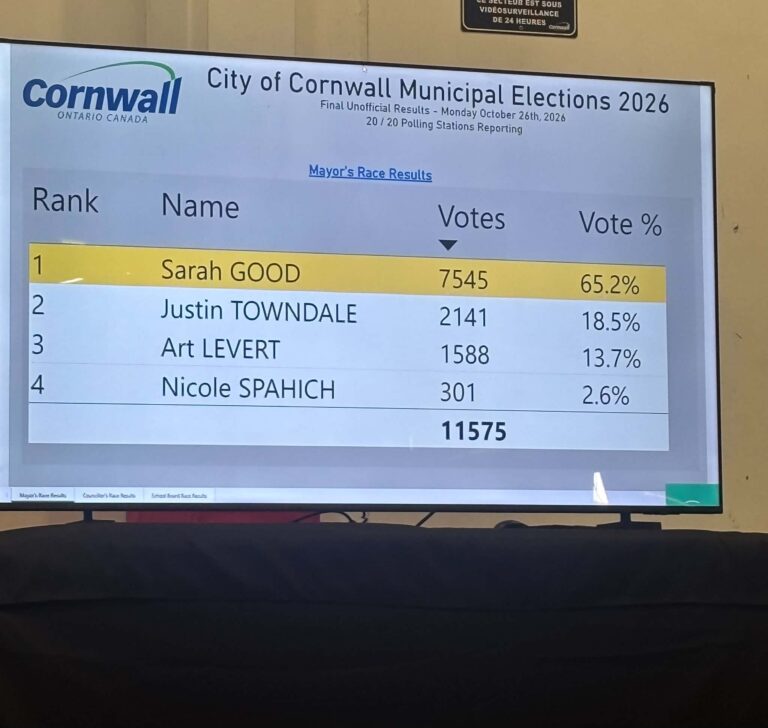
With Sarah Good’s 2026 victory over Mayor Towndale, this is the fourth straight election that the incumbent mayor (or interim mayor) lost their bid for re-election. The last incumbent to win re-election was Bob Kilger in 2010, receiving 57% of the vote.
There is something more to this trend, and I hate to tease you all, but I will be writing about it in the near future.
2. Cornwall Really Likes Incumbent Councillors
Five Councillors stood for re-election. Four of them got back in, and Fred Ngoundjo, who did not win, was still very high-placing 11th. Joël Côté, who is the 8th name on Council, also served on Council back in the mid-2000s. Todd Lalonde, having been a CDSBEO Trustee in the past, marks 6/8 of Council’s names having been municipally-elected officials at some point in time.
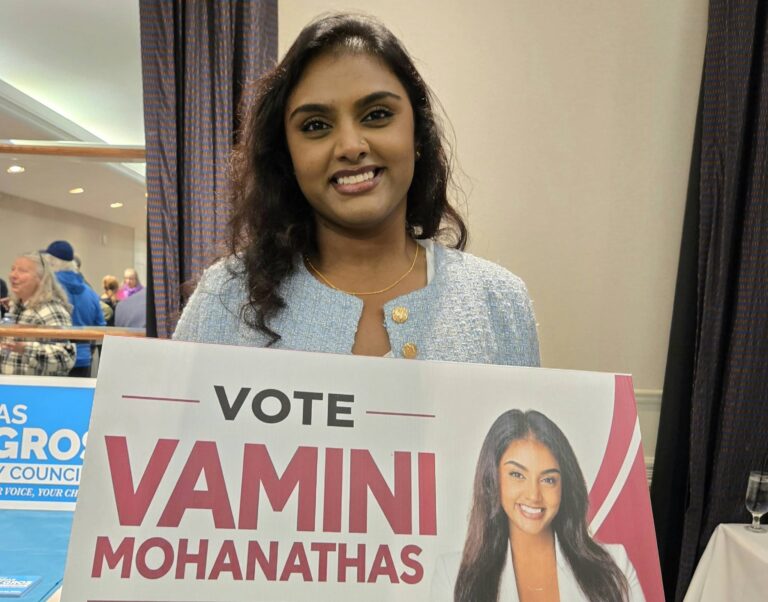
This is not even to mention Sarah Good winning the mayor’s seat on the back of her popularity as a councillor. Ultimately, several relative newcomers (like Vamini Mohanathas, Lisa Olmstead, Joanne Parker, and Jeremy Rose) ran very strong campaigns, but they were simply not strong enough to overcome this city’s incumbency bias.
3. Women are Underrepresented as Council Candidates and by Voters
Just six of the 26 names in the Council race were women. Just one of these six names (Elaine MacDonald) actually made it onto Council.
This means two things: first, women are underrepresented as candidates, making up just under a quarter of the total candidates. Second, they are underrepresented by voters. With six women in the race, the closest whole number to a representative amount of women on council would be two.
Interestingly, many of the first names off the list were women. In spots 9-15, four of the spots are women, including Vamini Mohanathas in tenth, who would’ve made a 10-seat Council.
4. Online Campaigns are Not as Strong as They Seem
Candidates who ran their campaigns online often looked like shoo-ins, but mostly ultimately fell short. Lisa Olmstead, Jody Mitic, and Christopher Leclair had some of the strongest online presences in the Council race, and finished 12th, 16th, and 20th, respectively.
Art Levert had a tonne of support online, which was not something replicated in the results. This is demonstrable: our Facebook-based poll found him winning ~21% of the vote, and he ended up only receiving ~11% in actuality.
As the unofficial results came in on election night, the aforementioned candidates (and some others) placed higher when the online polling station came in than they did at the end of election night. Vamini Mohanathas, another candidate who ran a strong online campaign, was in 8th place when the online return came in, and finished in 10th. Lisa Olmstead and Jody Mitic also fell one spot each during the same time-span.
5. Council is Very Ideologically Moderate
The majority of the names that made Council campaigned as social liberals and fiscal conservatives. Todd Lalonde specifically campaigned on “needs before wants” and fiscal responsibility.
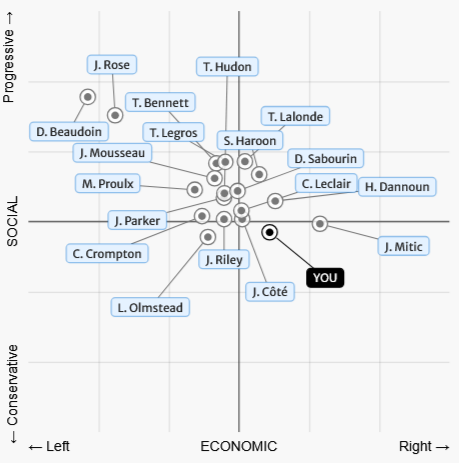
And though this is not entirely representative of a candidate’s true beliefs, the five Councillor-elects who filled out The Star’s Vote Compass (Bennett, Côté, Lalonde, Riley, Sabourin) were all plotted near the centre of the graph. None of them were in the socially conservative quadrant, but Lalonde, Sabourin, and Côté were all in the economically right quadrant.
6. Unofficial Results are… Unofficial
On election night, the results we received contained a couple of major mistakes. For one, a human error caused a display error which showed Mayor Towndale receiving over 2,000 less votes than he actually did receive. Secondly, a failure to account for votes from other townships meant that the city mistakenly unofficially declared Krista Ryan the winner of a Trustee race rather than the real winner, Donna Nielson.
In times like this, it’s important to remember that unofficial results are, in fact, unofficial. The City provides this information to be more transparent with the public, but results are not certified as they come on election night for this very reason. These were easily-explainable human errors and should not draw questions about the integrity of the certified results, which require levels of scrutiny that rule out major error.
So please, don’t reduce us to the level of America by calling “rigged” over these errors.
7. Sarah Good is one of Cornwall’s Strongest Electoral Forces
Good entered electoral politics in 2022 when she first ran for City Council. As a newcomer, she received more votes than anyone in Cornwall’s 2022 Municipal Elections, including the Mayoral candidates.
A few years later, she ran as a Liberal in SDG for the 2025 Federal Election. Per Poliwave, she received 46.7% of the vote in Cornwall, which ties Bernadette Clement as the best result of any Liberal candidate since 2004. She also received 39.8% of the vote in SDG as a whole in that election, which is the most of any Liberal candidate since 2000. Having received 26,407 votes, she attained the second most votes for a Liberal in the riding since at least 1968, only behind Bob Kilger’s 27,080 in 1993.
Now, in the 2026 Election, she has put up another incredibly strong performance. Though historical Cornwall municipal results are notoriously hard to find, we can say that Ms. Good’s 7,545 votes received are a 20-year high for a Mayoral candidate, with the last candidate to receive more being Bob Kilger in 2006. In the same time-span, only Kilger’s vote-share of 57% in 2010 surpasses Good’s 53.9% received in this election.
8. Heartbreak for Many Returning Challengers
Jason Riley finished one spot away from making City Council in 2022. He returned this year and succeeded in making Council, finishing in 5th place.
The rest were not so lucky.
Claude Poirier, who finished in 12th place in 2022, received over 1,300 more votes this year than he did in that election. He finished 9th, which would have been good for Council in 2022’s 10-Councillor system. This year, though, he’s the first name off the list in another heartbreak.
Other returning names who failed to make Council this time around also all received more raw votes than in 2022. Carol Boileau received 2,337 votes (+426) and jumped 3 spots in the rankings, and Christopher Leclair received 1,401 votes (+441) and jumped 6 spots. Fred Ngoundjo, who lost the seat that he won in 2022, actually received over 800 more raw votes than he did in 2022. His loss can be attributed to increased voter turnout and a shrinking of Council size.
Rather remarkably, Mary Jane Proulx earned 1,610 votes, the exact same amount of votes that she received in 2022.
9. Online Voting Likely Helped Turnout
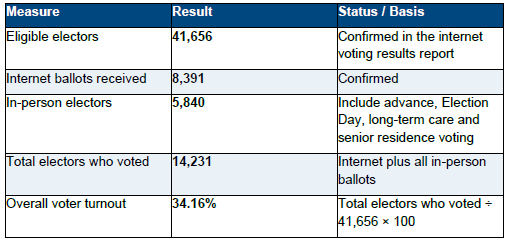
When it was all said and done, just under 14,000 residents cast votes in the Mayoral race. This is up significantly from the 10,028 who did so in 2022. While participation is still not nearly high enough, it’s getting there. Based on early data that we have, it seems like at least 5,000 of this year’s votes were cast online. While there’s no way to know how many of these people would not have voted otherwise, this figure marks a big success for the City’s first time allowing online voting.
10. Cornwall Has a Strong Crop of Residents Who Care for Their Community
You may not like the elected council. You may not have liked several of the candidates that ran but did not get in. But the fact remains: councillors don’t get paid a lot, and it’s an honourable and largely selfless endeavour.
26 candidates threw their names in the hat. Among these 26 were Gen-Z candidates, candidates of minority groups, elderly candidates, disabled candidates, and candidates running from various ideological positions. There was likely a face in the race to represent anybody who can vote in Cornwall, and that’s something to be proud of.
So until next time, let’s work to build a better Cornwall!
About the Author