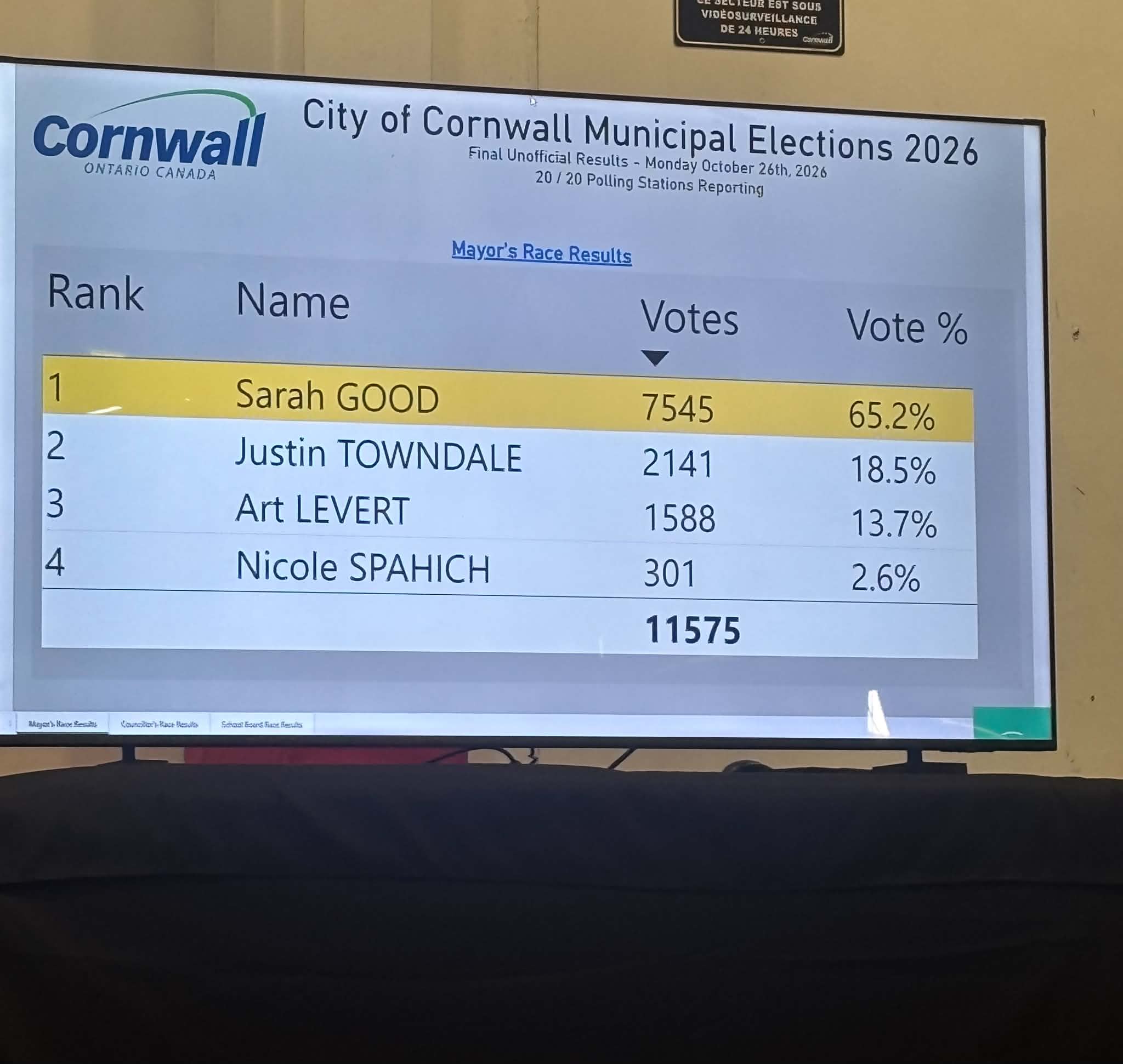
Unofficial final results of Cornwall Mayoral Election
Editor’s note, 6:52pm 10/27/2026: Some of our analysis in this article is now null due to the fact that the city’s official results show that Mayor Towndale received over 2,000 votes that were not initially counted.
This means that our poll is, in fact, closer than initially expected. We projected that Sarah Good would finish with 48% of the vote. She finished with 54% of the vote. We projected that Justin Towndale would finish with 29% of the vote. He finished with 33% of the vote. We projected that Art Levert would finish with 21% of the vote. He finished with 11% of the vote. Nicole Spahich finished with 2% of the vote, which is what we projected.
Mayor Towndale and Nicole Spahich’s results were both within a 5% margin of error. Sarah Good’s results were just outside of it. Art Levert was the biggest miss, as we over-sampled him by a wide margin.
The analysis that follows is still largely poignant, but our polling miss was overstated due to having been based on the unofficial results.
Well, the Cornwall Municipal Election has came and gone, and with it, some of the most interesting results in recent local electoral history.
If you would recall, I conducted a poll for The Seeker leading up to last night’s election regarding mayoral vote intention. Before we get into the analysis of where I went wrong (because I did), I’d like to make a quick acknowledgement. In our publishing of this poll, The Seeker was accused, most frequently of being too progressive-biased to find accurate results, and, at worst, deliberately fixing the results of our poll to benefit Sarah Good.
We, of course, reject this idea completely. As the election results have shown, we picked up an early trend on Ms. Good’s support, but, as a matter of fact, did not find just how much support she was to receive in actuality. I say this with the knowledge that our detractors will likely not read this piece, but to insinuate that our poll was deliberately manipulated is beyond insulting. It’s only one insinuation in a pattern of media-distrust, but it is insulting nonetheless. With that out of the way, let’s discuss the survey’s results compared to the election.
What Went Wrong, What Went Right? In Defense of Our Findings
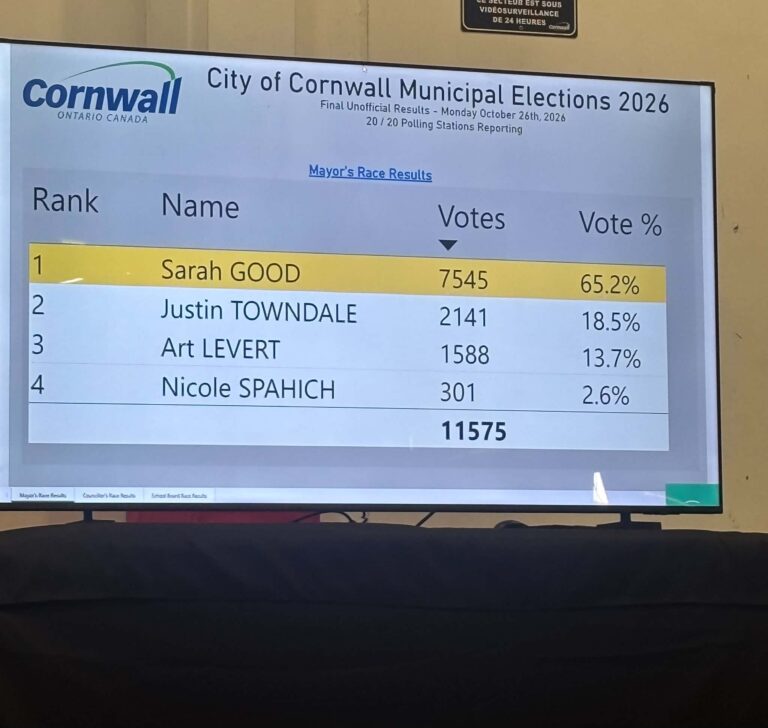
In our survey, we found that Ms. Good polled at 48%, Mr. Towndale polled at 29%, Mr. Levert at 21%, and Ms. Spahich at 2%. In actuality, Ms. Good received 65% of the vote, Mr. Towndale received 19%, Mr. Levert Received 14%, and Ms. Spahich received 3% (note: these numbers are not yet finalized but are broadly correct and await confirmation from the City Clerk).
There was a clear understatement of Good voters in our poll and a clear overstatement of Towndale & Levert voters. The implied Margin of Error for a poll of our sample size is 4-5%, a mark that we missed for every candidate except Nicole Spahich. Once again, due to the nature of our self-selected sample, a scientific Margin of Error does not necessarily apply, but it’s still a useful barometer to gauge a poll’s accuracy.
By that regard, our poll missed the mark. In my view, there are a few reasons that this is the case. For one, the communities that we surveyed cannot be expected to be reliable samples of Cornwall’s broader population. We shared the poll primarily to popular Cornwall Facebook groups, which evidently lean anti-Good and pro-Levert/Towndale. In the future, we could likely yield better results by combining this online methodology with a control sample of truly random, in-person respondents.
Furthermore, there was no way to account for turnout metrics in our poll. This is one of the most pressing issues in all of Canadian municipal polling — especially in Cornwall, where turnout typically lands well under 50%. There were inevitably people who filled out our survey who did not end up being one of the ~11,500 individuals to cast a vote in the mayoral race. It will be hard to definitively account for this in the future, but it is now clear that Ms. Good’s base are high-propensity voters; they will show up for her regardless.
It also seems also reasonable to make the assumption that increased turnout can only benefit non-establishment candidates such as Art Levert. He thrived in our poll, and his best demographic on election night was the batch of online voters, who likely would not have voted in a lower-turnout election with no online option. This is ultimately conjecture, however, and it would be interesting to test these hypotheses further.
Finally, there was either a disparity in our intra-sample findings regarding age, gender, and partisan affiliation, or our weighting assumptions were off by a fair margin — but likely both. For example, it’s likely that we understated Ms. Good’s support with 2025 Liberal voters as well as what portion of Cornwall’s municipal electorate voted Liberal in 2025. We assumed that the municipal results would map one-to-one with Federal partisanship, but there is reason to believe that Liberals are higher-propensity than Conservatives, which is another thing that we should look further into with future polls.
There are a few points worth making in defense of our survey in spite of its ultimate errors. For one, beyond a major under-sampling of Good and over-sampling of Levert & Towndale, we broadly got the election’s narrative correct: Ms. Good would win big and Mayor Towndale would be fighting Art Levert for second place. We correctly predicted that Good had a comfortable lead and the ranking of all four candidates.
I’d also like to point out that this poll was conducted from October 8th to October 13th, with many responses being recorded over two weeks out from election day. The general vibe on the campaign trail was that Mayor Towndale gradually lost support throughout the campaign, especially after Towndale was found to have been the individual responsible for raising the concern with Good’s 2022 finances.
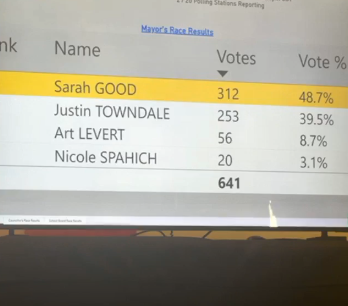
The first two polling stations to report were ostensibly advance voting stations, and the race showed Good leading Towndale by a narrow margin of 49% to 40% when these polls reported. Advance polls are not entirely representative of the electorate, but this level of deviation certainly implies that Towndale’s support decreased as the campaign went on.
There is no way to know with certainty, but we believe that there’s significant evidence indicating that our survey was closer to the public consensus on October 13th than on what election day would eventually yield.
Perhaps most interestingly is that we’ve observed what feels like a reliable indicator of high and low propensity voting. If we infer that online voters are those most likely to vote in high-turnout but not low-turnout elections (deduced from this election’s slightly increased turnout and another survey we conducted which shows a sizeable group of people having voted only because they could do so online), then it is generally establishment candidates who thrive in low-turnout elections and political outsiders who do well in high-turnout elections.
When the online poll came in, incumbents Dean Hollingsworth, Elaine MacDonald, and Denis Sabourin were at 7.0%, 5.2%, and 5.4% of the vote, respectively. By the time election day polls were counted, these candidates increased to 7.3%, 5.6%, and 6.0%. Claude Poirier, another establishment-esque community-oriented candidate increased from 4.2% to 4.9% between the online poll’s reporting and the final result.
On the contrary, Vamini Mohanathas, Jody Mitic, and Jason Mousseau were at 5.2%, 3.1%, and 2.2% of the vote, respectively when the online station reported. By the end of the night, these same three were at 4.7%, 2.8%, and 2.0% of the vote, respectively. Ms. Mohanathas was raised in Cornwall, but Mitic and Mousseau were not. These three also all share having less rich histories of community involvement than the aforementioned names. With these increases and decreases in mind, it’s reasonable to say that high turnout most benefits outsiders.
Conclusion
I’d like to thank several people who I’ve interacted with throughout the process of creating this poll and the election broadly.
First, thank you to the Seeker Chicks for allowing me to do this in the first place. It has been a blast, and it would not be possible without these two. I’d also like to thank all the readers/viewers of The Seeker who have followed our coverage intently. It is my honour to have be able to provide you all with information about this election.
Thank you to all of the candidates who’ve ran in this election and who I’ve had the privilege of interviewing in the process. Regardless of my personal disagreements with anybody who ran, I have nothing but respect for all of these names. Municipal politics are truly a selfless pursuit, and you all brought ideas to the table with the goal of improving Cornwall. That’s honourable.
Finally, thank you to those who argued against the findings of our survey in good faith for keeping me in check. I had long, respectful Facebook discussions with Josh Frappier and Brent Whitford about the methodology of my poll. Mr. Whitford told me that the Margin of Error could not reliably be believed, and he ended up being right. I’d like to thank these two and others for critically consuming media in the right way: not with baseless accusations but with good faith objections.
It’s only up from here! I plan to keep covering municipal politics and conducting local surveys, so stay on the lookout. Until next time!
About the Author