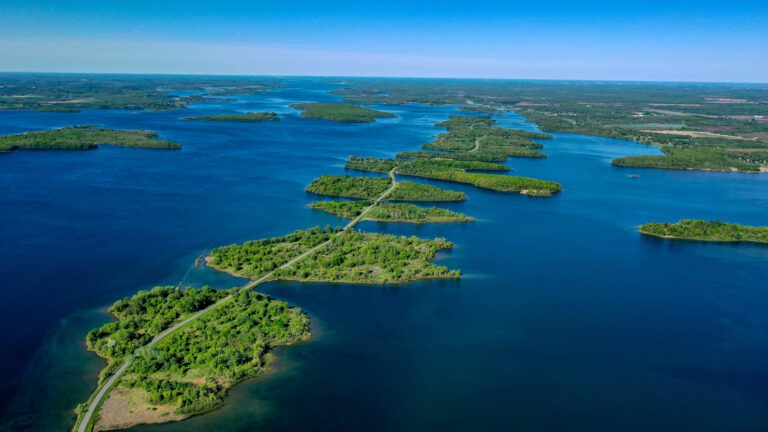
Tucked in the wilderness of Glengarry lies a little gem called Loch Garry, a hidden treasure for nature lovers. The lake is shallow with an eight-kilometer circumference accessed by launching on the narrow Garry River. Our group with seven kayaks and a canoe is ready for an adventure.
I love how the channel through the fen immerses us in nature from the outset by weaving through a rich biodiversity of plants such as sedges and reeds. The sheltered river can be deceptive, leading one to believe that the lake will be just as calm, which is not always the case. Today, however, as we enter the river’s outlet, I realize that I have never seen the loch so still. Its mirror-like appearance under a blue and sunny sky enhances the scene before me. The lake is murky, and not a place that evokes the desire to swim, a good enough reason to keep an eye out for rocks and jutting logs. But for paddling, it is peaceful and offers an opportunity to observe potential wildlife.
My attention is diverted by a loud distinctive rattle sound which can only be the cry of a Belted Kingfisher, a large-headed bluish-grey bird with a punk hairdo. I catch sight of it whizzing through the sky overhead on an ostensible mission, likely related to its next meal. These birds are fast and difficult to spot when immobile, but they know how to make their presence known when they are flying.
We follow the north shore where most of the homes and cottages are located eventually reaching a group of round canary-yellow buoys which appear to have the dual purpose of marking the area near a small private beach as a no-wake-zone, and to warn boaters of potential danger. Just beyond them lies a rock-wall scarcely below the water’s surface that extends from the shore for several meters. Its presence is a mystery, but I am curious to know its story.
We are getting hungry and since there is nowhere to moor or dismount, the lakeshore being either private or undeveloped land, we tether our watercrafts to each other to enjoy a side-by-side floating picnic. The canoe is in the middle of the cluster, with me at the bow, and although unable to see my companions lined up behind me, I can still join in on the conversation. We enjoy our peaceful drift for a while longer before picking up our paddles once more to make our way back.
We cross the lake to the mostly uninhabited side of the lake following the south shore and then cut across again to seek the river’s mouth amidst the tall vegetation. We are feeling the heat from the afternoon sun and the lack of wind, but, now back in the narrow waterway, we don’t have much further to go.
The serenity of our day is shattered when one of the kayakers puts up his hand motioning us to stop. He has discovered a double-crested cormorant in distress. It seems to be caught on something beneath the water, perhaps a broken fishing line, and is flapping its wings struggling to free itself. We flag down a motorboat with a telescopic fishing net thinking it might be useful in freeing the bird. Meanwhile, a second kayaker sprints into action. Delicately, she uses the tip of her paddle to search for the obstacle, probing beneath the surface of the water. Failing to locate its source, she slowly lifts the cormorant with the paddle’s blade. Though she feels a slight resistance, the thick weeds prevent her from seeing the issue. After a few more attempts, the vegetation begins to loosen, finally releasing the invisible impediment. The cormorant flies up, landing on her kayak. Shaken by its ordeal, it sits there for a moment, perhaps to get its bearings or else to silently thank its saviour, before diving, free to be wild once more. I turn to thank the fisherman whose net we would not need after all and realize with a start that he is none other than Stephen Douris, a fellow Seeker-writer. In the urgency of the situation, we had not recognized each other.
Elated with the outcome of this rescue, we acknowledge the hero in our midst. It certainly was a surprise ending to our day, and an adventure we will remember here on Loch Garry.
For more information about the Cornwall Outdoor Club, visit or follow us on Facebook.
About the Author