When a fire truck pulls up to a burning building in Cornwall or anywhere across eastern Ontario, the activity that follows happens with a speed and coordination that most bystanders find remarkable. Firefighters deploy equipment, connect to water sources, and begin suppression operations within minutes of arrival. At the center of this rapid response is a piece of equipment so familiar that it is rarely examined carefully: the fire hose.
Most community members have seen fire hoses in action, or at least coiled on fire apparatus as trucks pass by. Few have thought carefully about what a fire hose actually is, what it must accomplish under emergency conditions, and why the quality of fire hose equipment has direct consequences for fire suppression outcomes in their community. Understanding these things is part of being an informed community member in a place where fire safety depends on equipment that works reliably when it is needed most.
What a Fire Hose Must Actually Do
The phrase “fire hose” suggests something simple — a tube that carries water from one point to another. In practice, a fire hose deployed at an active structure fire must perform under conditions that would destroy most conventional piping or flexible tubing. Working pressures of 10 to 20 bar or more are standard in firefighting operations — pressures sufficient to rupture garden hoses, conventional plastic pipe, and most other flexible conduit materials that might come to mind as analogies.
At the same time, the fire hose must remain flexible enough to be rapidly unrolled and deployed across a fire scene, dragged over rubble, concrete, asphalt, and debris, bent around corners and obstacles, and maneuvered by firefighters who are simultaneously managing breathing apparatus, protective equipment, and the physical demands of operating in a high-heat environment. A hose that is stiff, kinked easily, or resistant to rapid deployment creates operational delays that translate directly into fire growth and increased property damage.
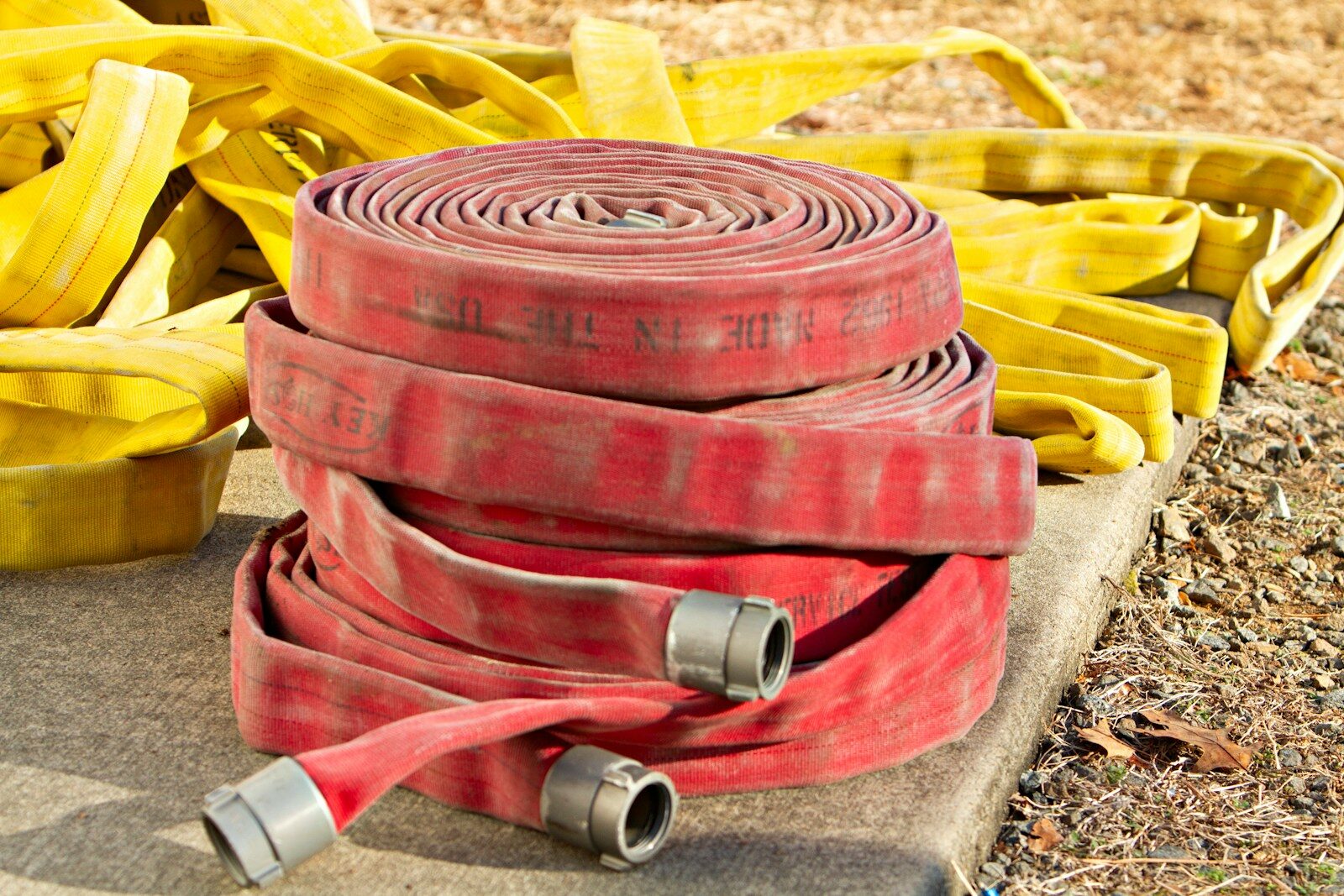
A fire hose is therefore an engineered composite structure — not a single material performing all functions, but a combination of components each optimized for a specific role. The inner liner provides the watertight barrier that contains the pressurized water without absorption or leakage. The outer jacket provides the structural strength that resists burst failure under working pressure while maintaining the flexibility that field deployment requires. The coupling hardware at each end provides the mechanical interface with hydrants, apparatus connections, and other hose sections — threaded to national or regional standards that ensure compatibility with the full range of fire service equipment the hose will be connected to in service.
Materials and Construction Quality
The textile jacket is the structural heart of a fire hose, and the quality of the materials used in its construction is a primary determinant of hose performance and service life. Modern fire hose jackets are typically woven or braided from high-tenacity synthetic fiber — most commonly polyester — in patterns specifically engineered to distribute tensile load uniformly when the hose is pressurized. The molecular orientation of the fiber within the yarn, achieved through controlled drawing processes during manufacturing, determines the breaking strength and elongation characteristics of the finished jacket structure.
This material quality matters in practical terms. A fire hose jacket constructed from high-tenacity polyester yarn consistently achieves higher burst pressures, lower elongation under working load, and longer service life under the repeated pressurization, abrasion, and UV exposure of active field use than one constructed from lower-grade yarn, even if both appear externally similar when new. For fire departments operating on limited budgets — as most volunteer and municipal fire services across eastern Ontario do — the total cost of ownership calculation for fire hose procurement often favors higher-quality equipment when service life extension is properly accounted for.
Testing, Maintenance, and Service Life
NFPA 1962, the standard for fire hose care and use in North America, requires fire departments to conduct annual service testing of fire hose at pressures exceeding working pressure to verify jacket integrity. Hoses that fail service testing — through leakage, jacket separation, or coupling failure — are removed from service before they fail in the field. This systematic testing regime means that well-maintained fire hose inventories in compliant fire departments should not experience catastrophic failures during emergency operations.
But testing identifies existing failures rather than preventing them. The maintenance practices that extend hose service life and reduce failure rates include thorough drying after every use to prevent mildew formation and liner degradation, storage away from chemical contamination, UV exposure, and physical damage, and regular visual inspection of jacket condition, coupling integrity, and gasket condition. Departments that invest in proper hose storage racking, drying systems, and structured inspection programs consistently achieve longer hose service lives than those that treat hose as a consumable to be replaced on a fixed schedule regardless of condition.
Community Investment in Fire Safety Infrastructure
For residents of Cornwall and surrounding communities in eastern Ontario, the quality of fire suppression equipment operated by local fire services is a public safety matter that is ultimately determined by municipal budget decisions and procurement choices. Community members who engage with local government on public safety priorities, who attend municipal council discussions about fire department budgets, and who understand what fire equipment quality means for suppression capability are better positioned to advocate effectively for the investments that keep their communities safe.
The fire hose — humble, familiar, and rarely examined — is a surprisingly important piece of that safety infrastructure. Its performance under emergency conditions is the product of engineering decisions made in its manufacturing, procurement decisions made by municipal purchasing offices, and maintenance decisions made by fire department officers. All of these decisions are shaped by the knowledge and priorities of the communities they serve. Understanding the equipment is the starting point for understanding those decisions and engaging with them meaningfully.
About the Author