

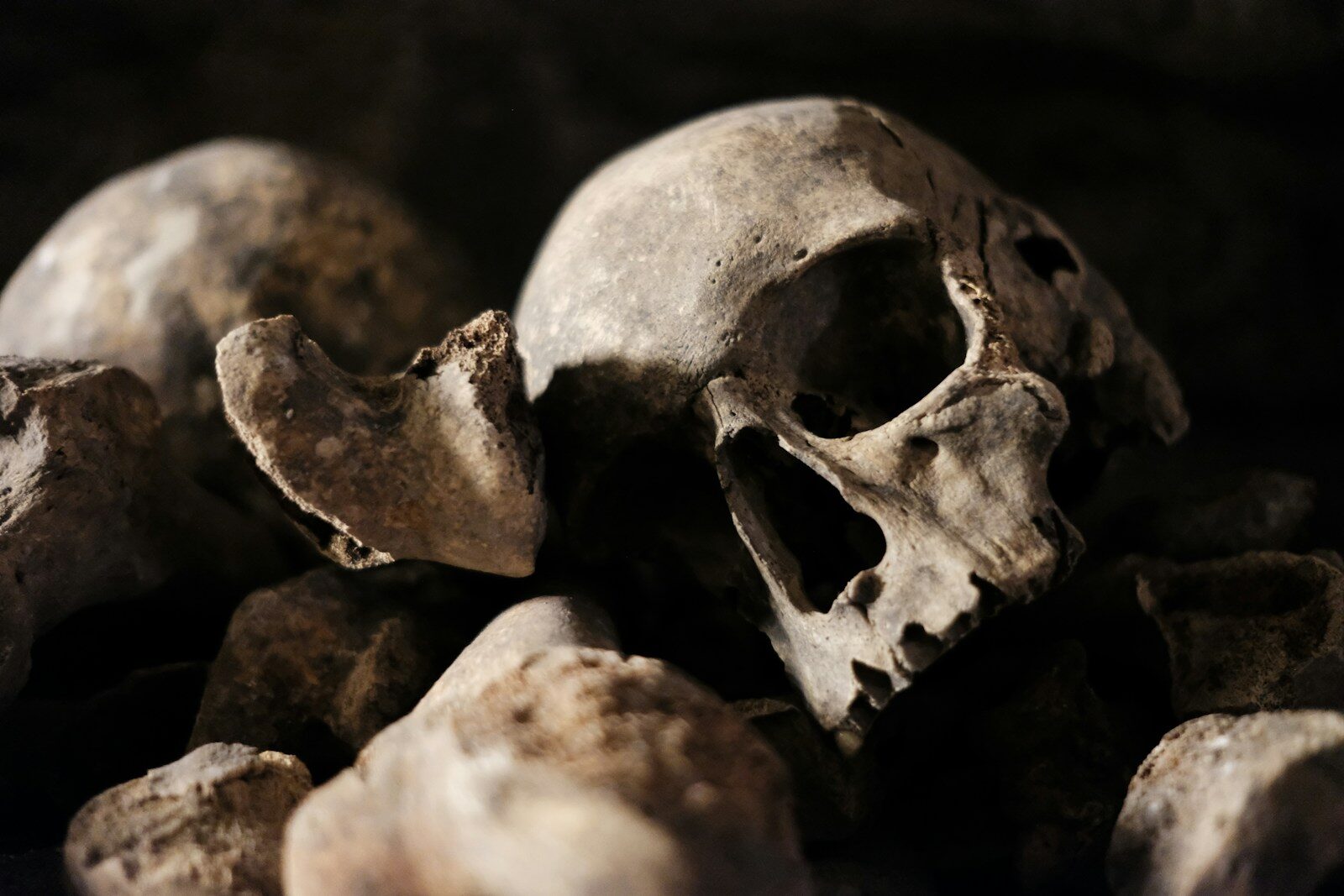
The human skull is a universal symbol, yet its meaning is never fixed. As the photographer David Bailey once noted, “The skull is nature’s sculpture.” Throughout history, artists, institutions, and societies have used this biological object to express our deepest anxieties about mortality, power, and identity. Rather than being a simple emblem of death, the skull acts as a cultural mirror, shifting its meaning based on who is looking at it.
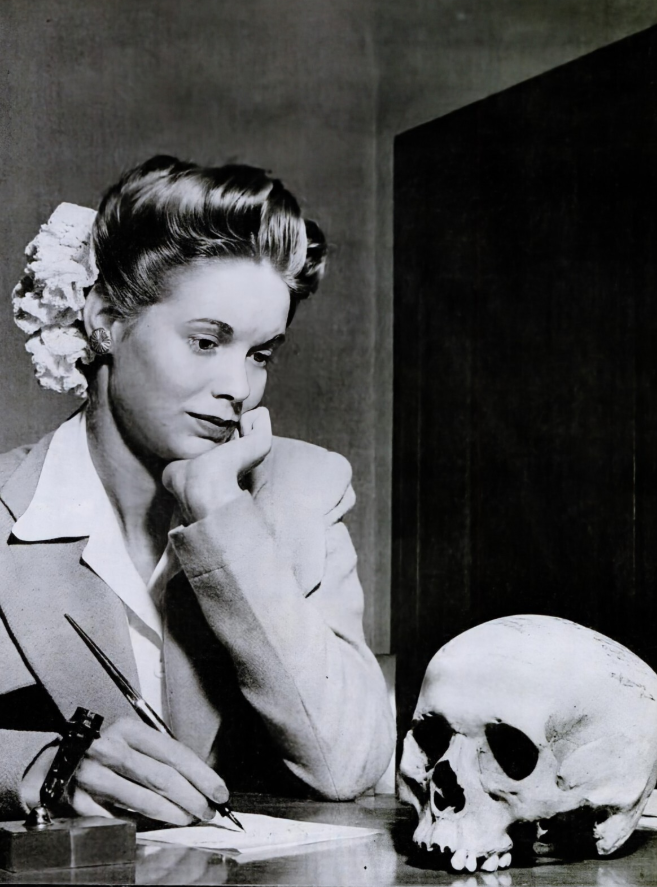
May 22, 1944, issue of LIFE, p. 35 LIFE Magazine Photo: Ralph Crane
In times of violent conflict, the skull has frequently been weaponized to devalue human life, often fueled by systemic racism. A stark example of this occurred in May 1944, when LIFE magazine published a photograph by Ralph Crane depicting Natalie Nickerson, a twenty-year- old war worker, gazing at a human skull on her desk.
The skull was a trophy sent by her boyfriend, a Navy lieutenant stationed in New Guinea, signed by him and 18 of his comrades with the inscription: “This is a good Japanese—a dead one picked up on the New Guinea beach.”
While the collection of enemy body parts was widespread and difficult to control during World War II, the photo sparked immense outrage.
Interestingly, the military high command reprimanded the lieutenant not out of moral disgust over the desecration of a corpse, but because the photograph violated the Geneva Convention and provided the enemy with potent anti-American propaganda.
This incident demonstrates how the skull can be stripped of its humanity and reduced to a transactional piece of political property.
In direct contrast to the exploitation of wartime trophies, the Western art tradition has long used the skull as a tool for deep, personal self-reflection through the concept of memento mori (remember you must die).
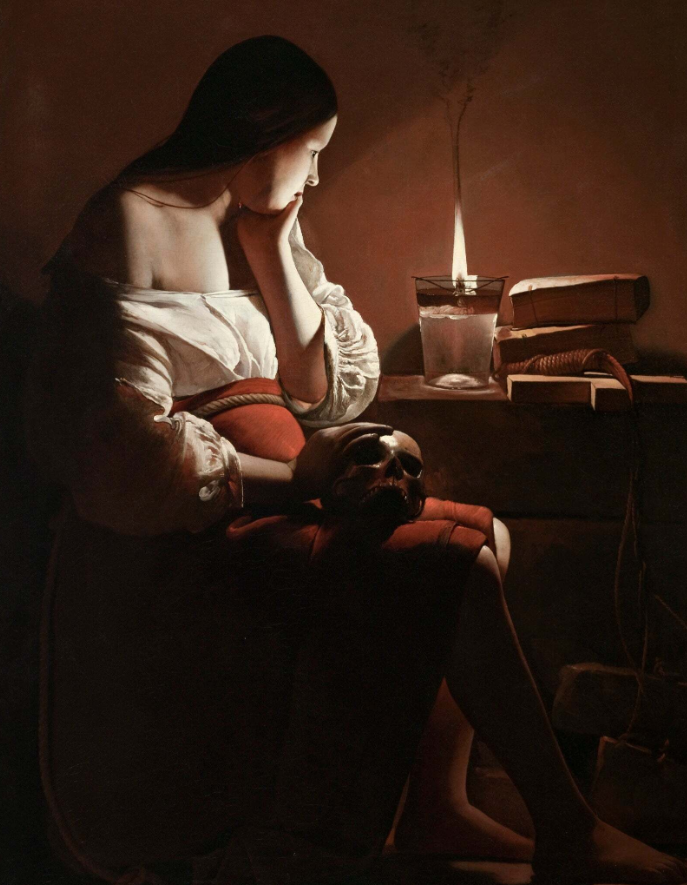
Georges de la Tour, The Magdalen with the Smoking Flame, 1640, oil on canvas, courtesy of LACMA
In European art, the skull serves as a sudden disruption that forces the viewer to confront their own mortality. A classic example is Georges de La Tour’s seventeenth-century painting, The Penitent Magdalen, which depicts Mary Magdalene sitting in quiet contemplation with her hand resting thoughtfully on a human skull.
De La Tour surrounds the subject with symbolic objects: a mirror representing the fleeting vanity of physical beauty, and a candle flame symbolizing the soul’s purification. In this context, the viewer is meant to look at the skull and recognize that it represents their own future.
This tradition continues in contemporary art, as seen in the Städel Museum’s recent exhibition, Mary Magdalene: Sin. Pray. Love., featuring the work of artist Nieves Gonzalez. Contemporary curator Victoria Rivers notes that the representation of the female body and the skull serves as a “sacred archive” connecting humanity with the divine.
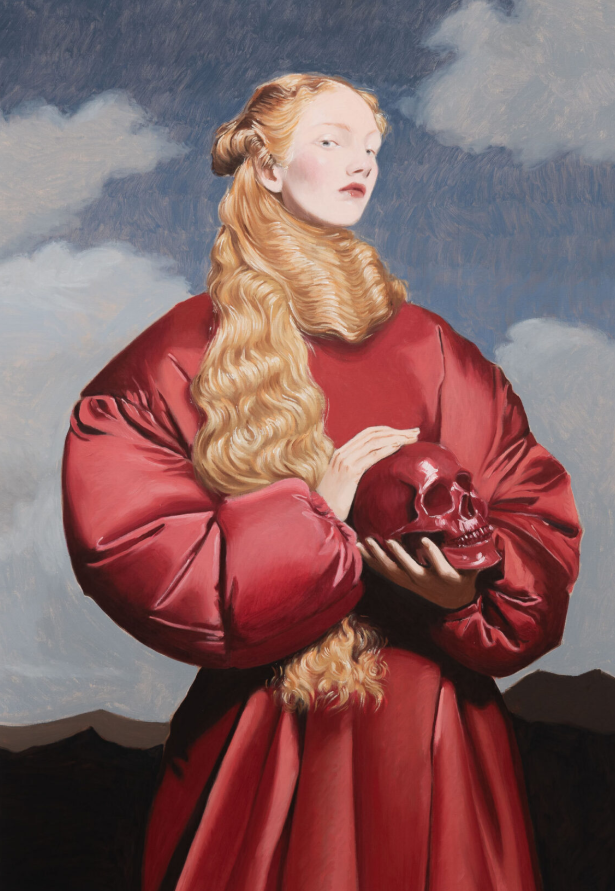
Nieves González, La sfida (The Challenge), 2025 oil on canvas, © Nieves González
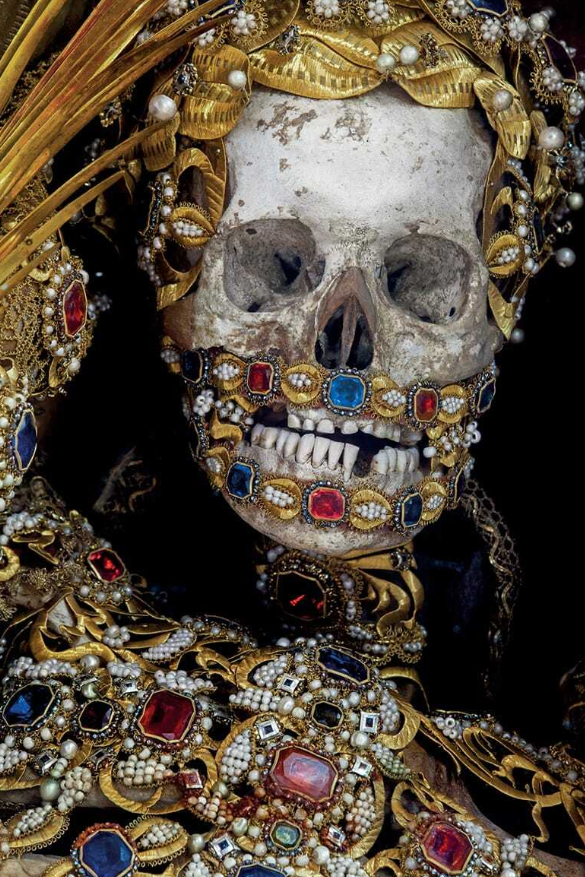
Koudounaris, Paul. From the book – Heavenly Bodies: Cult Treasures & Spectacular Saints from the Catacombs. Thames & Hudson, 2013.
The “Catacomb Saints” sixteenth and seventeenth centuries, the human skull and skeleton were mobilized by institutions to project divine authority and political power.
In 1578, vineyard workers in Rome accidentally uncovered ancient catacombs containing thousands of skeletal remains from early Christians persecuted by the Roman Empire. The Catholic Church seized this opportunity, exhuming the bones and transforming them into the “Catacomb Saints.
These skeletons were sent to churches across Northern Europe—the frontline of the fierce theological war against Protestantism. To counter the plain, minimalist style of the Protestant Reformation, Catholic parishes lavishly decorated these skulls and bones with real gold, silk, and precious jewels.
While historical institutions used the skull to demand respect or fear, artists have consistently used the symbol to mock authority and critique society through dark humor.
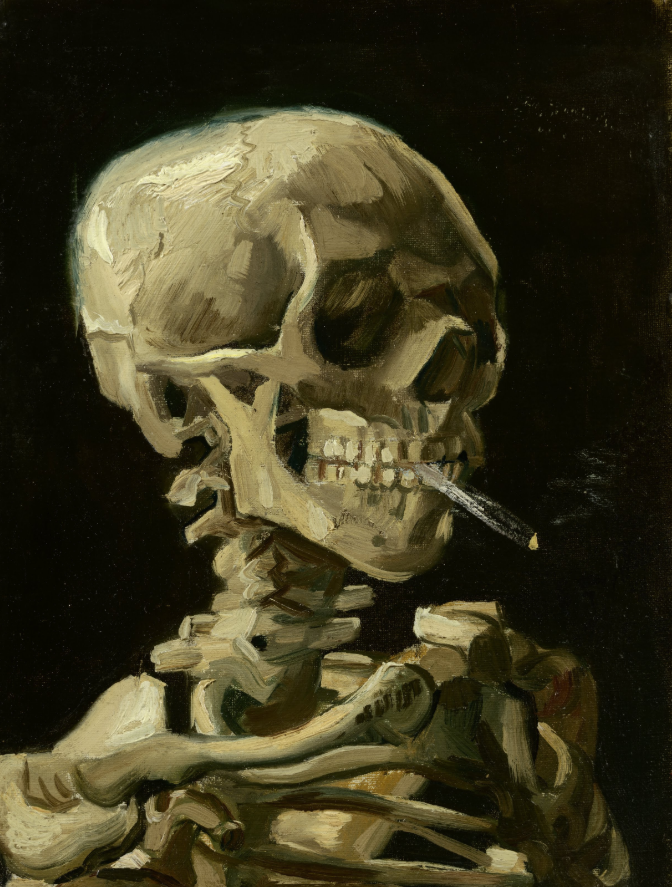
Vincent van Gogh, Skull of a Skeleton with Burning Cigarette, 1886, oil on canvas, Van Gogh Museum, Amsterdam
In the winter of 1885, Vincent van Gogh painted Skull of a Skeleton with Burning Cigarette while attending the Royal Academy of Fine Arts in Antwerp.
Frustrated by the boring, conservative academic routine that forced students to study skeleton drawings for months before being allowed to paint live models, Van Gogh added a lit cigarette to the skeleton’s teeth as a rebellious, satirical joke.
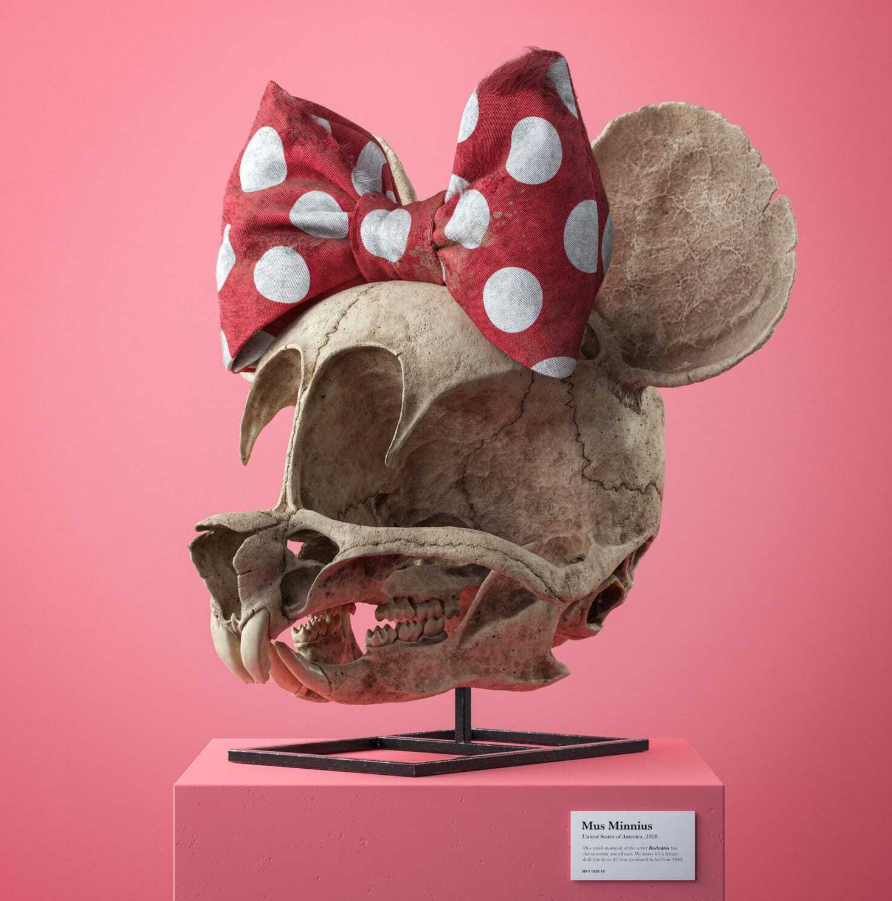
Filip Hodas, Mus Minnius – USA, 1928, 2020, from the series Cartoon Fossils, mixed media courtesy of the artist
Today, contemporary artists carry on this punk-rock tradition. Mixed-media artist Crystal James created Luck Charms, 2023, placing a human skull inside a bowl of bright, sugary breakfast cereal to show how life is sweet but fleeting.
Similarly, artist Filip Hodas creates Cartoon Fossils, making hyper-realistic, museum-style skulls of characters like SpongeBob SquarePants and Tweety Bird. By treating pop-culture icons like ancient fossils, Hodas plays with the idea of memory and time, proving that even our childhood fantasies are subject to history.
Ultimately, the journey of the skull through art history proves that the meaning of an image depends entirely on the intention of the creator and the perspective of the viewer. Whether it is weaponized as a racist wartime keepsake, contemplated as a spiritual reminder of mortality, glittering in gold as a religious icon, or holding a cigarette to mock a boring teacher, the skull remains a profound canvas for human expression. It is the ultimate boundary between fine art,
historical documentation, and pop-culture storytelling.
By studying how this single object has been adapted across the centuries, students of culture can better understand how humanity navigates the complex line between life, death, and creative legacy.
About the Author