Until we can comprehend the beguiling beauty of a single flower, we are woefully unable to grasp the meaning and potential of life itself. —Virginia Woolf
Floral imagery runs through everyday life. We encounter it in our homes, cupboards, wardrobes, bedspreads, and curtains, often so naturally that its influence can fade into the background.
That familiarity also helps explain why gardening remains such a widespread pastime: in 2023, about 59% of Canadian households grew fruit, herbs, vegetables, or flowers for personal use. In many ways, this reflects the influence of artists who have long looked to nature for
inspiration—and whose work, in turn, invites us to see the natural world more closely.
Visitor to the Crystal Bridges Museum looking at – Georgia O’Keeffe, Jimson Weed/White Flower No.1,1932, oil on canvas, Crystal Bridges Museum of American Art, Bentonville, Arkansas
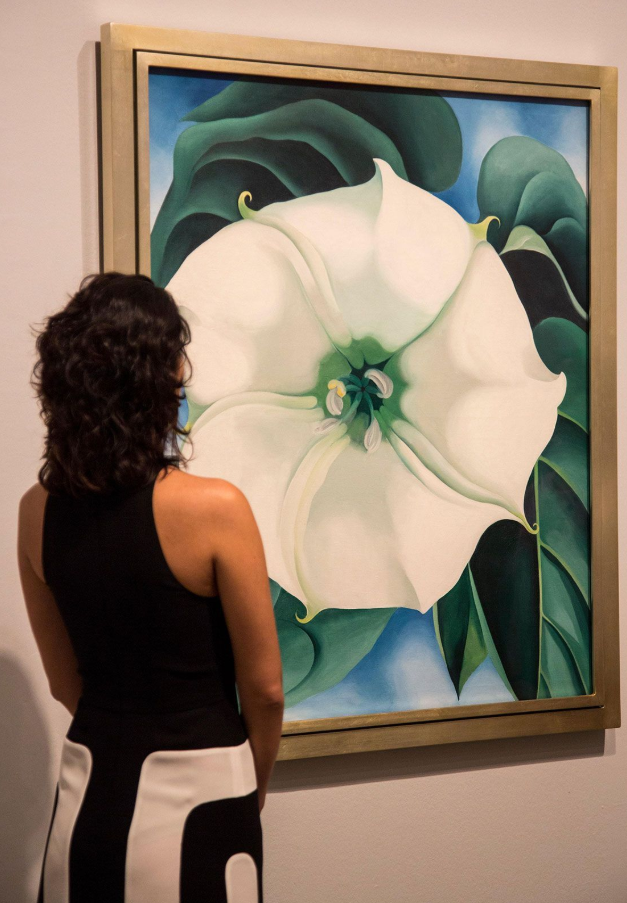
In 2014, Jimson Weed/White Flower No. 1 (1932) by Georgia O’Keeffe made headlines when it sold for $44.4 million at auction, setting a record at the time for a work by a female artist. The painting—an enlarged, swirling white blossom set against blue with green leaves—was acquired for the Crystal Bridges Museum of American Art, where it remains today.
O’Keeffe explained that she painted flowers on a monumental scale because people often pass them by without really seeing them. By enlarging her subjects, she encouraged hurried viewers to slow down, look closely, and appreciate the complexity of the natural world. Her large-scale floral paintings helped redefine how flowers could function in modern art.
Marc Quinn, Burning Desire, bronze, red car paint, 12.9 × 14.3 × 7.1 ft, 2011. Kew Gardens, London. Courtesy of Royal Botanic Gardens, Kew. © RBG Kew Gardens
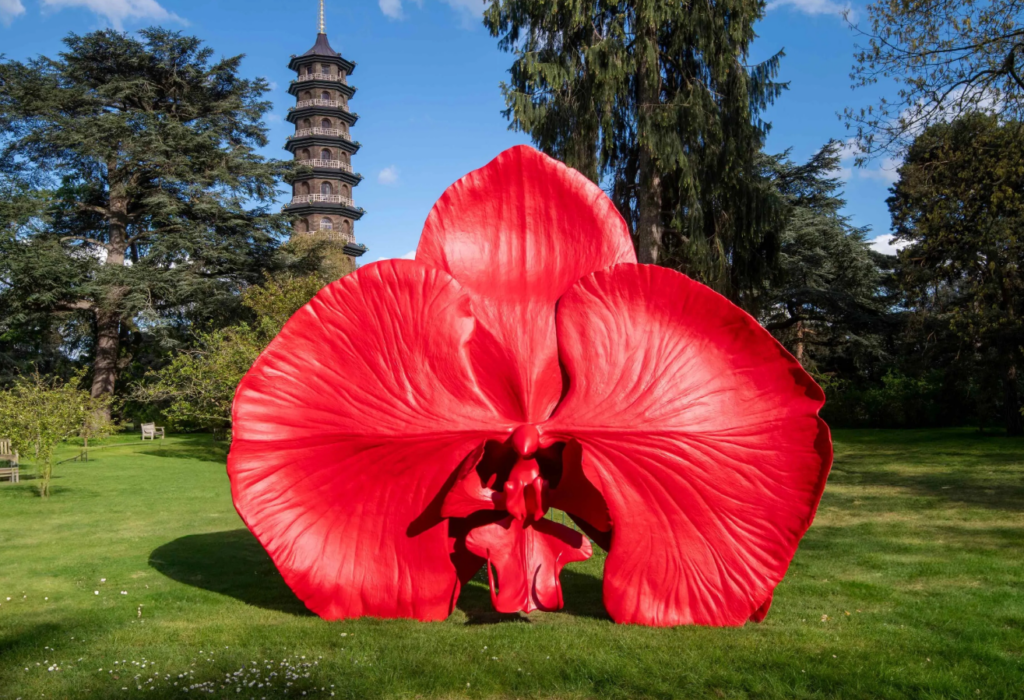
For decades, British artist Marc Quinn has explored humanity’s complex relationship with the natural world. His exhibition Light into Life, created for Kew Gardens, brought together site- specific works developed in dialogue with one of England’s most celebrated botanical landscapes.
Burning Desire is based on the Phalaenopsis orchid, a houseplant familiar to many viewers. Enlarged to monumental scale and cast in bronze with glossy red car paint, the sculpture transforms a delicate flower into something both striking and uncanny. Despite its size and weight, it still appears fragile and almost weightless. Quinn has observed that Kew Gardens may feel natural, but it is also carefully designed and maintained. That tension between nature and human control is central to the work: the garden appears organic, yet it is deeply shaped by selection, arrangement, and cultivation.
Courtesy British Museum
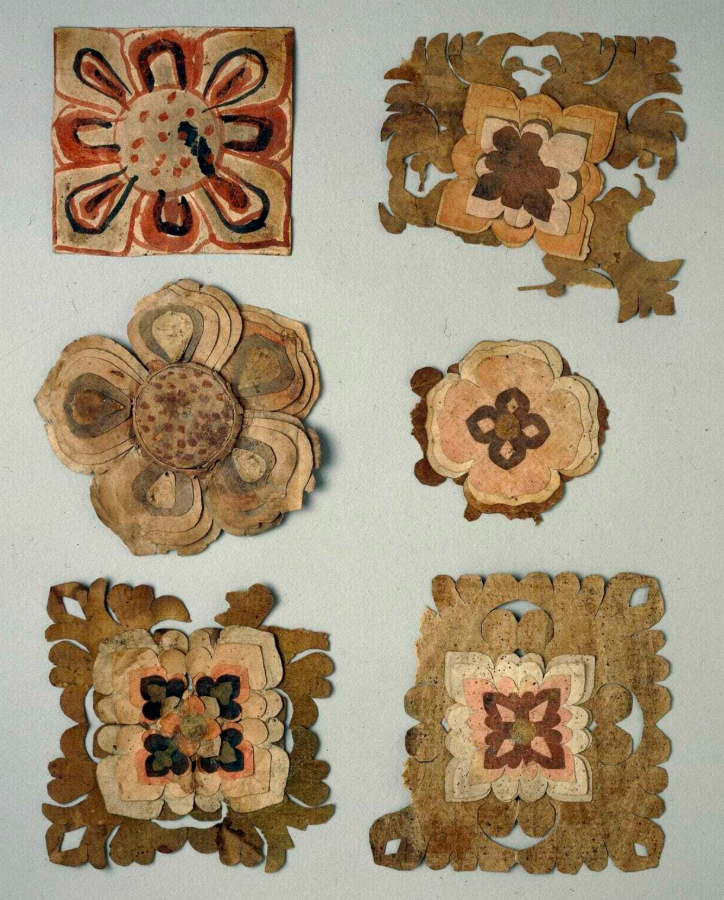
Sealed in a cave for nearly 1,000 years, these paper flowers are a remarkable example of preservation. Since paper was first developed in China more than 2,000 years ago, it is especially fitting that the Mogao Caves yielded such well-preserved paper artifacts.
These flowers may be among the earliest surviving examples of cut paper and collage, showing how the Tang Dynasty preserved everyday objects alongside major works of art.
Rachel Ruysch, Still Life with Flowers on Marble Slab, 1716, oil on canvas, Rijksmuseum, Netherlands
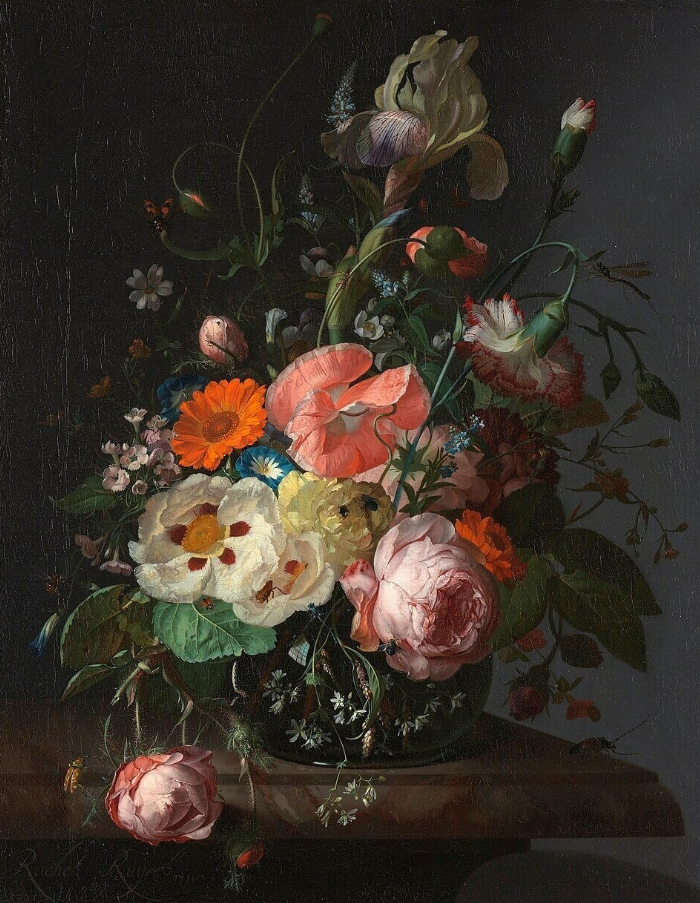
This 1716 painting by Dutch artist Rachel Ruysch was created near the end of her tenure as a court painter, at a time when her reputation was at its height. Her work commanded high prices during her lifetime, and seventeenth-century estate inventories show that a painting by Ruysch could be valued more highly than one by Rembrandt—or even by her husband, the portrait painter Jurriaen Pool.
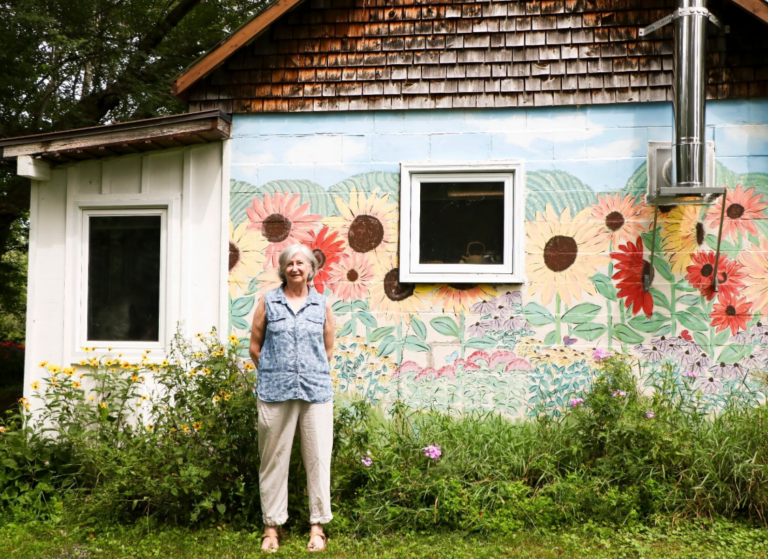
While living in Atlanta in the 1980s, regional artist Cynthia Gatien studied photography, sharpening her technical skills and deepening her attention to nuance, detail, and colour. After returning to Canada and settling in Montreal, she joined friends interested in decorative painting. Together they explored techniques such as wall painting, marbling, and ragging before opening a studio to paint floorcloths and other objects.
The upcoming exhibition Off the Wall features textile artist Jayne Allister alongside Cynthia Gatien. Allister’s tapestries offer whimsical interpretations of flora and fauna.
Visit Cline House Gallery from July 8 to August 1, 2026, and see their art in bloom! Opening Reception is Saturday, June 11th at 1 pm.
Cline House Gallery is located at 204 Second Street East in Cornwall. Gallery hours are Wednesday to Saturday – 10 am to 4 pm.
About the Author