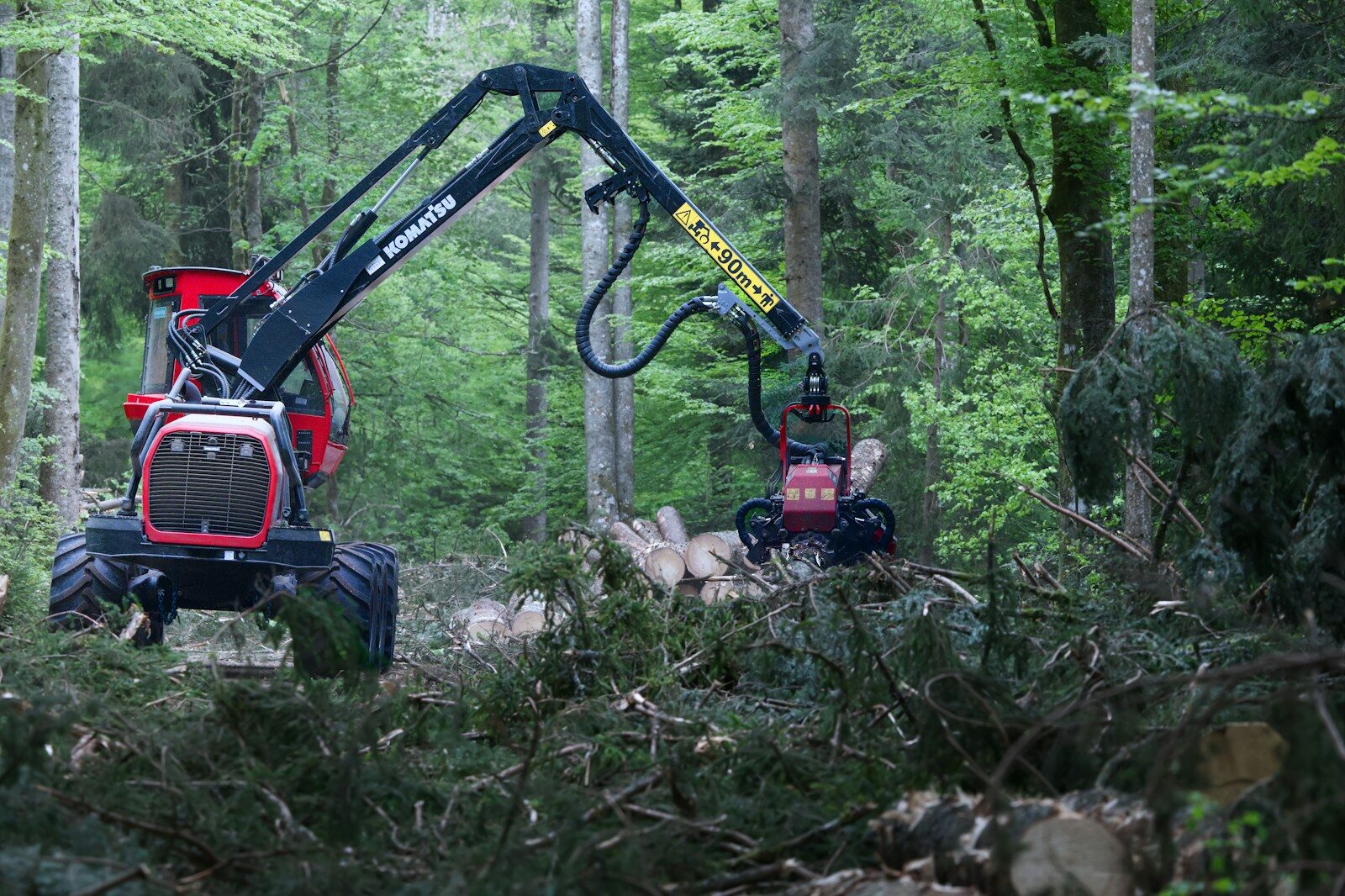
Across Canada, wood heat, storm cleanup and woodlot work keep skid steers busy handling logs. Ice-damaged trees, windfall and cut firewood lengths all end up in a pile somewhere, and the pile has to be moved without spending the day on foot.
A log grapple attachment closes two arms around a load so a skid steer can lift, carry and place it. The size and shape of that grip decides what it can pick up, which is why a wood grapple is judged first by how wide it opens.
How a Grapple Gets a Grip on a Log
Hydraulic cylinders pivot the grapple arms toward the fixed jaw, squeezing the load between them. Pressure from the skid steer’s auxiliary circuit drives the closing, so how firmly a load is held depends on both the cylinder and the machine’s hydraulic pressure.
Because the load is clamped from the sides, a log is held more securely than on forks. A wood grapple lets the operator pick up round, uneven pieces that would roll off a pallet fork, and keep them in place while traveling over rough ground.
Opening Width Against Clamping Force
Clamping force gets most of the attention, yet a load that will not fit between the arms never gets clamped. A grapple in the 30 inch class handles firewood-length logs and small trees, but a thick butt log needs more opening than force.
Piling several logs into one grip raises the clamp requirement quickly, because the outer pieces carry the squeeze for the inner ones. A smaller bite held firmly is safer and faster over a day than a big one that slips as the machine turns.
Tine Shape, Load Balance and Carrying Low
Tines that curve inward cradle round logs, while straight tines suit stacked lumber and brush. Keeping the load’s center of gravity close to the machine keeps the rear wheels planted, and a load held out at arm’s length tips the skid steer forward.
Carrying logs low, with the grapple a foot or two off the ground, keeps the machine stable on uneven woodlot trails. Raising the load only at the pile and lowering it before turning avoids most of the tipping incidents that log handling causes.
Safety and Care Around a Loaded Grapple
A short list covers the main risks with logs.
- Keep everyone clear of the load and arms
- Lower the grapple to the ground to park
- Check pins, bushings and hoses before each shift
- Never lift people or use it as a platform
Logs can shift, roll or spring free when released, and bark and ice make a grip less certain. Pins and bushings at the pivot points wear first, so greasing them and checking hose connections for leaks catches problems before a load drops.
Trade-Offs and What Comes Next
Compared with forks, a grapple handles round and irregular loads far better, but it is heavier, uses hydraulic flow and adds more to maintain. For a property that moves only the odd pallet, forks remain the simpler tool among skid steer attachments, while for wood the grapple wins.
The check that matters most is whether the opening width fits the thickest log that will be handled. TMG Equipment gives the width, weight and mounting style for this wood grapple, so an owner can match them on paper and then see the attachment in person.
About the Author