
If you are interested in the history of World War II, you probably know that the American Army transmitted orders in the Navajo language to baffle the Imperial Japanese Armed Forces. But did you know that the Canadian Army enlisted approximately 100 men to communicate in Cree, Ojibwe, Kanien’keha (Mohawk) and other languages?
The ruse was so successful, that neither the Germans or the Japanese could decipher these messages. The method was so efficient that the U.S. Marines found that using Indigenous words was faster than encrypted.
In recognition of the Indigenous soldier’s vital contribution to the War, Congress in Washington passed the Code Talker’s Recognition Act, awarding a Congressional gold medal to “Native American Tribes,” that were involved in the program and a Silver Congressional medal to individual service men, in 2016. With no fewer than 17 of these code talkers coming from Akwesasne, the St. Regis Mohawk Tribal Council, the federally-recognized governing authority of the American based section of the trans-international-border that bisects Akwesasne, received a gold medal, designed with the input of the local community. Previous to this interim, Sub-Chief Michael Conners accepted a canvas certificate announcing the award on behalf of Akwesashron:non, in a ceremony held in Washington D.C. , on November 20, 2013. (As this is an American military honour, the gold medal was presented to Akwesasne’s American governing body.)
Out of the 17 local men, only Louis Levi Oakes (1925-2019) lived long enough to be publicly awarded the Silver Congressional Medal as an “Akwesasne Code Talker,” in 2016, followed two years later when the Canadian Assembly of First Nations staged a special commemorative Assembly in the House of Commons in Ottawa honouring him.
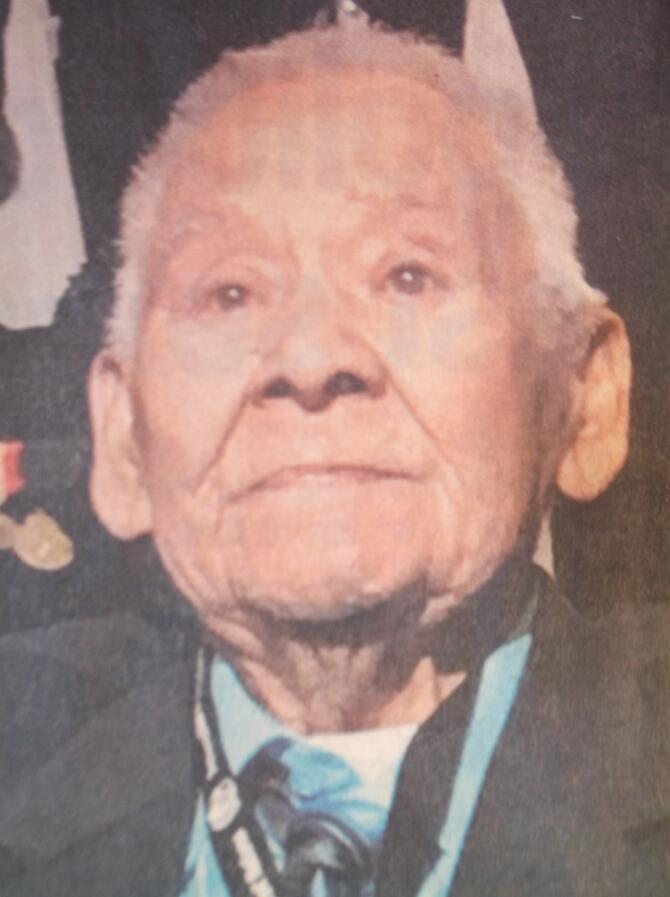
Louis “Levi” Oakes at the 2018 Canadian code talker ceremony, held 73 years after the War. Along with the Congressional Silver Medal, he received the Silver Star for Gallantry in Combat. (Photo courtesy, Levi Oakes Family.)
You may have noticed that the Americans were the first to acknowledge the code talkers contribution to the war effort. This is largely due to the fact that most if not all of these local men joined the American forces.
When asked why he joined the American Army, Levi Oakes told “Ottawa Citizen” reporter Maura Forrest at the Assembly held in Ottawa that “…as one of his brother’s was beaten up and jailed by the RCMP (in Niagara Falls) because he hadn’t reported for Service in Canada,” he volunteered to serve with the Americans.
Levi Oakes along with other members of his family signed up to serve when he was 18, After basic training, he was transferred to a camp in Louisiana, where an officer learned that he spoke Mohawk, and transferred him to a training facility to learn code talking. After his instructions were completed Levi became a Technician Fifth grade, in B Company of the 442nd Signal battalion. Over the course of the War, Oakes saw action in the South Pacific, New Guinea, and the Philippines, to finally end-up in Tokyo. The War over, he was given an honourable discharge, having earned the Silver Star for Gallantry in Combat. Moving to Buffalo, Oakes married Annabelle (Mitchell) to raise a family, while working as an iron worker for the next three decades. When he retired he returned to Akwesasne, where he was employed by the Mohawk Council as Public Works Supervisor.
Sworn to an oath of secrecy about his wartime responsibilities and even after his contribution was declassified in Canada in 1963 and 1968 in the U.S., he remained silent. And his family was proudly surprised when they learned that their Dad would receive the Congressional Silver medal, as according to his son Wally ,if they pestered him too much about his military service, he would solemnly reply, “If I told you I would have to kill you.”
When questioned about the prestigious award, Oakes’ daughter Dora said that “…her father was pleased with the recognition decades after the fact, but they both wished it had come sooner before all of the other Mohawk code talkers had passed away…Why wait ‘till the last one.”
Levi Oakes died surrounded by his family in 2019 and was buried with full military honours highlighted by a military fly-past.
Levi’s cousin, Alex Hebert Oakes Sr., (1924-2008) was the recipient of the American Silver Congressional Medal, “Akwesasne Code Talker,” American Bronze Star of Valour, and two Purple Hearts.
Born and educated in St. Regis, 17 year old Alex volunteered for the American Army. Years after the War, he told his daughter Pat, that he was “a paratrooper with the 82 nd Airborne,” and had landed in Normandy the night before D-Day. He also took part in Operation Market Garden in the Netherlands, in September 1944 and the Battle of the Bulge, and that is all the family knew.
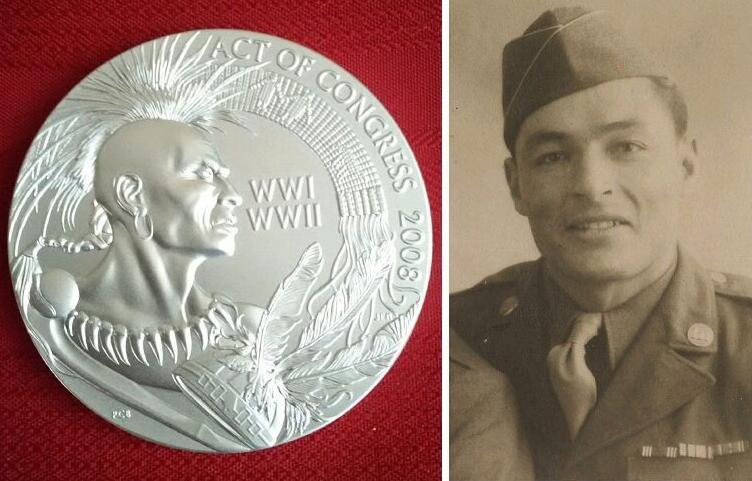
Code talker Alex H. Oakes Sr., in his WW II U.S. Army uniform and the Silver Congressional Medal, he was posthumously awarded. (Photo courtesy, Ontario Power Generation.)
Given this convincing War record, his family were “honoured” and surprised to learn, over CKON radio that their father was one of 17 code talkers from Akwesasne to be posthumously awarded the Silver Congressional Medal, engraved “Akwesasne Code Talker,” at a public ceremony to be held in May of 2016. New York State assembly woman, Addie J. Russell confessed that: “…there is a bittersweet irony to the role the Code Talkers played given the history of American colonialism and cultural genocide against Native Americans”
“The irony of the underlying reason we are gathered here today is not lost on me.
It was civil disobedience against an oppressive government that eventually proved critical to saving that government and her allies.”
In common with so many Mohawks, after the War Oakes worked as an iron worker.
In reminiscing about her father, an appreciative Pat Oakes said that he “…was a proud Kanien’keh (Mohawk) speaker.
“After the War he played a key role in the Akwesasne community. He became Grand Chief in the 1960s, leading the community with quiet compassion. He also formed a veteran’s group for disabled residents who had been involved in several conflicts, including WW II and the Vietnam War
CODE TALKER SAMPLER.
For English words that did not have Indigenous equivalents, representative words such as “turtle” for tank, “iron fish” for submarine and “humming bird” for fighter plane, might be used.
About the Author