

Eastern Ontario remembers January 1998. Drive through older neighbourhoods in Cornwall and you can still spot maples with lopsided crowns, the ones that lost a leader to the ice and grew back crooked. Most of the damage that winter came from trees that were already weak: split forks, dead limbs, trunks hollowed out by rot. The ice only finished the job.
Fall is when you catch those problems. Some Ontario towns have made tree care part of the rules. Oakville requires a permit before removing most private trees 15 cm or larger in diameter, so an arborist Oakville homeowners hire will usually handle the paperwork along with the inspection. You don’t need a bylaw to do the same check at home. You need a free afternoon in October or November and a pair of binoculars.
Why fall is the right time
Once the leaves drop, you can see the whole branch structure: which limbs cross, where the forks are tight, which branches hang over the roof. Trees are going dormant, so pruning cuts stress them less than in spring. The ground is usually firm, which means a truck or lift can get into the yard without tearing up the lawn. And you’re doing it before the first freezing rain puts weight on every weak point.
Six things to check from the ground
Walk around each large tree slowly, looking up and then down.
- Dead branches. Bark peeling off in sheets, no buds at the tips, or branches that stayed bare all summer. These are the first to come down.
- Tight V-shaped forks. When two trunks grow from one point with bark squeezed between them, the joint is weak. Under ice load, these split down the middle.
- Cracks. Look for vertical cracks in the trunk or at the base of large limbs. A crack that’s grown since last year is urgent.
- Fungus at the base. Mushrooms or shelf-like growths near the roots often point to decay inside the trunk or root rot.
- A new lean. Many trees lean. A lean that’s changed, or soil cracking and lifting on one side, means the roots may be letting go.
- Branches over the house, driveway or wires. A healthy limb over the roof is still a risk under a few centimetres of ice.
Take photos from the same spots every fall. Comparing this year to last year is often the clearest way to see a problem developing.
Which trees break first
Some species handle ice far better than others. If your yard has the weaker ones near the house, they deserve a closer look.
| Tree | How it tends to fail | What to watch |
| Silver maple | Brittle wood, splits at forks | Large limbs over roofs and driveways |
| Manitoba maple | Weak wood, many narrow forks | Branches breaking in wind and ice |
| Willow and poplar | Fast growth, soft wood | Heavy limbs, rot at old wounds |
| Birch | Bends under ice, may not recover | Young trees bowed to the ground |
| Ash | Dead trees turn brittle after emerald ash borer | Any ash that’s thinned or died back |
| Oak, sugar maple, hackberry | Strong wood, usually hold up well | Still check for deadwood and cracks |
Ash deserves its own warning. Emerald ash borer has killed ash trees across Ontario, and a dead ash becomes dry and brittle fast. If you have one still standing near the house, don’t wait on it.
What you can handle yourself
Plenty of fall tree care is safe for a homeowner:
- Removing small dead branches you can reach from the ground with a pole pruner.
- Watering evergreens deeply before the ground freezes, which helps prevent winter browning.
- Spreading 5 to 8 cm of mulch over the root zone, kept a hand’s width away from the trunk.
- Wrapping the trunks of young trees against sunscald and rodent damage.
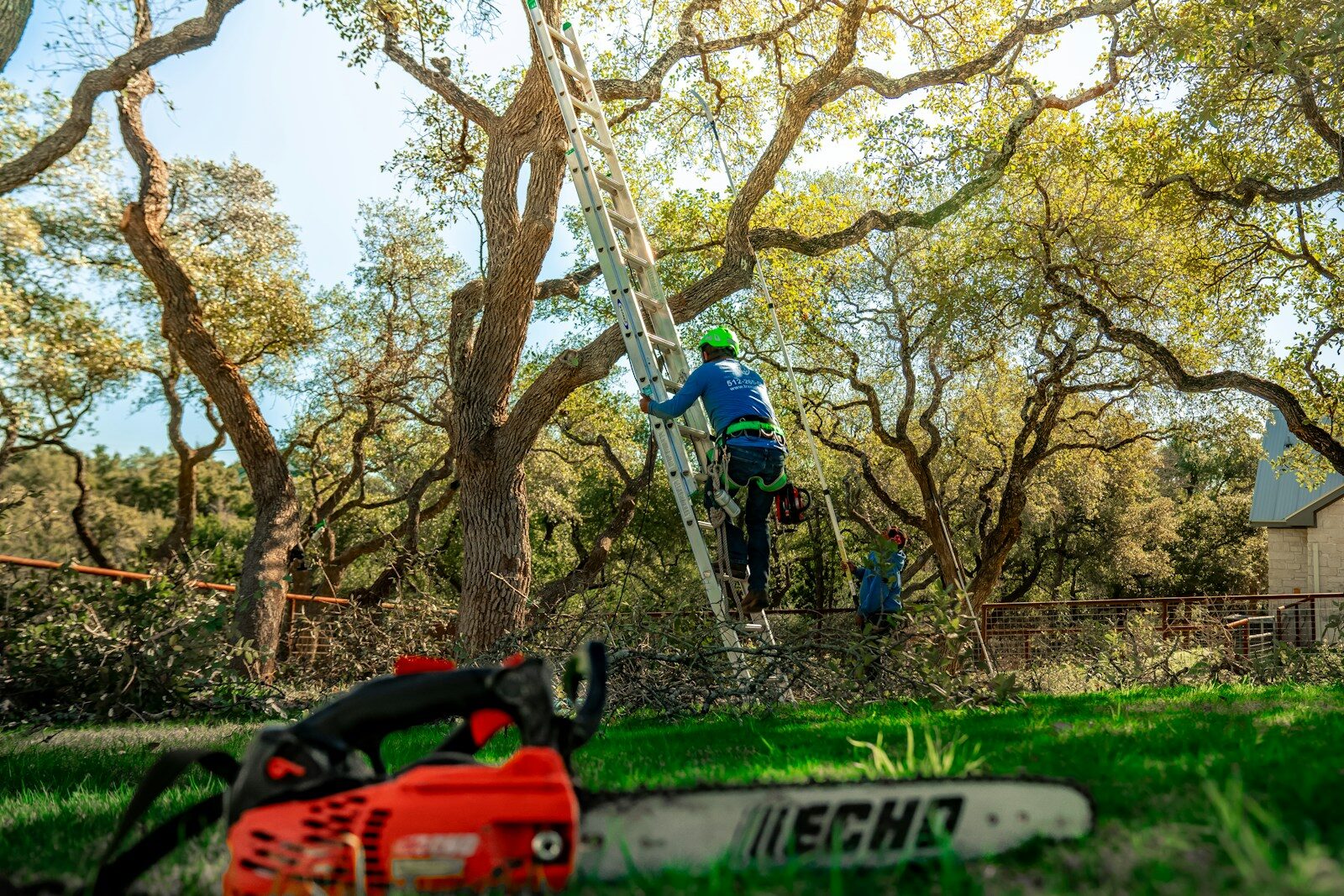
Leave the rest to someone with training and insurance. Never climb a ladder with a chainsaw, and never work near a power line. Utility lines are the utility’s job, full stop.
When to call in a professional
Call for help if you find large dead limbs over the house, a crack in the main trunk, or a split-prone fork on a big tree. A certified arborist can often save a tree with cabling or bracing, which ties weak forks together so they share the load, or with selective pruning that reduces weight at the ends of long limbs.
Before you hire anyone, ask:
- Is the person assessing the tree an ISA-certified arborist?
- Can they show proof of liability insurance and a WSIB clearance certificate?
- Will the quote be in writing, including cleanup and stump grinding?
- Do they know the local rules? Check with the City of Cornwall or your township before removing a large tree.
Be wary of anyone who offers to “top” a tree by cutting the crown off flat. Topping produces a mass of weak new shoots that break more easily than the original branches. The same goes for crews that use climbing spikes on a tree they’re only pruning; spikes wound the trunk.
After a storm hits
If a tree or limb comes down, stay clear of any wire it’s touching and call your electrical utility. Take photos of the damage before any cleanup, because your insurer will want them. And don’t sign with the first crew that knocks on the door the next morning. Storm-chasing contractors show up fast, charge high, and are often gone by the time you find a problem with the work.
A tree that’s been checked in October is far less likely to be on your roof in January. Put it on the calendar next to cleaning the gutters.
About the Author