
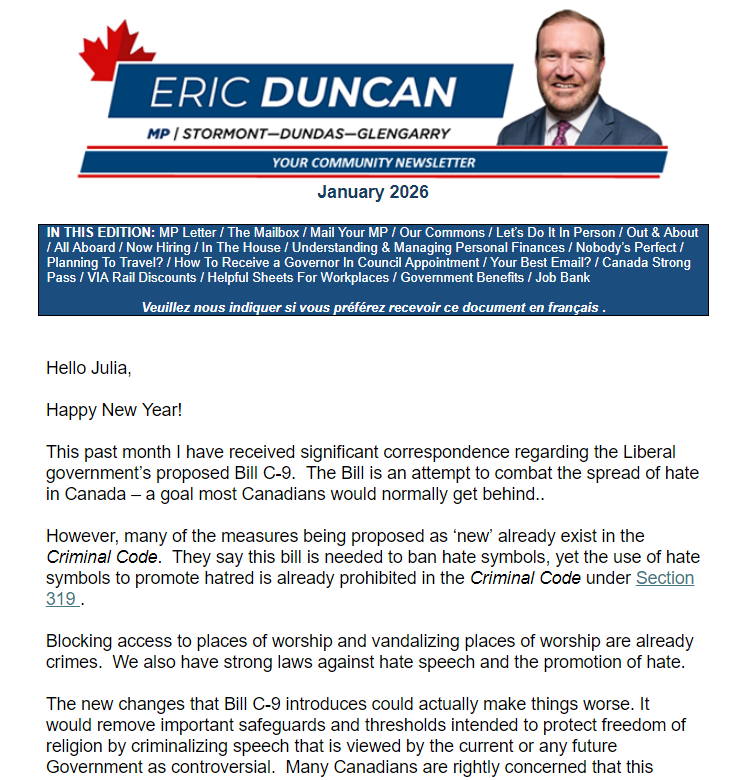
Today, I received a newsletter from local MP Eric Duncan. In it, Duncan is outlining his concerns with the federal government’s proposed Bill C-9, legislation aimed at addressing hate-motivated harm. (If you want a copy, email me, and I will forward it to you.)
The newsletter raises familiar and serious concerns: freedom of religion, freedom of expression, government overreach, and the fear of creating what is described as “thought police.” These are not trivial issues, and they deserve careful, informed discussion. But the framing used in this message leaves out important legal and social context and risks fueling unnecessary fear rather than meaningful debate.
Bill C-9
Let’s start with common ground. Hate, intimidation, and violence are not abstract concepts. Hate crimes targeting religious communities, racialized Canadians, and LGBTQ+ people have increased in recent years. That reality is not partisan, and acknowledging it does not threaten freedom. Protecting people from targeted harm is part of what freedom is supposed to guarantee.
The newsletter argues that Bill C-9 is unnecessary because many of its provisions already exist in the Criminal Code. That is partly true. But having laws on the books is not the same as having laws that work effectively in practice. Enforcement gaps, evolving forms of hate, and the growth of online harassment are precisely why governments revisit legislation. Simply saying “existing laws should be enforced” avoids the harder question: are current tools actually adequate for the realities Canadians are facing today?
A significant portion of the concern centres on the idea that Bill C-9 could criminalize religious texts such as the Bible, the Quran, or the Torah. This claim is often repeated, but it is not supported by the bill’s wording or by established Charter jurisprudence. Canadian courts have consistently applied very high thresholds when assessing hate-related offences, and freedom of religion remains explicitly protected under Section 2 of the Charter. Legitimate religious belief, teaching, and worship are not suddenly at risk because Parliament is debating updated hate legislation.
What is at risk when these arguments are emphasized is public trust. Suggesting that faith communities are under imminent threat shifts attention away from people who are already experiencing real, documented harm and replaces informed discussion with fear-based hypotheticals.
The newsletter also connects Bill C-9 to broader frustrations about grocery prices, housing, and crime. Those concerns are valid and urgent. But they are not mutually exclusive. Addressing hate does not prevent government from addressing affordability or public safety. Framing the issue as an either-or choice oversimplifies complex policy work and narrows public conversation.
Calling legislation like this “thought policing” minimizes the very real impact that hate speech and intimidation can have on people’s ability to live safely and freely. Words matter, particularly when they are used to dehumanize, threaten, or incite harm.
None of this means Bill C-9 is beyond critique. Reasonable people can disagree on scope, enforcement, and safeguards. But those debates are best served by accuracy, legal clarity, and a willingness to engage with the lived experiences of affected communities.
Healthy democracy is built through more than talking points. It grows through respectful, good-faith conversation, particularly on issues as important as rights, safety, and freedom. We welcome readers to share their thoughts in the comments below.
About the Author