

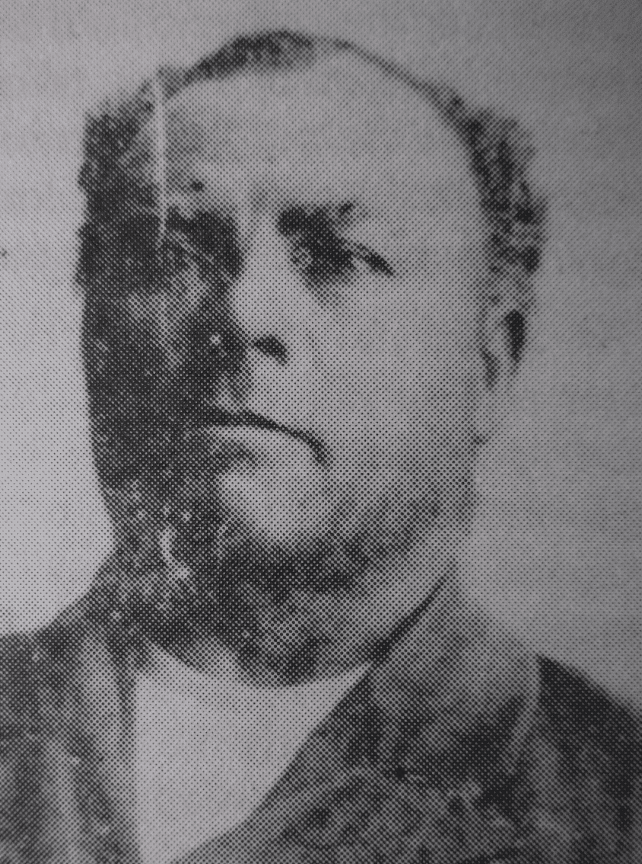
When the American wing of Winchester’s Methodist Episcopal Church began building their new Church in 1881, they used stone from nearby Baker Quarry, giving employment to the Baker Family and former slave, Union Army veteran, sailor and lime mason, Isaac Johnson. During construction of the Church, the head of the Baker Family was injured, leaving Johnson to take charge and complete the structure in 1886. Word of Johnson’s meticulous work quickly spread across Eastern Ontario and northern New York State, leading him to manage the construction of Waddington’s Town Hall, in 1884, while still supervising the completion of Winchester’s church. In Waddington, the local newspaper reported that “Mr. Johnson, is a coloured man from Winchester, Ontario is the contractor and one of the best architects in the country.”
Winchester United Church, (originally Methodist Episcopal). Tradition maintains that Johnson was such a precise craftsman, that when he saw the north wall of the church had reached the tops of the windows, that he and his crew were working on, was out of alignment by ½ an inch, he tore it down to the six foot wide foundation, and started over again.
Johnson subsequently left Winchester and moved to Morrisburg with his family where he built St. James Anglican Church, and a number of homes.
Movement across the international border was much freer than today, and Johnson and his family relocated to northern New York State. Continuing to work on both sides of the border, in 1897 Johnson fell from a derrick in a quarry in Cornwall, and was so badly injured he could not work again.
Never forgiving his “white” slave owning father for abandoning, and selling his family, Johnson now wrote a 40 page booklet titled Slavery Days in Old Kentucky…, printed in Ogdensburg, in 1891 to counter the emerging myths of the “Romantic Old South,” and to raise some money towards his children’s education.
In remembering his Canadian experience, Johnson wrote: “I never set my feet upon Canadian soil, even to this day, without a feeling of love and respect for its people of Canada, to me a Canaan.”
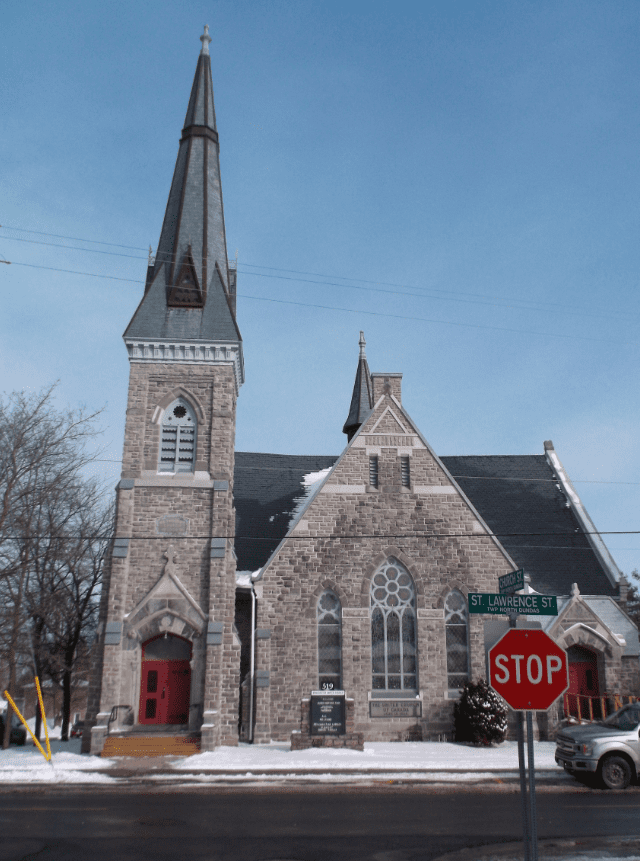
Winchester United Church, (originally Methodist Episcopal). Tradition maintains that Johnson was such a precise craftsman, that when he saw the north wall of the church had reached the tops of the windows, that he and his crew were working on, was out of alignment by ½ an inch, he tore it down to the six foot wide foundation, and started over again.
Johnson died of a heart attack in 1905. The obituary in the Ogdensburg “Daily Journal,” said: “Mr. Johnson was a respectable citisc(zen) and was well liked by those who knew him. He leaves a wife and seven children.”
BEFORE COMING TO CANADA, a thumbnail sketch.
Isaac Johnson was born in Kentucky to a white, farmer and black enslaved mother.
“His white uncles were slave traders and had stolen his mother from… Madagascar in 1840. She was given to Isaac’s grandfather, who bequeathed her to his son, Isaac’s father.” (Winchester United Church, history, Ennis, pg. 16.)
Isaac’s father was now ostracized for raising “children by a slave. A “weak” willed man, Johnson’s“…father now sold his farm and disappeared leaving Isaac age 7 for the sheriff to take the mother and four children to be sold.,” separately. Johnson, now saw his mother sold for $1,100 , her baby for $200, and then not understanding that he was also chattel, he was auctioned for $700.
In time Johnson met a black freed man, who had been unlawfully enslaved, who told him about Canada. The pair tried to escape, but were captured. Finally, in 1863 when the Union Army, swept through Kentucky, Johnson was hired as a cook, and subsequently enlisted in the 1 st Michigan Coloured Regiment to be wounded in action.
After the War he unsuccessfully searched for his family. Finding work as a sailor on the St. Lawrence and Great Lakes, he landed in Morrisburg in 1867, where he embraced Canadian freedom.
In defiance of his father’s memory, he now took his mother’s maiden name Johnson. Eight years later he married American Louisa Theodosia Allen in Canada, listing his occupation on his marriage certificate as a lime mason, a trade in which he made a name for himself by supervising and constructing numerous noteworthy public and religious structures.
About the Author