


Growth used to be simpler.
Companies would invest in marketing, generate leads, and rely on sales teams to convert those leads into revenue. Channels were relatively independent, data was limited, and optimization was often reactive. Marketing created activity, sales closed deals, and the connection between the two was loosely defined.
That model no longer reflects how growth actually happens.
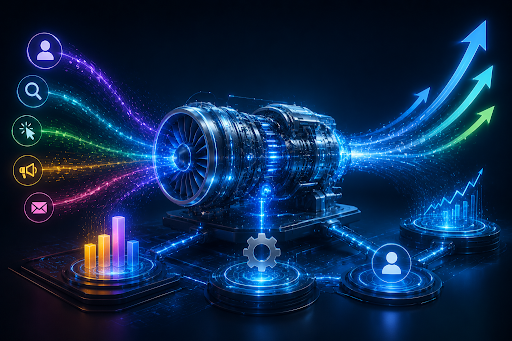
Today, growth is a system. One that requires alignment between visibility, infrastructure, and optimization. One that depends on data flowing across platforms rather than remaining isolated. And one that increasingly relies on artificial intelligence to operate efficiently at scale.
This is what defines the modern growth engine.
At its core, the system is built on three interconnected layers.
The first is visibility. This is how a business enters the consideration set. It includes search, paid media, content, and any channel that brings attention to the company.
The second is infrastructure. This is how that attention is captured, processed, and converted into opportunity. It includes websites, CRM systems, and data architecture.
The third is optimization. This is how the system improves over time. It includes analytics, testing, and increasingly, AI-driven decision-making.
Individually, each of these layers can perform.
Together, they determine whether a business can scale.
This is where the role of a modern digital marketing agency has changed.
It is no longer about managing campaigns in isolation. It is about designing systems where each component reinforces the others.
Visibility begins with intent.
In most industries, high-value opportunities are driven by users actively searching for solutions. These moments represent immediate demand, and platforms like Google Ads provide direct access to them.
However, accessing demand is not the same as capturing it effectively.
Many businesses run campaigns that generate clicks but fail to convert them into meaningful outcomes. The issue is rarely traffic volume. It is alignment.
High-performing organizations treat paid media as part of a broader system.
Their campaigns are structured with clear objectives. Messaging is aligned with user intent. Landing pages are designed to convert. Data is tracked and connected to downstream outcomes.
This is where structured Google Ads management services become critical.
Rather than focusing on campaign execution alone, they focus on how campaigns fit into the overall growth engine. They ensure that traffic is not just generated, but translated into opportunity.
Without this structure, paid media becomes inefficient.
Budget is spent, but performance is inconsistent. Leads are generated, but quality varies. Optimization is reactive rather than strategic.
The second layer of the system is infrastructure.
Once visibility is achieved, the website becomes the primary point of interaction. It determines how users engage, what information they receive, and whether they take action.
Yet many businesses treat their website as a static asset.
They invest in design, launch the site, and make incremental updates over time. What they often lack is a system designed to support growth.
A high-performing infrastructure connects every interaction.
Forms are integrated with CRM systems. User behavior is tracked. Data flows between platforms. Sales teams receive context about each lead, including how they engaged and what influenced their decision.
Without this connection, opportunities are lost.
Leads may be captured but not followed up effectively. Data may be collected but not used. Insights may exist but not be applied.
According to David Sahly, Vice President of Growth at Pulsion, “Most companies don’t lack effort. They lack connection. When systems don’t talk to each other, performance breaks down.”
This is where the difference between activity and outcome becomes clear.
Infrastructure determines whether marketing efforts translate into revenue.
The third layer is optimization.
This is where the system evolves.
In the past, optimization relied heavily on manual analysis. Teams would review data, identify patterns, and make adjustments over time. While this approach is still relevant, it has been enhanced significantly by artificial intelligence.
AI systems analyze large volumes of data in real time.
They identify patterns, predict outcomes, and adjust performance dynamically. This includes optimizing campaigns, refining targeting, and improving efficiency across channels.
However, AI is not a solution on its own.
It requires structure.
This is where AI optimization becomes essential.
AI optimization defines how artificial intelligence is applied within the growth engine. It ensures that systems are aligned with business objectives, that data is accurate, and that optimization is guided effectively.
Without this structure, AI can amplify inefficiencies.
For example, a campaign may optimize toward lower-cost conversions that do not align with revenue goals. Metrics may improve, but business outcomes do not.
With the right structure, AI becomes a powerful advantage.
It enables faster decision-making, more precise targeting, and continuous improvement across the system.
Another defining characteristic of the modern growth engine is scalability.
As businesses grow, their systems must support increased complexity.
This includes:
- More traffic
- More campaigns
- More data
- More touchpoints
Scalability is not just about handling volume.
It is about maintaining performance as complexity increases.
A well-designed system allows businesses to scale without introducing inefficiencies. It ensures that each layer continues to function effectively, even as demands grow.
This requires planning from the beginning.
Systems must be designed with growth in mind. Infrastructure must be flexible, and processes must be clearly defined.
Adaptability is equally important.
The digital landscape continues to evolve. New platforms, technologies, and strategies emerge regularly. Businesses must be able to respond without disrupting their operations.
AI plays a key role in this adaptability.
By analyzing data and identifying trends, AI systems enable businesses to respond quickly. However, strategic direction still comes from the business.
The system must be guided.
Measurement is another critical component.
Traditional metrics such as traffic and clicks are no longer sufficient. Businesses must focus on outcomes, including:
- Conversion rates
- Customer acquisition cost
- Revenue contribution
This requires integrated analytics.
Data must flow across platforms, and insights must be actionable. This allows businesses to optimize not just individual campaigns, but the entire system.
Over time, the impact of this approach becomes visible.
Some organizations continue to treat marketing as a series of disconnected activities. Each channel is managed independently, and performance is evaluated in isolation.
Others build systems.
They connect visibility with infrastructure. They integrate data across platforms. They apply AI within a structured framework.
The difference is not always immediate.
It compounds.
It shows up in how efficiently traffic converts, how quickly campaigns improve, and how effectively teams operate. It becomes visible in the consistency of results and the ability to scale without disruption.
In practice, this is where growth shifts from unpredictable to structured.
Not because any single tactic changes, but because the system supporting those tactics is aligned.
The modern growth engine is not defined by any one tool or channel.
It is defined by how those components work together.
And in an environment where complexity continues to increase, that alignment is what separates companies that grow steadily from those that struggle to maintain momentum.
About the Author