
Access to medical imaging can influence how quickly a healthcare professional evaluates a patient and determines the next appropriate step. In larger cities, hospitals and specialized imaging centers may be relatively close. In smaller or rural communities, however, patients may need to travel farther, wait for an available appointment or be transferred to another facility.
Handheld ultrasound cannot solve every access challenge or replace comprehensive diagnostic imaging. When used by appropriately trained healthcare professionals, however, it can bring focused ultrasound assessments closer to the patient and provide useful information during the clinical encounter.
Why Medical Imaging Can Be Difficult to Access in Smaller Communities
Traditional ultrasound systems are commonly located in hospitals, diagnostic imaging departments and specialized clinics. Maintaining these services requires suitable facilities, trained personnel and reliable technical support.
Smaller communities may have fewer imaging resources or limited access during evenings and weekends. A patient might therefore need to travel to another location even when the treating clinician only requires a focused answer to a specific clinical question.
This does not mean every ultrasound examination should be performed locally. Comprehensive studies and complex cases still require appropriate imaging departments and specialist interpretation. The challenge is identifying situations in which a focused bedside assessment can safely support care without creating an unnecessary delay.
What Is Handheld Ultrasound?
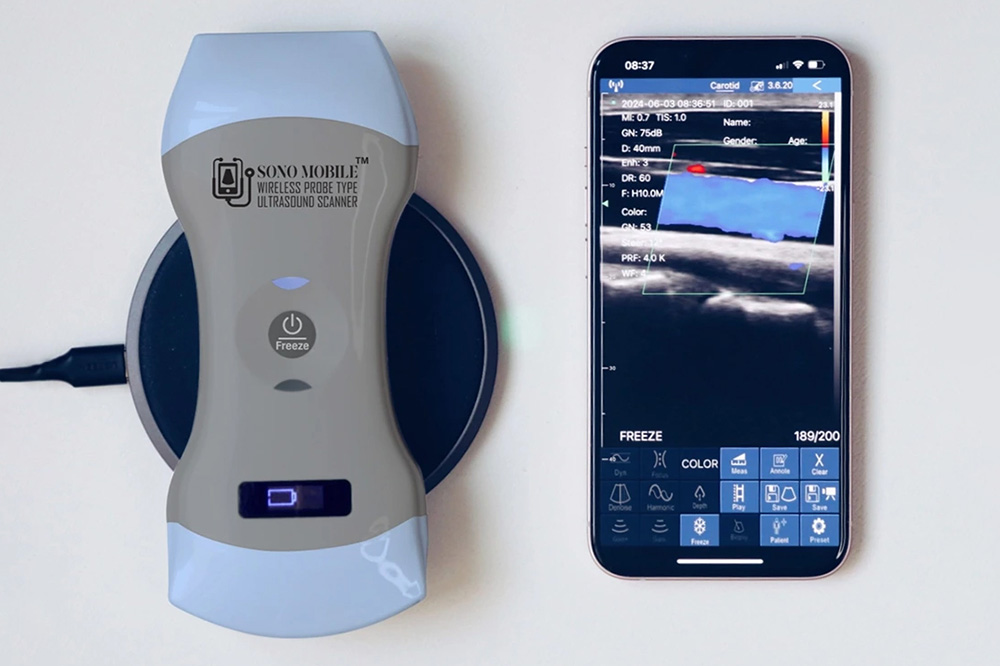
A handheld ultrasound is a compact imaging device that can connect to a compatible smartphone, tablet or computer. Depending on its probe design and software, it may produce images of structures such as the heart, lungs, abdomen, blood vessels, muscles and tendons.
These devices are frequently associated with point-of-care ultrasound, or POCUS. This refers to a focused ultrasound examination performed where the patient is receiving care. The clinician acquires and interprets the images in the context of a particular question, such as whether fluid is present around the lungs or which blood vessel is most suitable for vascular access.
How Is It Different from a Traditional Ultrasound System?
A cart-based ultrasound system generally offers a larger display, a wider selection of transducers and advanced features for comprehensive imaging. A handheld device prioritizes portability, rapid setup and use at the bedside.
The two formats should therefore be viewed as complementary rather than interchangeable. A focused examination can help guide an immediate decision, while a complete diagnostic study may still be necessary to confirm findings or investigate a condition in greater detail.
How Handheld Ultrasound Brings Imaging Closer to Patients
The main advantage of Handheld Ultrasound is that the equipment can be taken to the patient instead of requiring the patient to be transported to a dedicated ultrasound room. This flexibility may be particularly valuable when distance, mobility or limited infrastructure makes access more difficult.
Supporting Rural Clinics and Community Health Centers
In a rural clinic, a trained clinician may use POCUS to answer a focused question during an examination. The findings can help determine whether the patient can be managed locally, requires additional diagnostic testing or should be referred to a higher level of care.
Handheld imaging may also support collaboration with specialists when secure image sharing and remote consultation systems are available. Such workflows require clear protocols for documentation, privacy and follow-up.
Providing Bedside Imaging in Emergency and Acute Care
Moving an acutely ill or mobility-limited patient to another department is not always simple. A portable device allows selected assessments to be performed at the bedside while other elements of care continue.
In emergency and acute-care settings, POCUS may support the evaluation of trauma, breathing difficulty, circulatory problems or suspected fluid accumulation. It can also assist with procedures such as vascular access. The results must always be interpreted alongside the patient’s history, physical examination, vital signs and other required tests.
Extending Care Through Mobile Clinics and Home Visits
Mobile healthcare teams and clinicians conducting home visits often work without the equipment available in a hospital. A compact ultrasound device can add focused imaging capability without requiring a large cart-based system.
Potential settings include long-term care facilities, mobile clinics and community outreach programs. Whether scanning is appropriate depends on the clinical question, the user’s training and the availability of a clear pathway for referral or further imaging.
Where Can Handheld Ultrasound Support Clinical Care?
The applications available depend on the device, probe type, software and qualifications of the user. Common point-of-care applications may include:
- Focused cardiac assessments
- Lung and pleural examinations
- Selected abdominal evaluations
- Musculoskeletal and soft-tissue imaging
- Bladder volume assessment
- Ultrasound-guided vascular access
- Guidance for certain injections or other procedures
A limited examination should not be presented as a complete screening test. A normal focused scan may not exclude every relevant condition, and an uncertain or abnormal finding may require formal diagnostic imaging, laboratory testing or specialist assessment.
Potential Benefits for Patients and Healthcare Teams
For suitable clinical questions, bringing ultrasound to the point of care may provide healthcare professionals with relevant information earlier in the patient encounter. It can reduce the need to move some patients between departments and may help teams prioritize referrals or further investigations.
In smaller communities, this flexibility could also reduce travel for selected assessments. The benefit is not simply having a smaller machine; it comes from integrating the device into a safe clinical pathway with trained users and reliable follow-up.
Ultrasound also does not use ionizing radiation. Even so, examinations should be performed for an appropriate clinical reason and according to accepted safety principles.
Why Training and Clinical Oversight Still Matter
Ultrasound is operator-dependent. Image quality and interpretation are influenced by probe positioning, equipment settings, knowledge of anatomy and recognition of technical limitations. Portability does not remove the need for clinical competence.
Healthcare organizations adopting POCUS should establish requirements for training, credentialing, supervision and continuing education. They also need processes for storing images, documenting findings, reviewing examination quality and maintaining patient privacy.
Clinicians must recognize when a scan is inconclusive or when the patient requires comprehensive ultrasound, CT, MRI or another form of evaluation. Handheld ultrasound should support clinical judgment—not replace it.
What Healthcare Organizations Should Consider Before Adoption
Choosing a device should begin with the intended clinical use rather than portability alone. Important considerations include image quality, compatible probe types, battery performance, ease of cleaning and disinfection, secure data handling, software support and integration with existing image-management systems.
Organizations should also assess training requirements, quality-assurance resources, maintenance, warranty coverage and the long-term cost of ownership. A technically capable device will only improve access when the surrounding clinical program is prepared to use it safely and consistently.
A Practical Step Toward More Accessible Community Care
Handheld ultrasound is not a substitute for radiology departments, comprehensive imaging or specialist care. Its value lies in making selected, focused assessments available closer to where patients already receive treatment.
With appropriate equipment, trained professionals and strong clinical oversight, this technology can help rural clinics, community health centers and mobile care teams obtain useful bedside information. It represents one practical way to make medical imaging more flexible while keeping patient safety and responsible clinical decision-making at the center of care.
About the Author