By John Towndrow, Chair, Transition Cornwall+
Transition Cornwall+ has been active in the city for about 18 years now and our themes have been to foster:
- less reliance on the fossil fuel industry,
- local sustainability, and
- community building
In Canada we are now in a hot debate on how to thrive and protect our sovereignty from hostile outside forces. This is not new to us in the Transition Town movement. We have long advocated for local supplementing our basic needs for food, shelter, transportation, energy etc. If we grow most of our own food for example, then we are not dependent on food coming from other countries that could be cut off at any time and in turn consumes less fossil fuel for transportation and distribution.
It can seem like climate action has fallen off the main agenda these days due to economic uncertainty, however that doesn’t mean that the goals of Transition Towns have changed. In fact, they seem more important than ever. The goal of being more self-sufficient and less subject to outside forces can be realized through more local action in a variety of ways. Although it doesn’t always make the news the world is gradually decarbonizing, largely because it’s now the cheapest way to get our energy. (Los Angeles, for example, the largest municipal utility in the US, is on path to be at 97% carbon free power in four years)
Community Building
In Cornwall and area, we are so fortunate to have a rich cultural heritage that is growing more diverse all the time. The Indigenous, French, and English cultures are now joined by people coming from all over the world, bringing their wisdom, professional skills, food heritage, celebrations, songs and dance that we can get to know and share and that make our lives so much richer professionally, artistically and culturally. We get to learn from each other, help one another and that adds up to a much stronger and diverse community.
Growing Food
As I travel around the city and the area, whenever I see a large expanse of mown lawn, I always think wow, that could be used to grow a few vegetables or trees for shade and wildlife. For food, it doesn’t have to be a big area – even a couple of pots with some tomatoes, Swiss chard and kale or beans will provide fresh nutritious food much of the summer months.
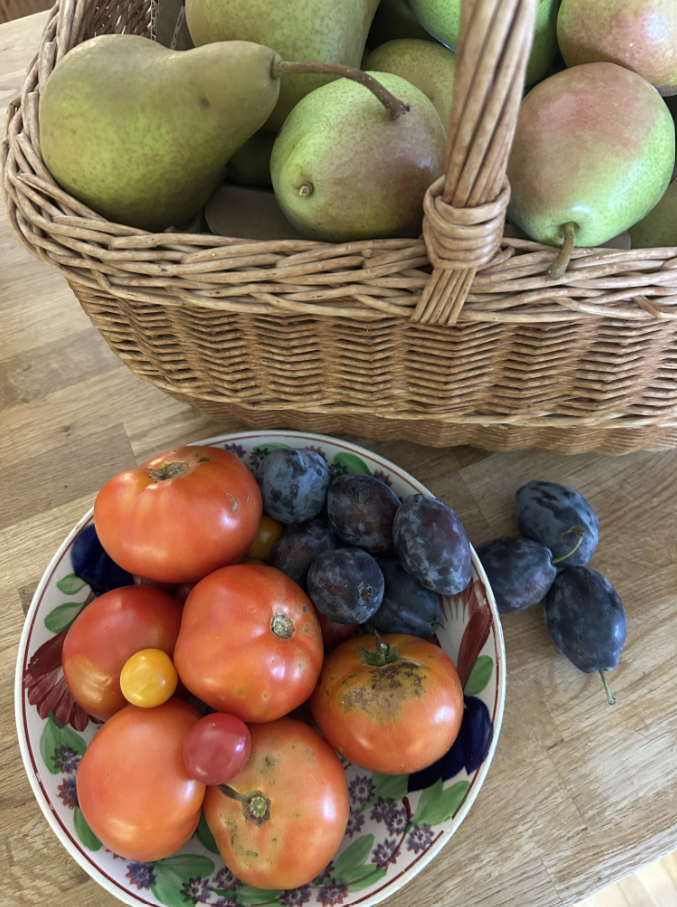
There is also a case to be made for community fruit trees. This year I harvested 45 pounds of Bosc pears from a tree on my property as well as more than a bushel of plums and Anjou pears from trees on my neighbour’s property. These don’t require spraying and are full of blossoms for pollinators in the spring. Imagine if this was repeated throughout the community how much fruit could be generated locally with no shipping or distribution costs?
Some communities have also created monthly potluck suppers. These gatherings are wonderful for community engagement; they improve mental health and provide a venue for sharing ideas around a delicious meal.
Local energy Conservation (and generation)
We can all take the time to assess our energy requirements and take steps to conserve the power we consume. We are fortunate here in Cornwall that our electricity comes from a renewable source in Quebec, however, we can still supplement that supply by generating electricity from local solar and wind installations. While this is difficult at an individual level, some communities have created solar co-ops to pool resources for neighbourhood systems or built into large new industrial buildings. As energy prices go up this can add to our local self-sufficiency. Transition Cornwall+ would love to hear from people who wish to explore these kinds of co-ops and other energy-saving options.
Re-skilling
How many times have you asked the question: why can’t this ‘such and such’ item be repaired instead of being thrown away? Many communities are setting up repair cafés and maker spaces. Instead of ordering that item online these spaces provide an opportunity to make a simple repair or even actually make something locally. Perhaps a repair café could be a part of our weekly Farmers Market.
So, my conclusion is that in these uncertain times the work of Transition Towns – building local resilience and self-sufficiency is alive and well. Beyond buying locally this work by all of us can help to make a community like Cornwall and area thrive and prosper.
This video of a community called Whidbey in Washington State is a nice overview of the benefits of Transition Towns: https://www.youtube.com/watch?v=-sRMVJcrGSY
About the Author