
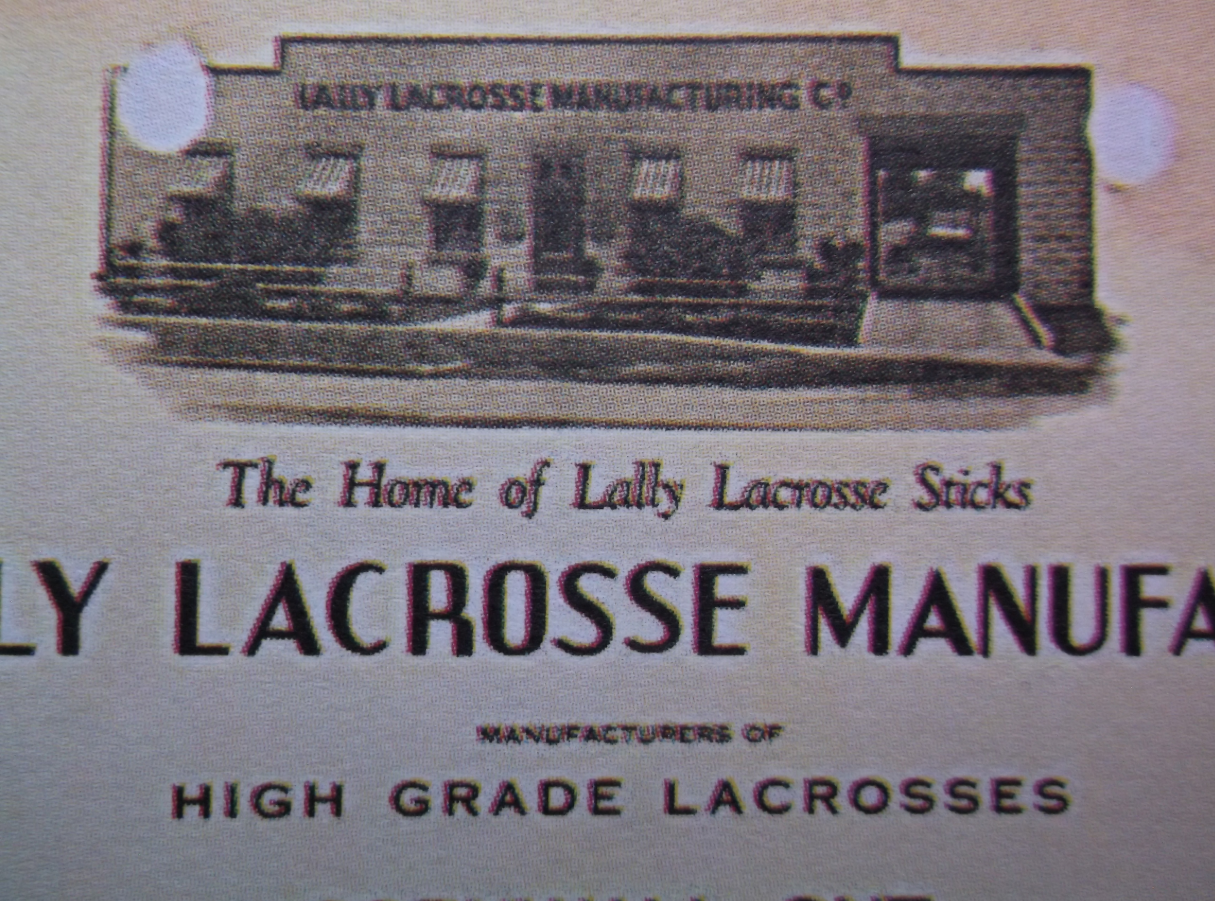
Letterhead for THE LALLY LACROSSE MANUFACTURING COMPANY, depicting their concrete block Cumberland St. factory, built in 1920 and now occupied by J.F. Markell Homes
In late 19th century Canada, lacrosse was “Canada’s National Sport,” and Cornwall was the game’s epicenter, producing world class teams and lacrosse sticks.
Known originally as “hurls,” the first recorded local game between Indigenous people and Europeans was played amid military pomp between St. Regis and Cornwall.
Former Grand Chief Mike Kanentakeron Mitchell told me that the game “…is also an expression of thanksgiving to the Creator and a way to purify the soul through intense athletic endeavor.” A lacrosse match was also a way for tribes to settle disputes without resorting to violence.
Mitchell continued: “You didn’t participate in a lacrosse game. You prepared for it. They ran miles, they went through the sweat lodge and they fasted (our ancesters)… did this and the same idea has held down through the years.
Lacrosse represented the nation and the Creator and you sent your best players to the field…It was a physical, cultural and spiritual experience rolled into play.”
Called either “tew:araton” (it has a dual net,) or “teiontsikwaeks” (they bump hips,) in Mohawk, the French colonists named it “le jeu de lacrosse.” Allowing for variations, the traditional game was played with a bat (stick) and ball over a large field bounded by two goal posts that could be more than a kilometer apart. A game started with the ball being placed in the centre of the field. The object being to keep the ball as far from the goal post as possible.
The local version of the game known as “hurls” was formalized in 1863 with the formation of a lacrosse club, which attracted an immediate following, giving birth to the “Young Victorians,” and the “Independents.” All of this interest led to the founding of the Cornwall Lacrosse Club, in 1879, to create a championship team.
Attracting Cornwall’s leaders and athletes alike, Mayor C.J. Mattice was the club’s first president, and led the Club to a string of victories that included the Eastern District trophy, the junior title and the Canadian Intermediate Champions.
Not content with being the junior champions only, in 1887, a senior team, named the “Immortals,” was formed and to win the World (Canadian) Champions, a year later. Comprised of local worthies such as future mayor and lacrosse stick manufacturer, Frank Lally, and part-time police constable , George Crites, the Immortals continued their winning streak until 1891.
As in all sports throughout the centuries, popularity equates with money, and in 1903 the Cornwall “Freeholder,” noted that the more lucrative salaries offered to players by larger centres across Ontario and beyond, witnessed “Cornwall…being raided, which is an excellent tribute to the quality of the players, if not their loyalty.”
Cornwall, however, remained famous for lacrosse due to two facts. Cornwall born Edouard C. “Newsy” Lalonde, cited as “the outstanding lacrosse player of the half-century (early 20th century), who became the only sportsman to be named to both the Canadian Lacrosse and Hockey Halls of Fame, and the Lally brother’s Frank and Joe, known as the “Father of Lacrosse in Canada.”
Space doesn’t do justice to covering Lalonde’s career, but if you are interested be sure to view the ‘Flying Frenchmen’s” historic plaque in front of the Cornwall Civic Complex.
Cornwall’s Lally brothers Frank and Joe P. were both named to the Lacrosse Hall of Fame, became mayors of Cornwall, were variously call the “Father(s) of Lacrosse in Canada” or “Mr. Lacrosse” and both managed Lally Lacrosse Manufacturing Co.
Former lacrosse team captain, Frank Lally retired from the game in 1889 and four years later opened what was to become the world famous Lally Lacrosse Manufacturing Co., which it is said exclusively hired Indigenous craftsman from St. Regis and Akwesasne to make the sticks.
A 1901 advertorial stated that since Frank Lally was an expert in handling the lacrosse stick “…it is not a matter of surprise that he should turn out what is acknowledged by all players to be the best stick in the world.” In the same year the factory turned-out 600 dozen sticks retailing at 25 cents apiece.
Two years later, brother Patrick “Joe” took over the business. In 1925, Joe Lally was instrumental in founding the Canadian Lacrosse Association and five years later, he donated, the now defunct Lally Perpetual Trophy, to be awarded annually to the winner of an international competition between a Canadian and an American team.
The Lally’s, however, were not without competition. Popular sentiment believed that it was only natural that Cornwall should excel in the production of lacrosse sticks. And in 1901, J.P. Kerwin opened the Cornwall Lacrosse Company, which produced 500 dozen “High Grade,” “XXX,” and patented goal-keeping sticks.
In the same year Kerwin “was honoured” to present the Prince of Wales, the Duke of Cornwall, with one of his products.
About the Author