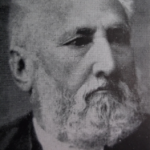



As formidable and secure as the historic Cornwall jail, once known as “Ault Castle,” after early 20th century Governor T.W. Ault may appear, its thick, high stone walls did not stop innovative prisoners from escaping.
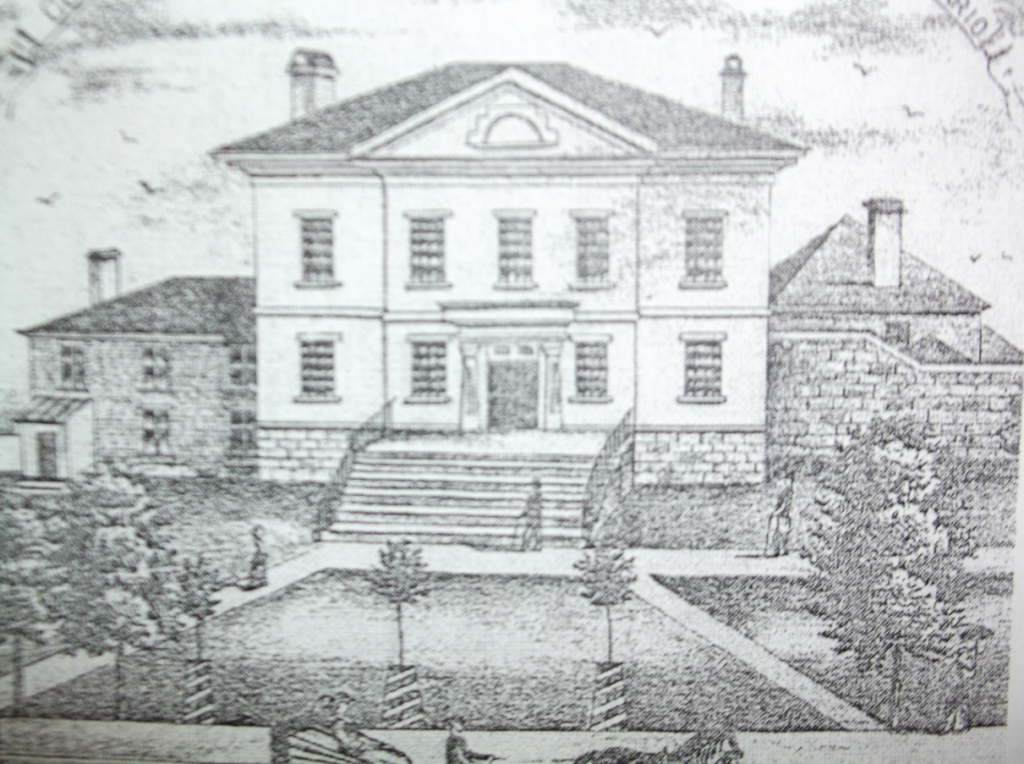
An artist’s rendition of the Court House and Jail, 1879.
BURN THE DOOR DOWN
The first successful escape took place in 1835, two years after the jail opened, when four prisoners burned holes through the north side door, enabling them to remove the door’s iron bolts. The fugitives included one suspected murderer, and were never apprehended.
CLIMB OVER THE WALL
Over the years some inmates simply climbed the heating wood-pile, stacked against the exercise wall, to go over the top to freedom.
THROUGH THE CEILING
Tradition relates that an inmate in the original 1834 cell-block attempted to escape by carving a hole in the ceiling of his cell. According to the story, once the prisoner had made a hole large enough to squeeze through, he climbed into the crawl space and headed towards Pitt St., all the while lacerating his back from the nails hanging from the floorboards. Nearing Pitt he found a bee hive, forcing him to turn back into his cell, where in the morning he was placed in solitary confinement for his efforts.
CORNWALL’S GREAT ESCAPE – DIG A TUNNEL
On April 11, eight Fenians, planning rebellion, were arrested at Cornwall’s railway station by Mayor Captain William Cox Allen and volunteer militiamen. This arrest heightened an already tense situation with the Province’s large restive Catholic Irish population, and exacerbated ill-will between Canada and the United States, where the Fenian cause, the liberation of Ireland, had substantial American political support. Frustrated by this arrest, government leader John A. Macdonald claimed that he only wanted the Irishmen followed and not detained , and typically washed his hands of the affair by passing it onto George-Etienne Cartier, who had authorized the arrests.
The Fenians were now charged with treason and remanded to the Cornwall jail to await trial that fall. Fearing that their arrest might provoke a violent Fenian response, two volunteer militia companies were dispatched from Montreal to protect Cornwall and guard the jail.
Even though the Fenians were heavily armed when captured, the government’s case lacked sufficient evidence to successfully secure a conviction, prompting suthorities to plant a spy amongst the prisoners. When he came-up empty handed, the government needed a way-out.
The inmates provided the solution by spending a month digging a tunnel under the jail’s walls.
Now according to historian Elinor Kyte Senior, “On September 2nd , a severe thunderstorm facilitated their plan. One of the sentry boxes stood close to the point where their tunnel emerged, but the storm had driven the sentry inside where he remained while five of the eight men crawled through the tunnel, scaled the (new) wooden fence and found a boat conveniently awaiting them on the river.” The escapees now sailed safely across the St Lawrence to New York, “much to the relief… of the Canadian government.” Fenian leader “Michael Murphy so appreciated the waiting boat that he arranged for its safe return to its Cornwall owner. “ Outraged the Press fumed that “Few doubted but that the escape had been contrived, or at least, winked at by the authorities.”
As for the three remaining inmates, they stood trial in Toronto where they were granted bail and then vanished.
STRIKE THE GUARD ON THE HEAD WITH AN IRON BAR
In 1892, murderer James Slavin made his unsuccessful bid for freedom by bashing the gaoler over the head with an iron bar while being served dinner. Protected by a regulation hard hat, the guard was stunned, permitting Slavin to run down the hall to knock out a second turnkey with his bar. An inmate, however, sounded the alarm and Slavin was quickly caught and hung for murder of Special Constable John R. Davey
ATTACH A ROPE TO A MOTORCYCLE
In 1975, local lore relates that an inmate was hauled over the jail wall with a rope attached to a motorcycle on the outside.
45 MINUTES OF FREEDOM
Murder suspect Daryl Bolton was the last person to escape on February 5, 1995 after the jail superintendent denied him the privilege of visiting his dying father.
A guard who spoke on the condition of anonymity said Bolton climbed the wall in the exercise yard “by grabbing a low hanging eaves trough on a shed in the yard and yanking himself up onto the roof. He then ran along the top of the structure.”
The guard continued “…the prisoner got past the barbed wire lining the top of the wall by throwing his coat over the top of the barrier,” and then jumped roughly 3 ½ metres to the ground and headed to the parking lot at the Cornwall Square to hide.”
Bolton’s escape was witnessed by the guards and within minutes they had the jail surrounded with the Cornwall Police.
The Fire Department , the OPP’s canine unit and members of the anti-smuggling Regional Task Force joined together and 33 minutes later Bolton was spotted on the third level southwest stairwell of the parking garage, and was turned over to the Cornwall Police 12 minutes later, ending the episode in 45 minutes.
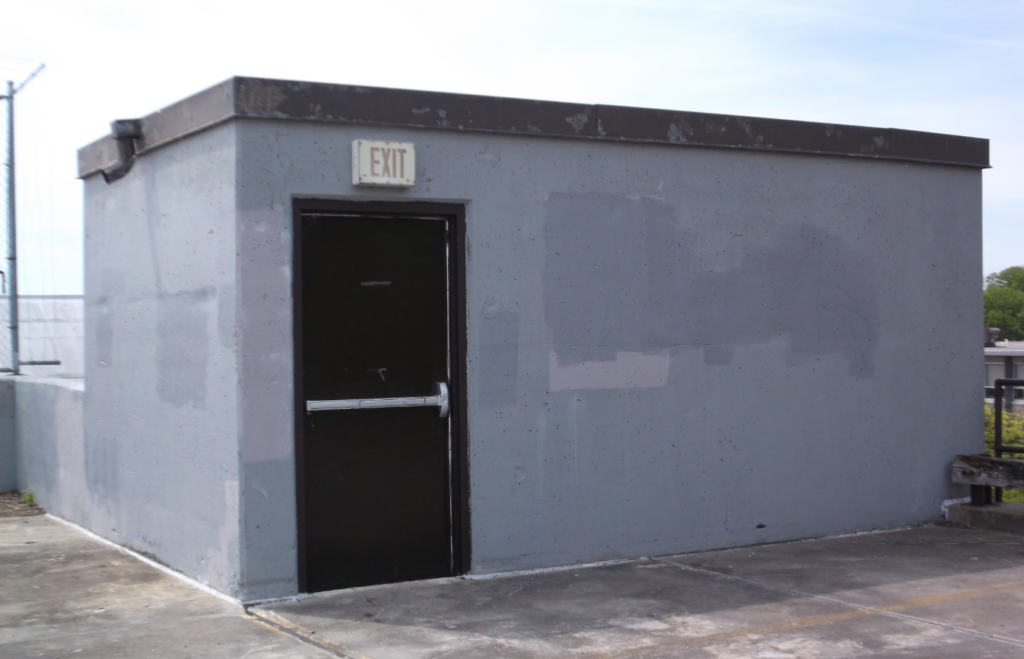
The Cornwall Square’s third level southwest parking garage stairwell where Bolton was captured.
Note on Sources: The material for this article came from an unpublished manuscript I was prepared around 2014. Continuing research will probably unveil additional break-outs.
About the Author