


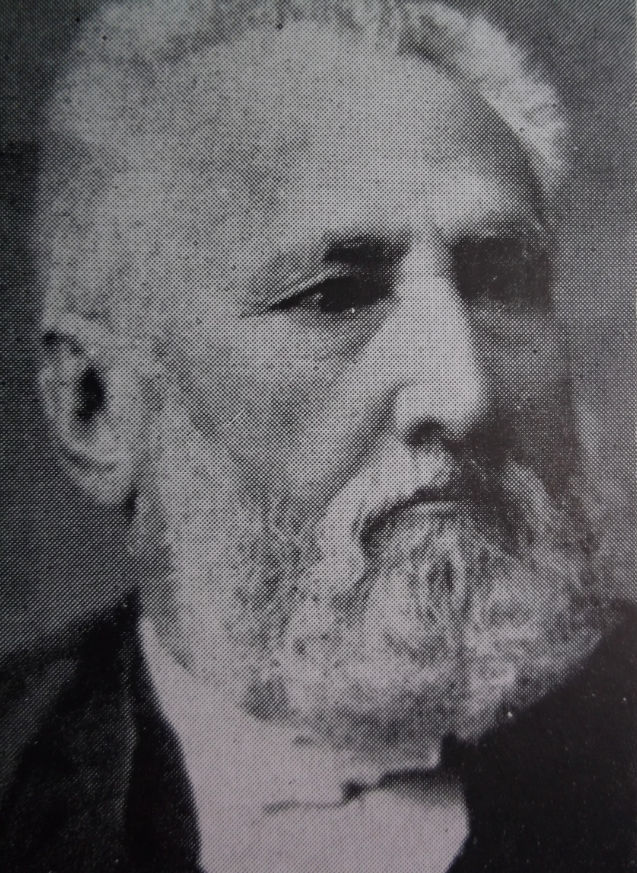
Rolland MacDonald, (1810-81) member of the provincial Legislative Assembly for Cornwall, 1844-46.Depending on the source, Rolland’s surname is either given as “Mc” or “Mac”. (Photo Courtesy, Harkness, J.G., “Stormont, Dundas and Glengarry, A History.”)
Cornwall’s electorate made political history when they elected Rolland MacDonald, believed to be Canada West’s (Ontario), first indigenous person to provincial public office, as their member of the Legislative Assembly, in 1844.
The son of North West Company fur trader John MacDonald of Garth and his Metis wife Nancy Small, Rolland was born at Fort Garry N.W.T. (Winnipeg , Manitoba, some sources say he was born at Fort William or Fort Qu’Appelle in present day Saskatchewan, I will go with Fort Garry as that is where his tombstone states he was born). After his father retired from the fur trade and moved to Cornwall, he had the money to pay for his son’s education here and in Montreal, allowing Rolland to be called to the Bar in 1832.
Rolland now began practicing law in partnership with George Greenfield Macdonell in St. Catharines. In 1835, he married Ann Boswell, the daughter of a Royal Navy Captain. Apparently doing well, a notice in the St. Catharines’ “Journal,” of July 27, 1837, informs the public that he had opened a new law office, in a building across from his house.
When the Rebellions broke out in 1837 he volunteered to fight the Rebels.
After the Rebellions, MacDonald returned to Cornwall to practice law. Having established himself here, he ran for a seat in the provincial House of Assembly in 1841, for Cornwall, but was defeated “despite the vigorous support of his father.”Not deterred, he remained in Cornwall to successfully win the seat, in 1844. Apparently more interested in the law than politics, he resigned his position before the end of his term, in 1846.
All the while he maintained his connection with St. Catharines to attain the rank of captain in the Town’s militia.
After leaving politics, MacDonald maintained his law office in Cornwall until 1850/51, according to Cornwall historian Judge, J.F.Pringle. If this is the case, MacDonald had offices in Cornwall and St. Catharines. While it is possible that MacDonald had an office in both towns, there is also a chance, given the distance between the two places, that Pringle’s notes are incorrect, as on June 14, 1847, MacDonald advertised in “The Niagara Chronicle,”that he was back in St. Catharines “at his old stand,” as “Barrister and Attorney at Law, Solicitor and Master Extraordinary in Chancery.” Now reestablished in St. Catharines, MacDonald entered into a partnership with a man named “Rykert,” became a Queen’s Counsel, Crown Attorney, Clerk of the Peace for Lincoln County and was subsequently appointed County Court Judge for Welland County , in 1873.
As fearless as his father, W.J. Rattray wrote in his book The Scots of British North America, that in 1837, MacDonald the loyal militiaman “opposed…the Rebels led by William Lyon Mackenzie) as a dragoon at Gallow’s Hill (aka Battle of Montgomery’s Inn) and became a captain of the St. Catharines cavalry, on duty near the (Niagara) frontier. As a supernumerary officer of the 93rd Highlanders, he took part in the Battle of the Windmill, at Prescott, and was subsequently Lieutenant-Colonel of the 5th Lincoln Battalion.”
MacDonald next encountered Mackenzie in court, where he reputedly lost his only case, while prosecuting Mackenzie for libel, who successfully defended himself with a six hour long harangue.
Upon his death, MacDonald was buried in St. Catharines’ Victoria Lawn Cemetery, before a large crowd with full Masonic honours.The “Hamilton Spectator,” of December 12, 1881 reported that:
“The Welland Railway ran a special train, thus enabling a large number of friends from the county of Welland to be present.The legal profession of the city (of St. Catharines) also attended in a body.”
And that is all I have, leading me to repeat the sentiments of one of Glengarry’s most eminent historians, Royce MacGillivray, who wrote:
“For a man of who must have stood out among his contemporaries in the places where he lived, the details of his life now prove remarkably difficult to recover.”
About the Author