


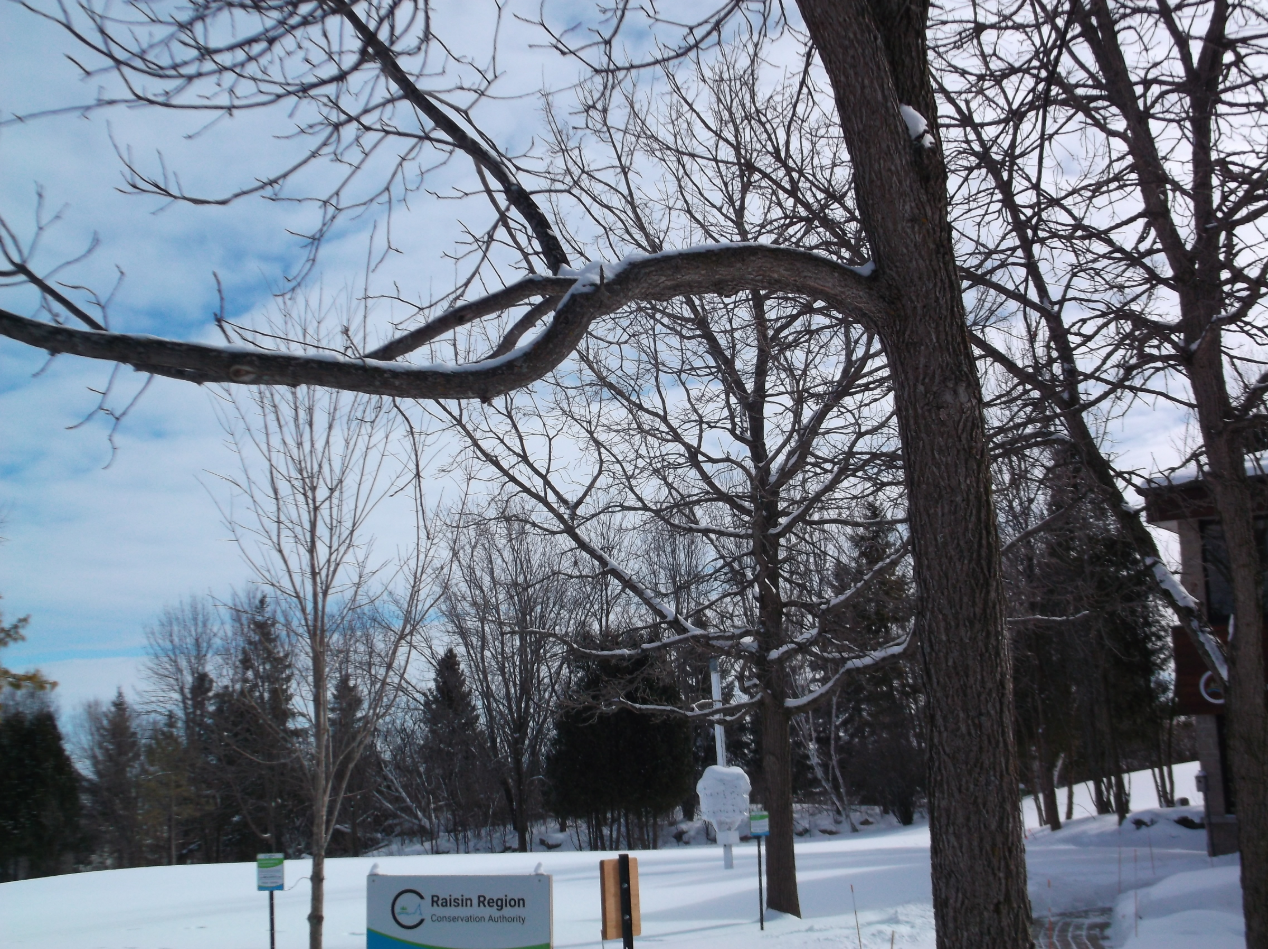
I don’t know about you, but now that spring is reputedly here, I can’t think of anything more enjoyable than a walk through one of our many conservation areas, even if there are patches of snow!
If you read historic accounts of early Upper Canada, it was one large, seemingly inexhaustible forest.
The all encompassing forest provided food, wood for boats, homes, , fences, furniture, roads and numerous other needs, as this image titled “Bush Farm near Chatham,” circa 1838 shows. (Courtesy, Library & Archives, Can., C-011811, the blemishes are from the copied image..)
Fortunately, numerous settlers wrote about their experiences and some like Scottish born and educated James Croil, published a detailed “sketch,” of what they found.
Purchasing John Crylser’s farm, on the site of the War of 1812 battle of the same name in 1845, Croil, while not a pioneer put together the first, comprehensive description of the European settlement of Dundas County in his book Dundas or A Sketch of Canadian History, published in 1861. Covering topics ranging from boulders to war, Croil stated that “Nearly all the varieties of trees which are common to Upper Canada may be found in the woods of Dundas, excepting black walnut and white wood.”
Using Croil as my guide, I am going to take you on a tour of these trees, that in most cases have been conveniently labeled and mapped out in the pamphlet “Gray’s Creek Arboretum.”
This tree can live for two centuries and provides shelter, sustenance and materials for animals and humans alike. When the wood decays in the still living tree, it creates cavities suitable for nesting birds and animals. The soft wood is ideal for carving, and was even used to make prosthetics in the early 20th century. And the fibrous bark provided Indigenous peoples material to make baskets, fish nets and mats.
The pioneers used berries from this tree to make jams and jellies. And who hasn’t taken black cherry cough syrup, made from the trees inner bark, a tonic shown to the settlers by Indigenous peoples? Growing to 22 metres, in the full sun, as it is “shade intolerant,” the wood is favoured for making furniture and musical instruments.
James Croil was correct when he stated that the tree is not native to Eastern Ontario, but over the years has been transplanted here from southwestern Ontario by humans and squirrels. Living up to 150 years, and growing to between 30 and 40 metres tall, the tree produces an edible nut, and hard durable wood ideal for furniture and gunstocks.
When Croil was able to find any Bur Oak, probably because he was in the wrong place, as it is Ontario’s most common species of oak. Growing tall or with a twisted trunk and gnarled branches in shallow soil, the durable wood is used for flooring, boats and canoes. Historically the acorns were ground into flour to bake bread.
Croil enthused that this species was “abundant,” and that isn’t a surprise as the oldest cedar in Ontario is said to be 1,300 years old. Favoured by builders for outdoor usage, many pioneer homes were covered by cedar shingles. Indigenous peoples used its fragrant bark to seep in tea to ward of diseases such as scurvy.
Croil notes that hickory is “peculiar” to North America, and that the wood was made into handspikes, and he might have added lacrosse sticks, and now baseball bats and skis. The tree is readily identifiable due to its splintering bark, while the tree’s nuts are edible in a variety of ways.
For Croil the Sugar Maple was “the most beautiful and useful of American trees.” He notes that at one time a local man collected 4,000 pounds of maple sap, only to see the yearly yield slip to 300 pounds, as the “finest trees” were rapidly “falling to the woodman’s axe,” or for highly collectable “bird’s eye and tiger” maple furniture. One of the hardest woods found in North America, it continues to be a valued for cabinets, cues, flooring, and finished wood work.
For James Croil birch was of value wood for “both for manufacturing purposes and for firewood.” Obviously not hearing about the canoe, the Indigenous peoples used the wood to fabricate baskets, canoes, cradles, toboggans and to weatherproof their buildings. The wood is can also be carved to make utensils, or used as pulpwood. The Conservation Authority asks you not be tempted to peel the bark off, as it can severely damage the tree.
A hike through Gray’s Creek will also take you past Butternut, Eastern White Pine, Green Ash, Staghorn Sumac, and White Spruce.
About the Author