

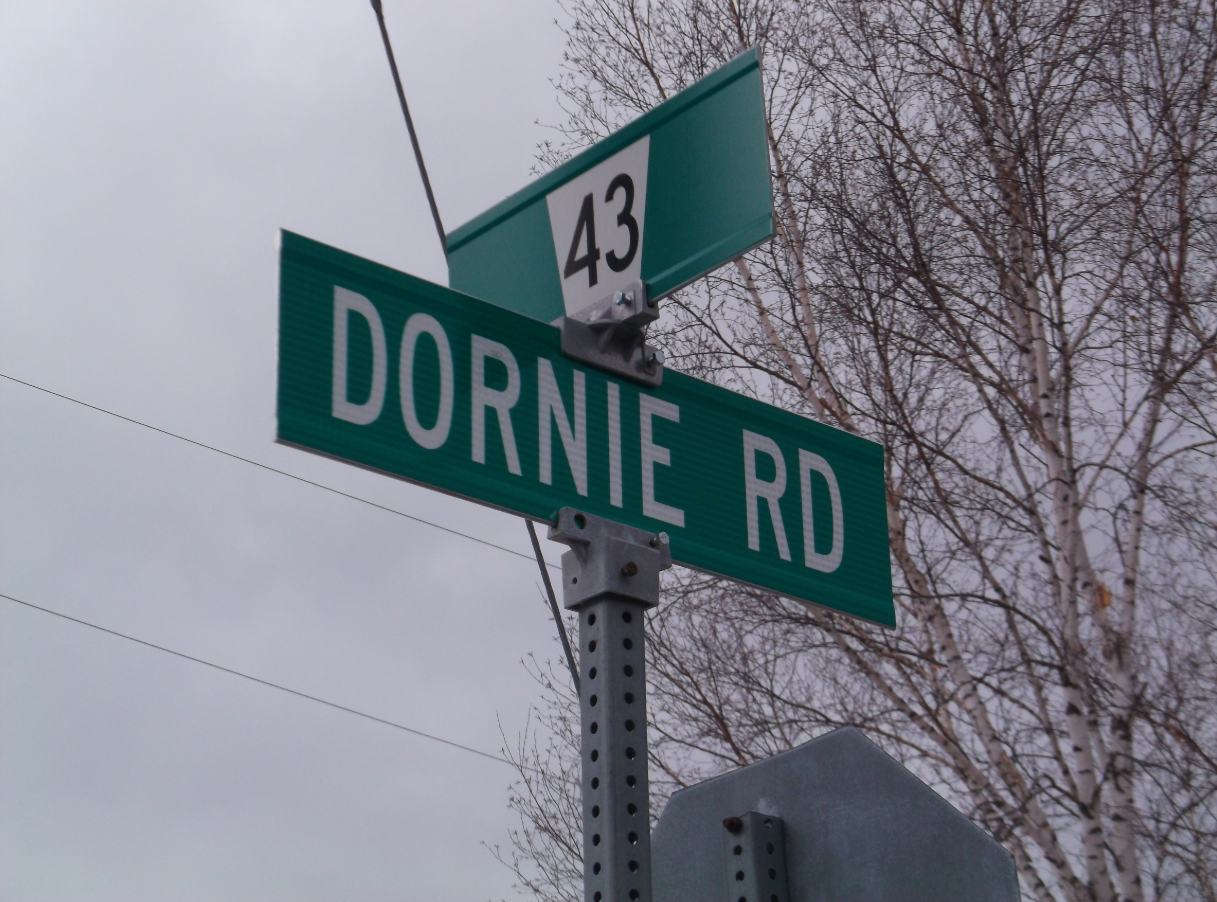
ornie’s road sign. You can find Dornie by turning north at Dornie Road off of County Road 43, or by going north from Alexandria on 34, and turning west, on Concession Road 4, and then crossing the railway tracks to the CPR overpass, and the historic plaque.
Fire not water destroyed the last remnants of the once thriving hamlet of Dornie, in the spring of 1954.
Most of us are familiar with the story of the disappearance of the Lost Villages of the St. Lawrence, but very few people take into account, how much the arrival of motorized vehicles, during the 20th century, led to rural depopulation throughout SDG, or in Dornie’s case – fire.
According to the historic plaque near the site of the former village, Dornie was once “A bustling community.” The Glengarry News, added that it was a “centre of production with a saw and shingle mill, railway blacksmith shop, cheese factory, school, and general store, housing a post office and boarding rooms.”
The settlement’s death was proclaimed in an April 22, 1954 headline, in the The Glengarry News, which read: “Dornie Is No More…Last Building Razed By Fire.”
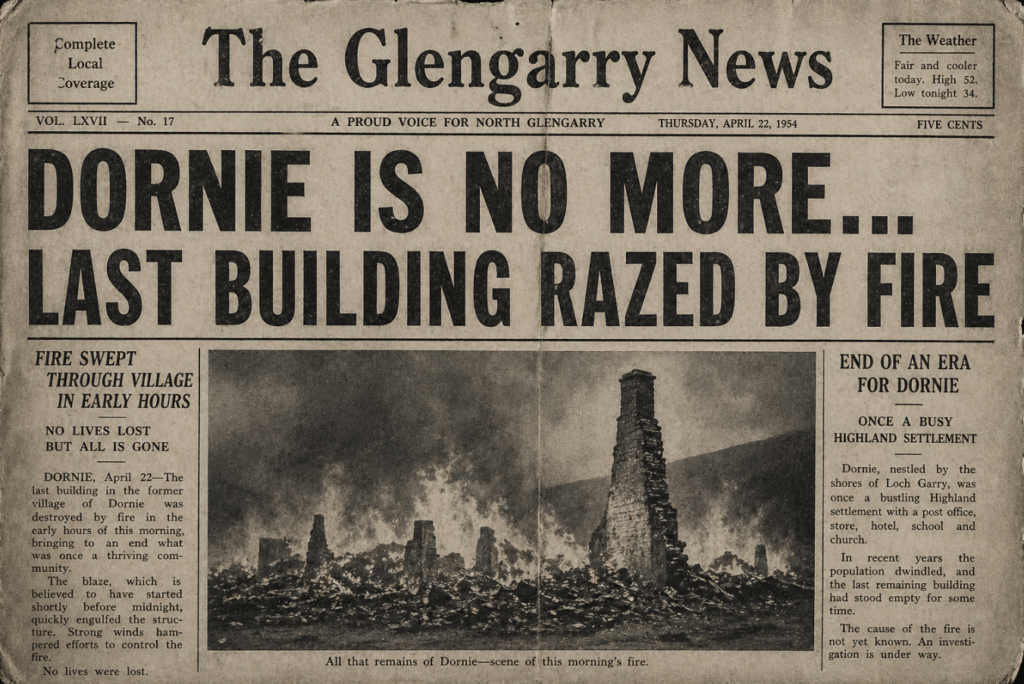
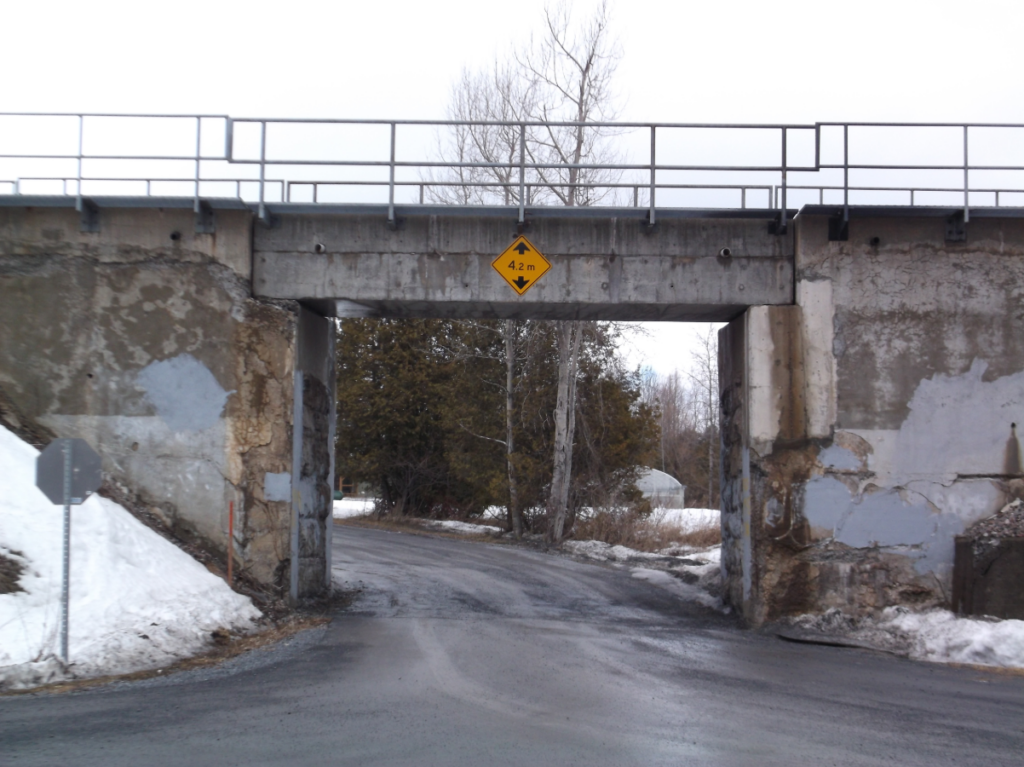
The story continued: “The last trace of…Dornie, went up in smoke, Sunday evening, when the old store (and home owned by Elzear Lagasse) was destroyed by fire. Now as one resident puts in, ‘only the street remains ,” and of course the CPR’s underpass, 5 kms west of Alexandria.
The Canada Atlantic Railway (CPR) brought Dornie to life, when it opened a “flag station” for passengers and a siding here, to load timber, and cheese, after it passed through in 1882.
Fortunately for history buffs, Gene Sandfield Macdonald, editor of “The Glengarry News,” and author of “The Rambling Reporter,” recorded the following comments from a few of the hamlet’s senior citizens.
They reminisced: “J.T. Schell opened a lumber mill on the east of the road north of the railway leading the place to be dubbed “Schell’s Mill.”
“A rail siding was constructed to the mill which shipped lumber and roof shingle. Twenty to 25 men were employed earning $1.12 per day.”
“A large boarding house (operated by Duncan John ‘McCramish’ McDonald) was located on the top of the hill…”
“A small hall…was located on the road between the bridge space over the Delisle River and the 4th Concession Road.”
“On Friday nights the hall was the scene of wide ranging debates. ‘Some of the more eloquent speakers were Angus (Mary Paul) Cameron, Blind Angus Cameron, and Father MacDougall’s’ brother of the 4th Concession.”
“A man named McLeod built and operated a cheese factory (but) the farmers became disillusioned (with) the returns they were paid for their milk, and joined together to buy McLeod out, and then hired their own cheese-maker.” A victim of industrialization, the factory closed in 1949.
“O’Hearn operated the ‘mill for three or four years’ and then sold it to Duncan Curly (postmaster) Macdonald, who moved the mill to the (train) station in Alexandria, likely with the help of municipal incentives.”
ORIGINS OF THE NAME
Glengarry Archivist Allan MacDonald has written that there are two theories behind the hamlet’s name. The first claims that an old-timer, told boarding house proprietor Duncan John McDonald (also MacDonald,) chose the name Dornie,, when applying for a post office from a place he found in a book about Scotland. Allan MacDonald, however, believes that is more likely that it was named between 1882 and 1898 “…when J.T. Schell sold his mill to O’Hearn, (Ahern) who wanted a post office and to make it official christened it Dornie.”
As for the original Dornie, it is in a fishing village in the Kintail district, in the western Ross-shire Scottish Highlands, near restored 13th century Eilean Doran Castle, on the road to Skye.
DORNIE TODAY
To try to uncover more about Dornie, I visited the site last summer and only found t an historic plaque and the railway overpass. Sure that there must be some evidence from the past, I walked through the underpass to try to find any remnants of the hamlet or railway siding. On my way back a pair of farmers asked me if I needed a tow, as it wasn’t uncommon for people to get stuck in Dornie Road. I thanked them , but said I was looking for signs of the former settlement that was finally destroyed by fire in 1954. From the confused look on their faces, I could see that they had never heard of the place. They both told me that they had grown-up here and knew the area like the back of their hands, and said that they had never seen or heard of the hamlet, sadly proving the reporter correct; Dornie is not only no more, but forgotten.
About the Author