


The term “global village” (first used by the Canadian philosopher Marshall McLuhan) means that all parts of the world are being brought together by the power of the internet and technological communications; the increased speed of exchanges has cultivated worldwide density, making social networks a catalyst for social change.
Tim Okamura is an artist whose work embodies notions of positive social change. His striking portraits emphasize the profound strength and resilience of women. In his ongoing Women Warriors series, individuals don highly realistic, traditional garments and wield swords, fans, or
scythes.
Okamura states that he didn’t intend for his art to be conceptual, it has challenged people’s ideas of who can represent who through art. He says “people can quickly sense if artwork is from a place of authenticity or not—my messages are positive and so are my representations and this is a celebration of my community.”
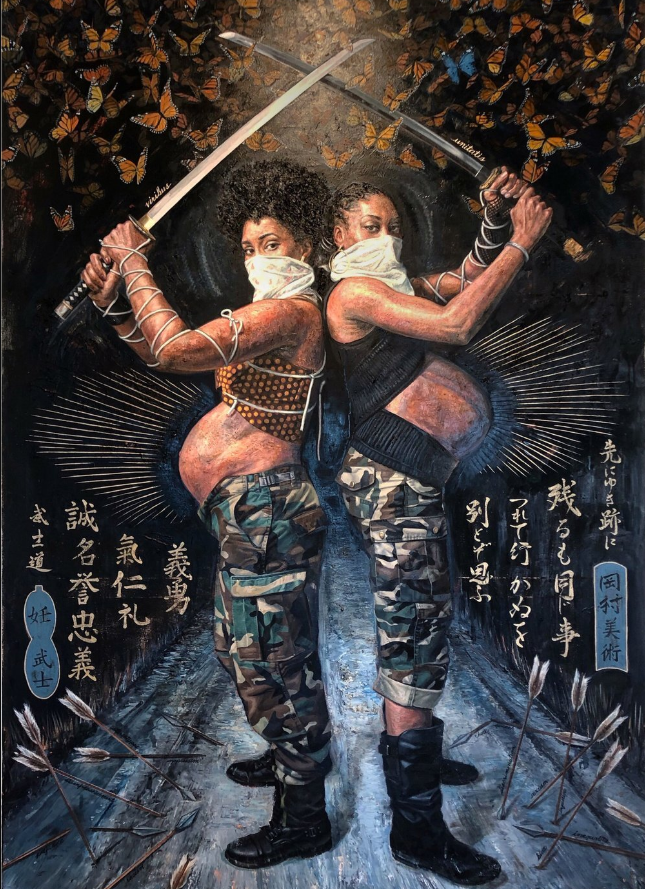
(Photo 1) Expectant Guard, 2019, oil on canvas, courtesy of the artist
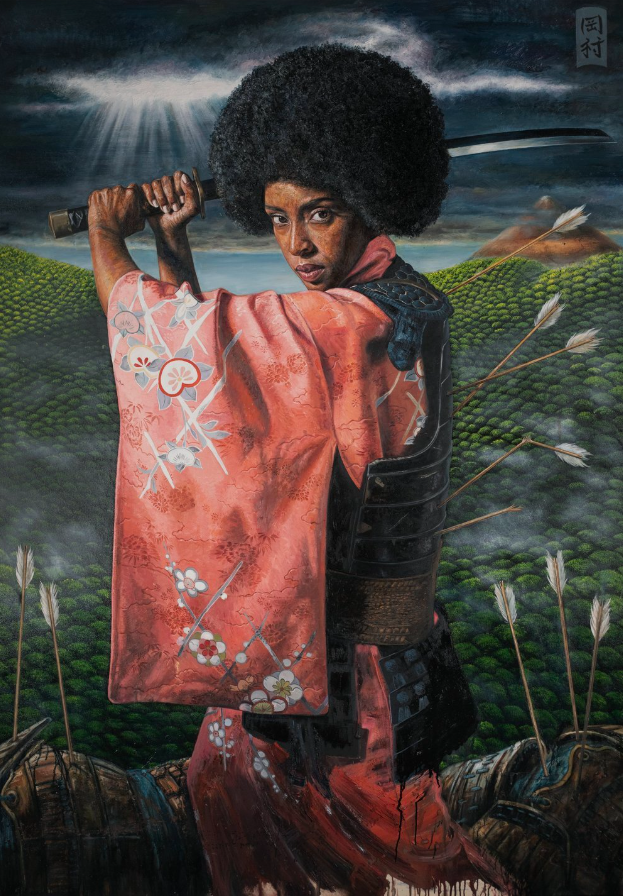
(Photo 2) Ebony Obsidian the Unbreakable, 2023, oil and acrylic on canvas, courtesy of the artist
You see Okamura is not black, he’s someone who has been influenced by and engages with black culture while representing aspects of his own cultural identity. As a Japanese-Canadian guy from Edmonton, he was surrounded by a diverse group of friends growing up; Okamura dealt with racism early on.
Today his life is grounded in the diversity of the urban experience in Brooklyn, NY, as well as the global access achieved through travel, and online research. Looking at the powerful and provocative women of colour whose eyes meet yours, one cannot help but call up that global village.
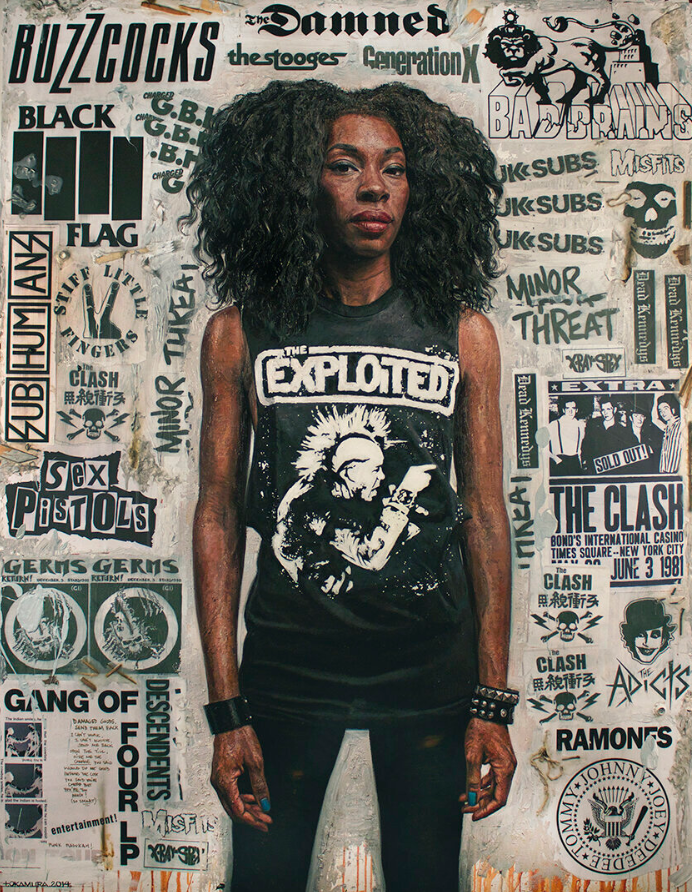
Punk Rawkah, 2014, oil on canvas, courtesy of the artist
Seeing a black female punk rocker and metalhead depicted one must understand that both forms of music have origins in early blues and slave music. These women like Okamura engage in an artform that doesn’t necessarily identify with their racial background on the surface.
The Women Warriors series features female samurais reminding us of the ongoing struggles and triumphs of real and fictional women. Consider Queen Nzinga Mbande (c.1583–1663) a 17th-century monarch of the Ndongo and Matamba Kingdoms in present-day northern Angola. A skilled diplomat and warrior, she fiercely resisted Portuguese colonial expansion and the Atlantic slave trade for nearly four decades.
It is these visual and conceptual juxtapositions that Okamura’s art zeroes in on. The women are more than skillfully portrayed; like time travelers they move from past to present seamlessly. In the painting the Expectant Guard the warriors stand boldly guarding the future; persevering and passing on that sense of empowerment, pride and sisterhood.
In 2006, Okamura was short-listed by the Royal Surveyor of the Queen’s Picture Collection for a commissioned portrait of the Queen of England.
Okamura’s art is on display in many public permanent collections. Celebrity collectors include Uma Thurman, musicians John Mellencamp, director Spike Lee, as well as actors Bryan Greenberg, Uma Thurman, Vanessa Marcil, Annabella Sciorra, and Ethan Hawke.
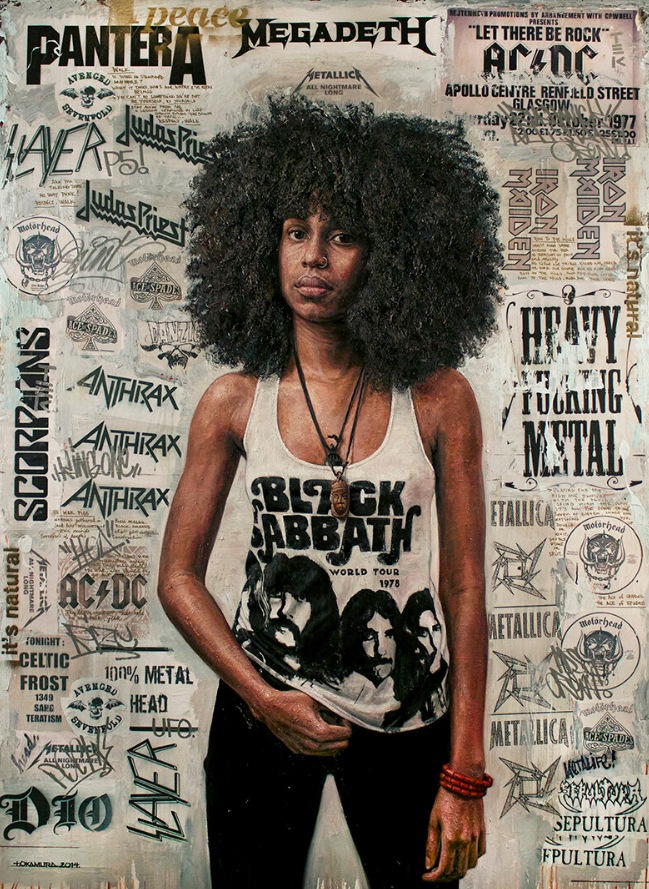
Metal Head, 2014, oil and collage on canvas, courtesy of the artist
Tim Okamura’s art reminds us that allies are vital in the fight for human rights. Black history is not just about black people but everyone who participates and engages in the cultural life that black people are part of.
About the Author