
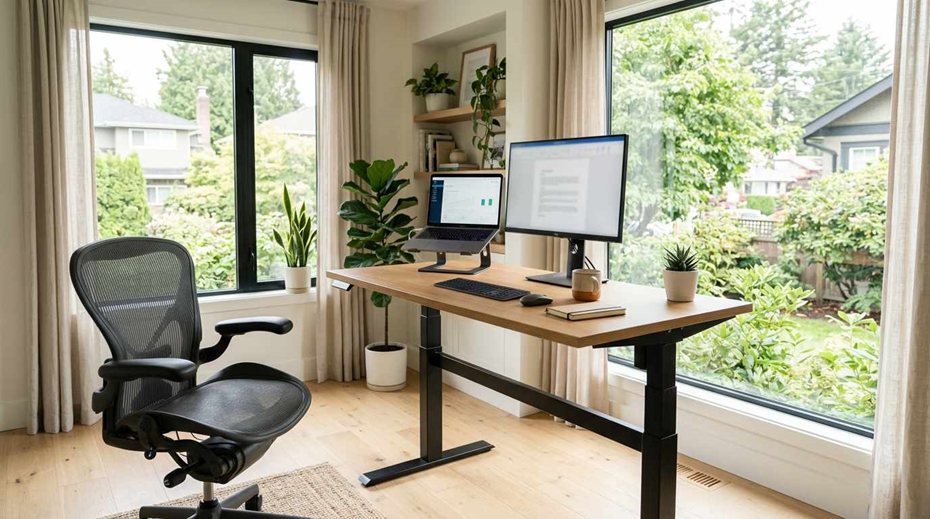
Standing desks have gone from a Silicon Valley curiosity to one of the most-searched home-office upgrades in Canada. With remote and hybrid work now a permanent fixture, more Canadians are asking the same practical questions: what does a good standing desk actually cost here, what features are worth paying for, and which brands are the real deal (including which ones are actually Canadian)?
This guide walks through all of it, from the specs that matter to a shortlist of the standing desks worth your money in 2026, including the Canadian-designed effydesk standing desks and how they stack up against the rest.
What to Look for in a Standing Desk
Before you compare brands, it helps to know what separates a desk you’ll love from one you’ll return. A handful of features do most of the work.
Motor type
Electric standing desks come with one, two, or three motors. Single-motor desks are cheaper but slower and less stable. Dual-motor desks are the sweet spot for most people: faster, quieter, and steadier, with the strength to lift a loaded desktop. Triple-motor desks are built for L-shaped or extra-wide tops and heavier gear.
Frame stability
The most common complaint about cheap desks is wobble at full standing height. Look for a three-stage lifting column (three nested segments per leg). More segments mean a wider height range and a steadier desk when it’s up high.
Height range
A good desk should suit users from roughly five feet to six-foot-four. Check both the minimum and maximum height, especially if you’re shorter or taller than average, or if you plan to share the desk. A range of about 25 to 50 inches covers most households.
Desktop material and size
Tops range from laminate and bamboo to solid hardwood and recycled materials. Laminate is affordable and durable; solid wood costs more but lasts and looks the part. Match the size to your room and monitor setup.
Weight capacity
Most quality desks handle 250 to 400 pounds. That sounds like a lot until you add two monitors, a monitor arm, a PC, and everything else. Higher is safer.
Warranty and trial
A long warranty signals the maker trusts its own hardware, and a genuine trial period lets you live with the desk before committing. Both matter more when you’re buying online.
How Much Does a Standing Desk Cost in Canada?
Prices in Canada generally fall into three tiers.
Budget (around $300 to $600 CAD). Entry frames and basic desks, usually single or lower-end dual motor. Fine for light use, but expect more wobble and shorter warranties.
Mid-range (around $600 to $1,000 CAD). This is where most buyers land. You get a solid dual-motor lift, memory presets, better desktops, and a warranty worth having.
Premium (around $1,000 to $1,800+ CAD). Triple-motor frames, solid-wood tops, L-shaped and corner designs, and the sturdiest builds.
One Canada-specific tip: buying from a Canadian brand usually means free domestic shipping and no surprise cross-border duties or customs delays, which can add a painful chunk to the price of a desk shipped from the US.
The Best Standing Desks in Canada
Here are four brands worth shortlisting, with an honest look at where each fits. Three of the four are Canadian.
effydesk: the best all-rounder (Canadian)
Designed in Vancouver, effydesk builds the most well-rounded range for Canadians who want quality, real support, and a desk they can test at home first. The line splits into four desks, so you can match one to your needs:
· Nimble (from $715 CAD): the entry model, a dual-motor desk with a 25 to 50 inch height range and a memory keypad that stores four preset heights. The everyday workhorse, in three tabletop sizes (47, 59, and 71 inches).
· Wildwood (from $925 CAD): the same lift under a solid hardwood top, offered in acacia, walnut, or pheasantwood.
· Terra (from $1,294 CAD): a carbon-negative desktop pressed from recycled chopsticks through Vancouver’s ChopValue, for the sustainability-minded.
· Grove (from $1,425 CAD): the L-shaped corner desk, with a triple-motor lift and a 410 lb weight capacity for multi-monitor and heavier loadouts.
Across the range you get a control box with a gyroscope sensor and anti-collision that stops the desk if it meets an obstruction, a cable-management tray, free shipping across Canada, a 100-day risk-free trial, and a warranty up to 20 years on the frame and motors (10 years on the Terra).
There’s also a frame-only Shift option from $645 if you want to keep your own top. Compare the four models side by side to find the one that fits your space and budget.
· Build quality: 5/5
· Value: 4/5
· Warranty and trial: 5/5
· Canadian-owned: Yes (Vancouver)
MotionGrey: budget-friendly (Canadian)
Founded by two engineers out of UBC and based in Richmond, B.C., MotionGrey focuses on affordable dual-motor desks. A good option if price is your first priority and you still want a Canadian company behind the sale.
· Value: 5/5 · Canadian-owned: Yes (B.C.)
Progressive Desk: customizable (Canadian)
A Canadian maker that designs and manufactures its own desks, with a good range of frames and solid-wood tops for buyers who like to configure their setup. Backed by a long warranty.
· Customization: 4/5 · Canadian-owned: Yes
FlexiSpot: widest range (global)
One of the biggest names in the category, FlexiSpot offers a huge catalogue at competitive prices and stocks a Canadian warehouse. Worth noting for the “which are Canadian” question: FlexiSpot is a global brand spun out of Loctek, a Chinese manufacturer with US headquarters in California, so it’s not a Canadian company even though it ships domestically.
· Range: 5/5 · Canadian-owned: No
Are Standing Desks Worth It?
For most desk workers, yes, though not for the reason people expect. A standing desk won’t melt away health problems on its own. Its real value is that it lets you break up long stretches of sitting, which is the part that wears on your back and your focus.
The healthiest posture is simply your next one, and being able to swap between sitting and standing at the tap of a button makes changing it effortless. If you spend six or more hours a day at a desk, the ability to move is worth the money.
How to Choose the Right One for You
With the shortlist in hand, match the desk to your situation.
By budget. Slot yourself into one of the three price tiers above and buy the sturdiest desk you can at that level. Stability and warranty are where cheap desks cut corners.
By space. Small room or a corner? A compact rectangular top or an L-shaped corner desk uses the footprint better. Measure before you buy.
By use. Running two or three monitors, a desktop PC, and studio gear? Prioritise a higher weight capacity and, ideally, a triple-motor frame for a smoother lift.
By priority. If easy warranty service and local support matter to you, a Canadian brand keeps things simple. If rock-bottom price is everything, a global brand’s sales can win, with the tradeoff of less local recourse if something goes wrong.
Frequently Asked Questions
What is the 20-8-2 rule for standing desks?
It’s a simple guideline for splitting up your time: for every half hour, sit for about 20 minutes, stand for 8, and move or stretch for 2. The point isn’t the exact numbers, it’s to keep changing position through the day rather than locking into one posture, sitting or standing.
What is the highest-rated standing desk?
There’s no single winner, because the best desk depends on your budget, space, and how you work. Editorial roundups tend to favour sturdy dual-motor desks with long warranties, and in Canada the top-rated options usually come from established brands like effydesk, MotionGrey, and FlexiSpot.
Is FlexiSpot a Canadian company?
No. FlexiSpot is a global brand that grew out of Loctek, a Chinese manufacturer with US headquarters in California. It stocks a Canadian warehouse for faster shipping, but it isn’t Canadian-owned. If buying Canadian matters to you, effydesk, MotionGrey, and Progressive Desk are homegrown options.
Is the Costco standing desk good?
Costco’s rotating standing-desk deals can be fine for light, occasional use, and the return policy is generous. The tradeoffs are usually a less refined lift, a shorter warranty, and limited size or colour choices compared with a dedicated standing-desk brand.
How much should I spend on a standing desk?
For a desk you’ll use daily for years, the mid-range (around $600 to $1,000 CAD) gives you the most for your money: a proper dual-motor lift, memory presets, and a warranty worth having. Spend up for solid wood or a corner design; spend down only if the desk will see light use.
The Takeaway
A good standing desk comes down to three things: a stable dual-motor frame, a size that fits your space, and a warranty that backs it up. Set your budget, measure your room, and think about how much gear the desk has to hold. And if buying Canadian is on your list, you’re spoiled for choice, with several homegrown brands building desks as good as anything shipped in from abroad.
About the Author