


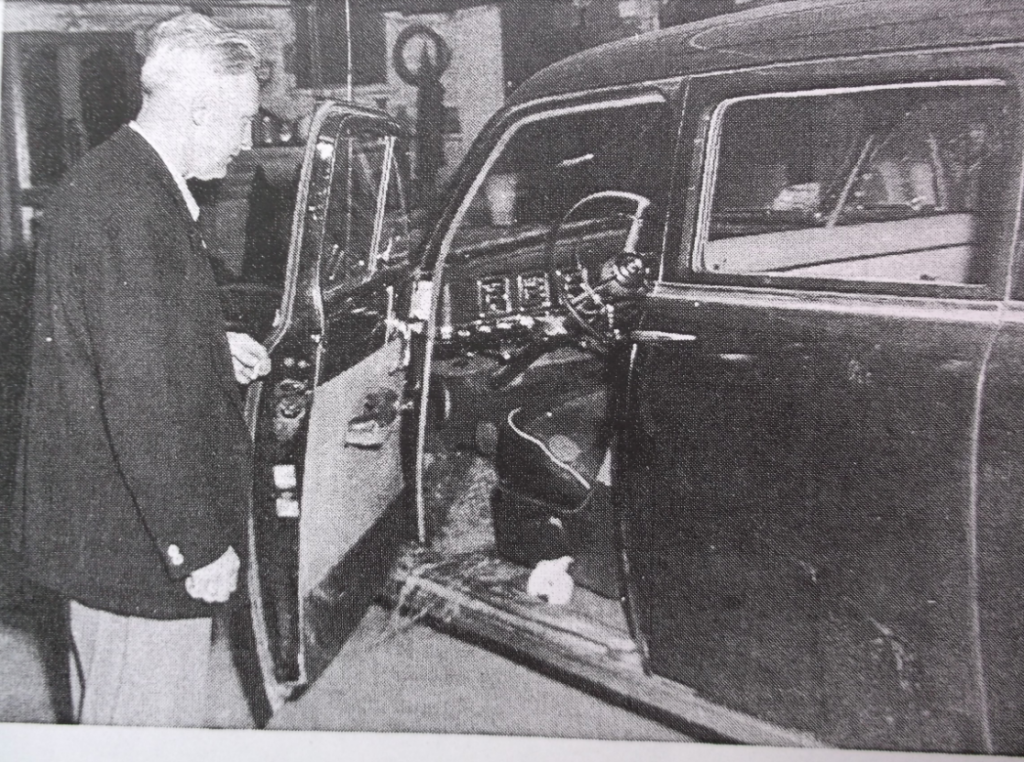
When Maxville’ ESSO garage owner Leonard Hurd’s bullet-riddled body was found in one of his taxis, a mile south of the village, by the OPP on August 16th 1952, the entire County was shocked.
Fortunately, the suspect left a small black bag in the rear of the seat of the car the body was found in, containing Henri Seguin’s military discharge papers and other personal effects. This discovery led Inspector R.H. Wannell, from the OPP’s criminal investigation branch, to ignite what turned out to be a four month Canada wide manhunt for Seguin, a search that did not end until Seguin was caught in a police shootout while attempting to rob a bank in British Columbia.
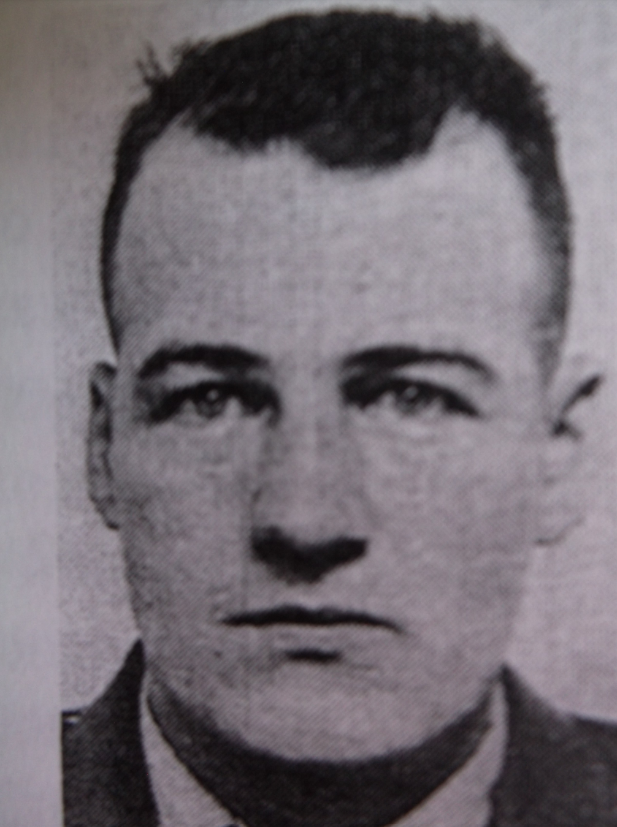
Now in custody, at trial Seguin was tried for wounding the bank manager and robbery. Found guilty, he was sentenced to 20 years, and then transferred to Kingston Penitentiary while awaiting trial for Hurd’s murder.
During the trial the judge and jury learned that Seguin went to Hurd’s garage on the pretext of looking for gas for his car stranded down the road from the gas station, believing that Hurd kept large amounts of money. Hearing Seguin’s plea for help, Hurd drove Seguin back to his car. Seguin now robbed and shot Hurd dead, and then fled, abandoning the car and initiating the cross-country chase.
The jury found Seguin guilty of murder and on October 17, 1953; he was sentenced to hang on January 19, 1954, at the Cornwall jail.
Cornwall Jail Governor (warden’s are generally American,) J. Sutherland Dickey responsible for keeping Hurd alive for judicial execution said, “Three guards watched over him in eight-hour shifts…they were under my instructions to watch him at all times. They sat about four feet from the grill in front of the cell…which was seven feet four inches by four feet seven inches, and lighted by two bulbs in the corridor. The cell was shaded in the corners where a night pail was placed in lieu of toilet facilities. While here, Seguin was never allowed out of the cell except to wash or use the toilet instead of the pail.”
Seguin opted for using the pail, whenever he could, providing the clue for his successful suicide to “cheat the hangman.”
Even though Seguin had 17 visits, mainly from family members , in the presence of guards, the Inquiry into his suicide concluded that the poison was not given to him during one of these visits. Instead the Inquiry ruled that Seguin had hidden a half inch by 2 ½ inch aluminum cyanide capsule in his body, while in custody in B.C., explaining why he used the cell pail rather than the toilet when needed.
Acknowledging his life of crime, Seguin claimed that he was innocent of murder. Before he committed suicide, he wrote a 37 pages letter in jail to his sister, which was read at the Inquiry and said: “Justice has condemned me as a dog, they will try to hang me like one, but I will try my best not to. I will cheat them to the very last end, if I do succeed to cheat them in the END I will be to clade (too glad) to do so. If I don’t cheat them it will not be because I did not try so.”
Up until execution day, Seguin refused spiritual comfort, this changed an hour before it was about to take place. The Reverend Rudy Villeneuve was now called upon to visit Seguin and found the former “tough guy,” crying and sobbing violently.” Seguin then convulsed and the doctor was called. Seguin died some ten minutes later.
Father Villeneuve now gave the unconscious Seguin conditional absolution, explaining that when a person is unconscious and near death this is the procedure.
Father Villeneuve continued “He had sorrow for his sins, but he did not have time to tell me them before he took the convulsion.”
As for Seguin’s family – his sister Mrs. Lucille Regnier told reporters that the family had prayed for three days that Henri would be able to commit suicide rather than suffer “the ignominy of death on the gallows.”
“My brother said he was innocent of this crime all along and we are so relieved things turned out the way they did.”
As for Hurd’s widow – the former Edna Frances Blaney, she sold the business to George Greer in 1954 and moved to Sudbury, and died in 1983.
About the Author