


You’ve been told to sit up straight your whole life. You’ve tried. You start the morning with good intentions, shoulders back, spine upright — and by 10 a.m., you’re slumped over your keyboard again. By midday, your lower back aches. By the time you shut your laptop, your neck is stiff and your hips are tight.
Here’s the thing: that’s not a willpower problem. It’s a design problem.
The chair you’re sitting in was built for passive sitting. It gives your body nothing to do — so your body does nothing. Muscles disengage, your pelvis tips back, your lumbar curve flattens, and gravity takes over. Blaming yourself for bad posture while sitting in a chair that rewards slumping is like blaming yourself for speeding in a car with no speedometer. The environment is working against you.
An active sitting chair changes the equation entirely. Instead of propping you up, it requires your body to stay engaged — and in doing so, it makes good posture the default, not the goal.
Why Traditional Chairs Are Designed to Make You Slouch
Most office chairs are engineered around a single premise: support the body so it can rest. Padded backrests, lumbar cushions, headrests, armrests — every feature is designed to take load off your muscles and transfer it to the chair.
That sounds reasonable. In practice, it backfires.
When your muscles no longer need to stabilize your spine, they stop trying. The deep postural muscles — the erector spinae, the multifidus, the pelvic floor — are recruited only when they’re needed. Park yourself in a chair that handles all the stabilization, and those muscles progressively weaken. Weakened stabilizer muscles mean your spine has less active support, which means more pain, not less.
This is why most people with expensive ergonomic chairs still end up with back pain. The chair isn’t failing — it’s doing exactly what it was designed to do. The design itself is the problem.
What an Active Sitting Chair Actually Does Differently
An active sitting chair inverts this logic. Rather than replacing your body’s stabilizing work, it creates conditions where that work has to happen.
The key is movement. An active sitting chair sits on a dynamic pivot base that allows the seat to tilt, rock, and shift in response to your body. There is no rigid backrest to lean into. There are no armrests to offload tension. Your spine, core, and hips are constantly making small adjustments to keep you balanced — micro-movements that most people never notice but that engage the exact muscles traditional chairs put to sleep.
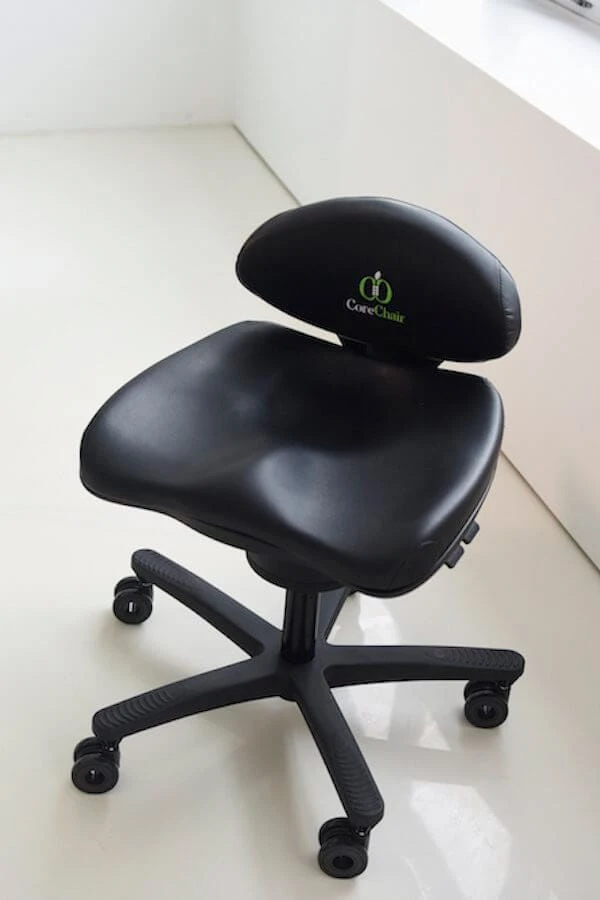
CoreChair is built around this principle. Its backless design is intentional: without a backrest, your postural muscles must do their job. The pivot base allows continuous, controlled movement in all directions. Your pelvis naturally finds its anterior tilt, your lumbar curve reestablishes itself, and your spine stacks the way it was built to stack — not because you’re trying, but because the chair requires it.
That’s the difference. A traditional chair asks you to maintain posture through conscious effort. An active sitting chair makes posture structurally inevitable.
The Muscles You’ve Been Sitting On
The pelvic floor and deep core muscles aren’t something most people think about at their desk. They should be.
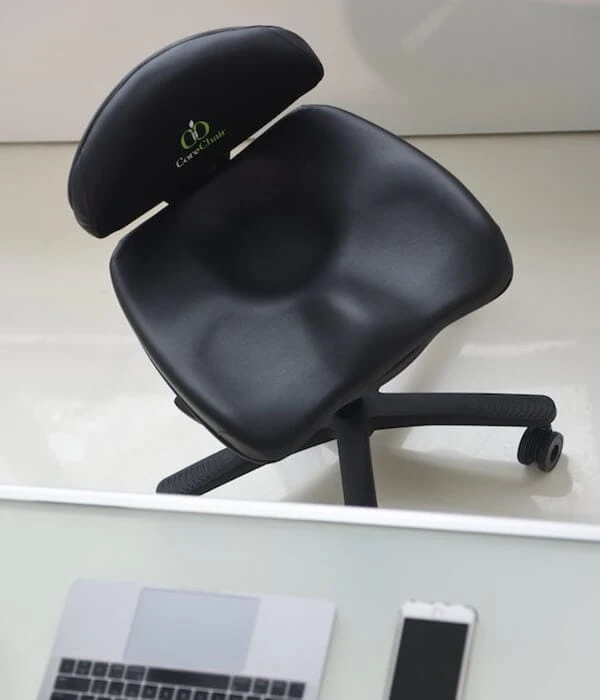
These muscles form the foundation of your spine’s stability. In a healthy, active body, they fire continuously to keep the lumbar spine in its natural curve. But hours in a passive, reclined chair compress the pelvis into a posterior tilt — your tailbone tucks under, your lumbar curve flattens, and the deep stabilizers go offline.
Over time, this creates a cycle: the muscles weaken because they’re not used, the spine loses support, pain increases, and people lean further into the backrest for relief — which deepens the problem.
Switching to an active sitting chair interrupts this cycle. The continuous micro-movement required by dynamic seating keeps the pelvic floor and core muscles recruited throughout the day. Not at gym intensity — at maintenance intensity. Enough to stay functional. Enough to keep the spine supported from within.
More Than Posture — What Else Changes
The benefits of an active sitting chair extend well beyond the spine.
Circulation improves. Static sitting compresses the backs of the thighs and restricts blood flow to the legs. The movement inherent in active sitting keeps circulation moving, reducing leg fatigue, swelling, and the long-term risk of vascular issues.
Focus sharpens. Increased blood flow means more oxygen reaching the brain. Many users of an active sitting chair report improved concentration and mental clarity — a direct result of better circulation and reduced physical discomfort.
Calories burn. Engaging stabilizer muscles all day adds up. Research suggests active sitting can burn meaningfully more calories than passive sitting — not a replacement for exercise, but a non-trivial addition to your daily energy output.
Pain reduces. By restoring natural spinal alignment and engaging the muscles that support it, an active sitting chair addresses the root cause of most desk-related back and neck pain rather than masking it with padding.
Making the Switch — What to Expect
Transitioning to an active sitting chair is not like swapping one office chair for another. Because your postural muscles have likely been underused for years, the first week or two may feel unfamiliar. Some people notice mild muscle fatigue in the lower back or core — that’s those muscles waking up.
The practical approach: start with 20-30 minute sessions and build from there. Alternate with standing or short walks as needed. Most people find they’ve adapted fully within two to three weeks and can’t imagine going back.
Choose an active sitting chair with an adjustable seat height and tension control on the pivot — this lets you dial in the range of movement to match your current fitness level and increase it gradually.
The Chair Should Work for You, Not the Other Way Around
Good posture was never supposed to be a discipline. It’s what your body does naturally when it’s supported and active. The reason it feels like discipline is that modern seating has created an environment where your postural system has nothing to engage with — so it doesn’t.
An active sitting chair restores the conditions your body actually needs. It doesn’t demand effort from you. It simply refuses to let your muscles clock out. And when those muscles stay online, your spine stays aligned, your circulation keeps moving, and the back pain you’ve been managing for years starts to loosen its grip.
You don’t have bad posture. You’ve just never sat in a chair designed to use it.
About the Author

![6abe94394c84c[1]](https://theseeker.ca/wp-content/uploads/2026/10/6abe94394c84c1-150x150.webp)


![6abe94394c84c[1]](https://theseeker.ca/wp-content/uploads/2026/10/6abe94394c84c1-768x434.webp)