

There is no route out of the maze. The maze shifts as you move through it, because it is alive. – Phillip K. Dick
Centuries ago the quintessential Renaissance man Leonardo da Vinci said “an average human looks without seeing, listens without hearing, touches without feeling, eats without tasting, moves without physical awareness, inhales without awareness of odour or fragrance, and talks without thinking.”
This is so very true when one considers our relationship to technology. It has brought about a sea of change in our lives to the point that it has taken over those very modalities of smell, touch, taste, sight, and sound. It is almost as if we have become automatons.
In stripping away the very core of technology, contemporary Italian artist Leonardo Ulian creates unique maze-like exoskeleton structures of wires, microchips, bits, and bytes; he reconstructs a new way of seeing technology that is spiritual, aesthetic, infinite, elaborate and ordered.
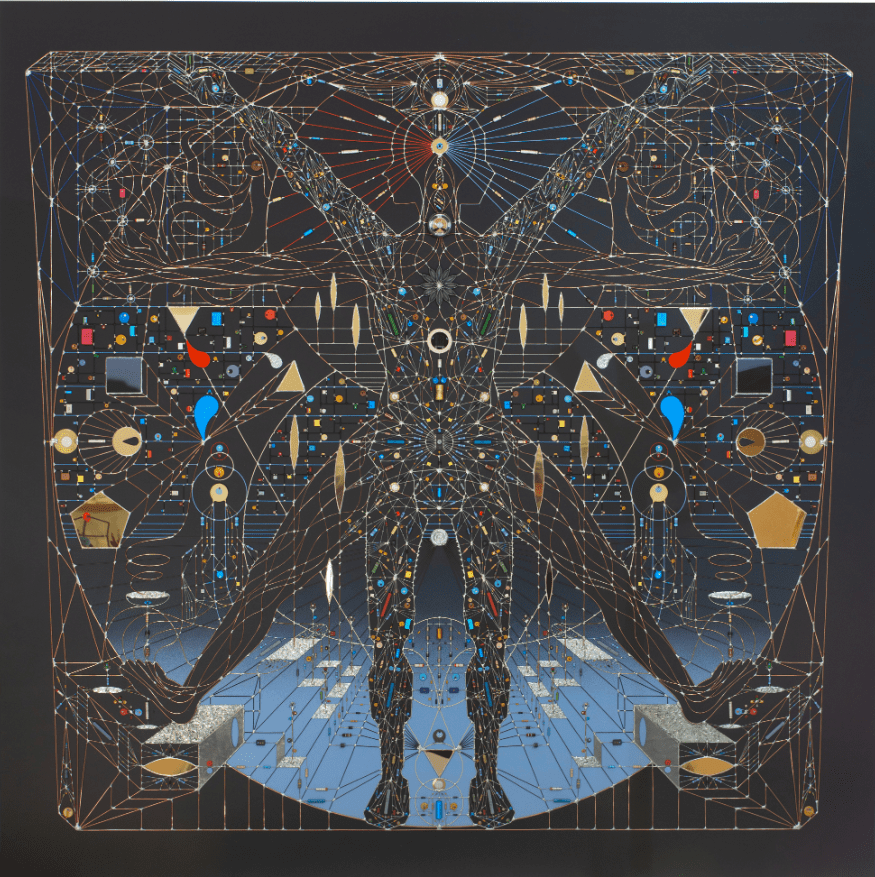
Leonardo Ulian, Technological Mandala 181 – Vitruvian Humanoid, 2024, mixed media, 180 cm x180 cm x 4,4cm, All images © Leonardo Ulian, shared with permission
This is so very true when one considers our relationship to technology. It has brought about a sea of change in our lives to the point that it has taken over those very modalities of smell, touch, taste, sight, and sound. It is almost as if we have become automatons.
In stripping away the very core of technology, contemporary Italian artist Leonardo Ulian creates unique maze-like exoskeleton structures of wires, microchips, bits, and bytes; he reconstructs a new way of seeing technology that is spiritual, aesthetic, infinite, elaborate and ordered.
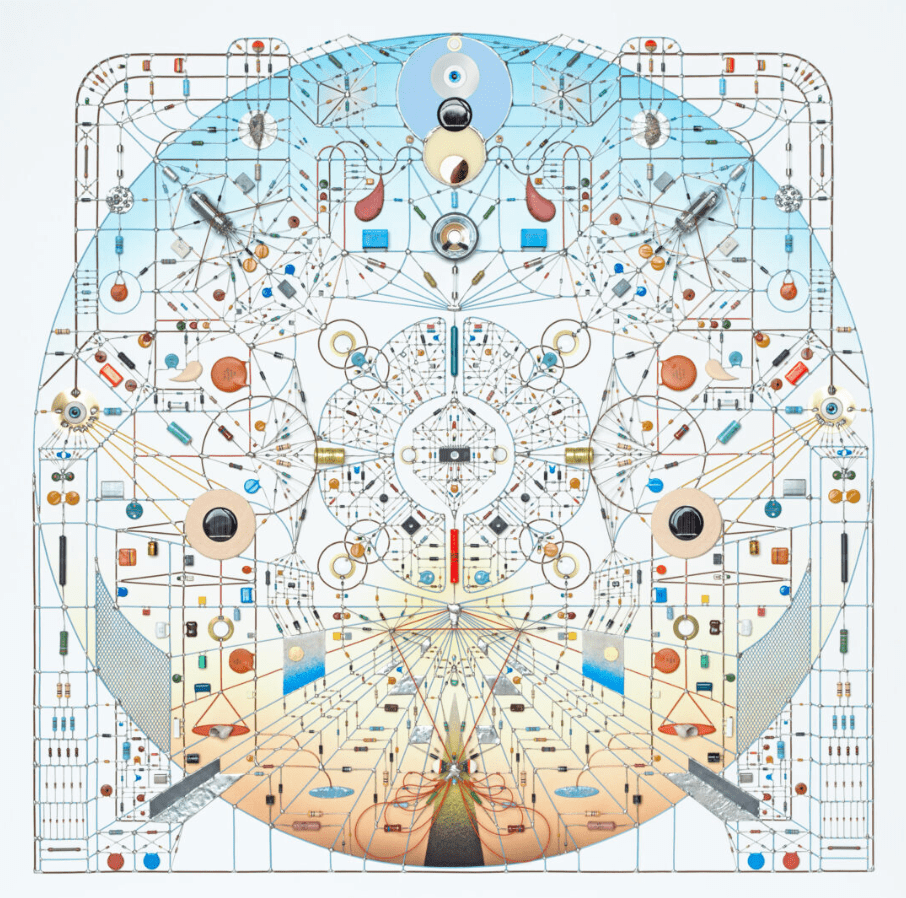
Technological Mandala 201 – Circus Circus Circus!, 2023 mixed media 100 x 100 x 4,5 cm, All images © Leonardo Ulian, shared with permission
His mandalas reference the infinite–in that there seems to be no beginning and no end. They read as elaborate social sculptures that remove the motherboard and expose the hidden beauty of systems. Systems that unite the analog with the digital, the old with the new, the everyday with aspects of spirituality.
Ulian uses tiny electronic components, arranged with meticulous detail; he creates and arranges colour, balance and symmetry, producing giant mandala-shaped circuits whose overall shapes are neither fully square, circular, nor rectangular.
His Technological Mandalas Series have been exhibited all over the world.
He says “the fact is that electronic technology has become an important part of our daily lives, almost something to believe in or something to worship. With my works I want to reveal what is hidden from our eyes and represent electronic circuits as extraordinary, ethereal objects.
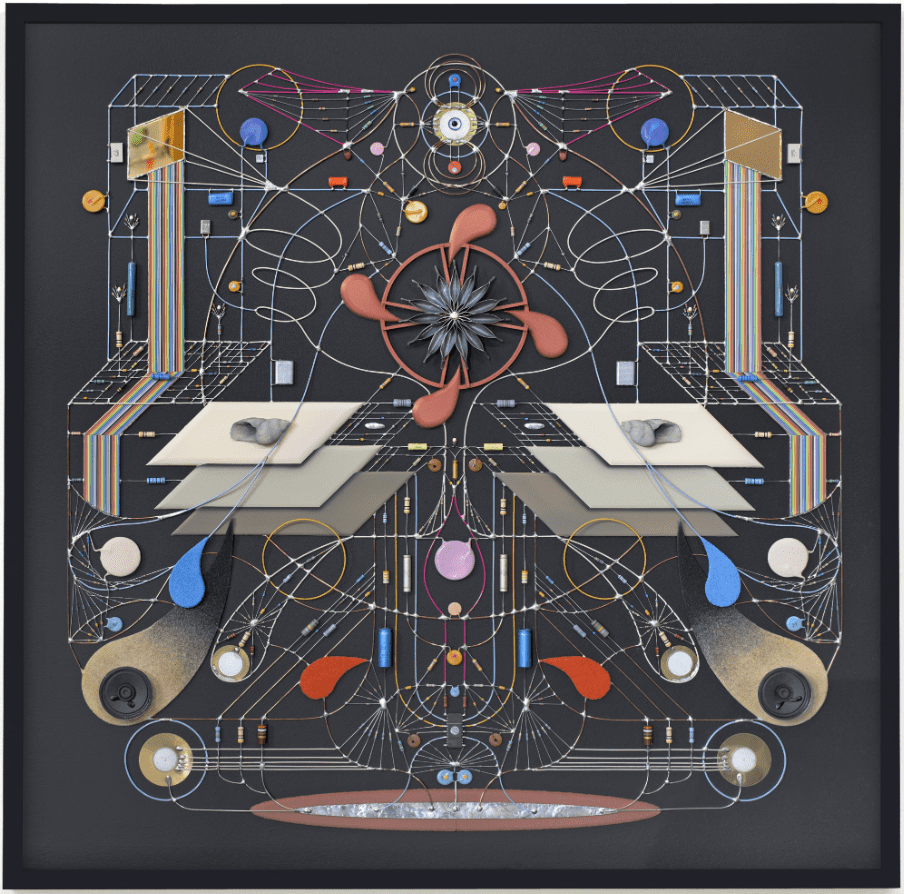
Leonardo Ulian, Techno Atlas 02, – Three Worlds and the Revolving Sun, 2024, mixed media, 84 cm x84 cm x 4,5 cm, All images © Leonardo Ulian, shared with permission
When I think of my creations, I imagine them as ephemeral gadgets, and I use the word
“ephemeral” because technology—and especially electronic technology—is somehow “impermanent” and constantly changing. I’m fascinated by the process of transformation: when you do one thing, something else is automatically destroyed.
I’m not a spiritual person, or at least not in the traditional way, but I like the idea of a universe made of infinite connections, between people, objects, feelings, states, planets, and minds, like the bonds I develop in my technological mandalas.”
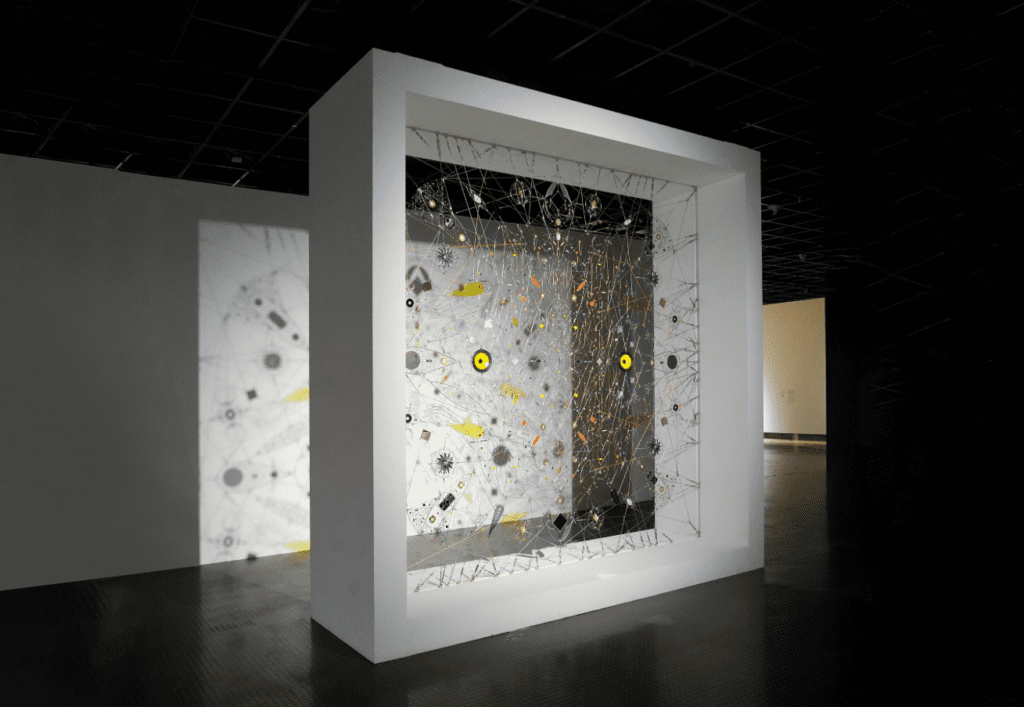
Leonardo Ulian, Technological mandala 118 – Revolution, Involution, 2025,3 mt. x 3 mt, All images © Leonardo Ulian, shared with permission
Making meaning from representation rather than from reality has long been a notion of art since mechanical reproduction started pumping out pictures. How many people have seen a reproduction of Da Vinci’s Mona Lisa, as opposed to seeing the real thing? And yet strangely enough the reason one would see the real is largely due to knowing its reproduction.
I came to know and have followed Ulian’s artwork through the Internet. My knowledge of his work is purely digital. Ironically then the very tools I use to gain a visual/literal understanding of Leonardo Ulian’s art are the very tools he uses to make art.
Here is an excerpt from the interview I conducted with this fascinating artist.
When did you first realize you wanted to be an artist?
It all happened quite late in my life, after I moved to London. Although I had always engaged in creative pursuits in Italy such as playing in bands, making things, taking art courses, and working as a graphic designer, I never considered that being a full-time artist could be a viable way to earn a living.
While pursuing my BA in Fine Arts in London, I worked as an art assistant for one of my professors. During that time, I realized that it was somehow possible to be a full-time artist. I wanted to dedicate my time to creating my own art and trying to make a living from it.
Is there another body of work that inspires you?
I am inspired by traditional Tibetan mandalas, particularly in my ongoing series titled “Technological Mandala.” My sources of inspiration are diverse and include nature, geometry, tarot, ancient history, the artist Joseph Beuys, meditation, Paul Teck, and the movement of Art Brut, to name a few. I have a long list of influences because I am a curious person; the spark for new ideas often comes from unexpected places. You just need to be aware and ready to catch it.
Would you agree that your art conjures up ideas of connectivity, disconnectedness, the subterrestrial technological workings of life?
One of my recent projects is the Technological Mandala 118 – Revolution, Involution, which I created for the 2025, 5th Hangzhou Fiber Art Triennial in China. This artwork is a 3-meter by 3- meter suspended mandala, composed of various pieces connected within a square structure that is slightly detached from the wall behind it.
After completing the installation, something unexpected occurred. Typically, shadows can pose a challenge for my work; unlike the flat surface of a painting, my components protrude, which means that if the lighting isn’t right, the shadows can be distracting. However, in this instance, the shadows cast by the wires and the colored perspex pieces onto the wall became an integral part of the artwork.
As I reflected on this, a new meaning began to emerge in my mind. The subtitle “Revolution, Involution” suggested a shift in the artwork’s presentation. I began to see the new work projected onto the wall as a shadow of our technological society—a side we often prefer to ignore, yet which undeniably exists and influences our lives, much like the shadow of our inner self described by the psychiatrist Carl Jung. This observation is not a criticism; rather, it offers a perspective on the reality of our existence.
About the Author