

Take thy beak from out my heart and take thy form from off my door! – Edgar Allan Poe, The Raven
Imagine a world without birds….it would be like a world without air. It is as if their presence is that ethereal layer between us and another world; their ability to fly, places them in a kind of spiritual or magical realm. Birds exhibit a dominion over the air, performing incredible aerial maneuvers and, in some cases, migrating thousands of
miles, which leaves us in awe of their capabilities.
Artists of all disciplines have been drawn to and inspired by our feathered friends – we are attuned to the melodious songs, calls and vocalizations that serve as a means for humans to
connect with and identify different species in their environment. So attuned are we, we create songs about our relationship with them. Think of the Beatles singing Blackbird and Anne Murray singing Snowbird.
Birds have more than just one sensory appeal; their beauty and aesthetic presence is oft admired – vibrant colors, intricate plumage, and diverse shapes.
Artist and avid birder Fred Tomaselli’s Wild Things, 2024, uses glass and ceramic mosaics with elaborate embellishments to emphasize the ideas of highly detailed and dense plumage. This piece was commissioned by the Metropolitan Transit Authority of New York City for one of their subway stations.
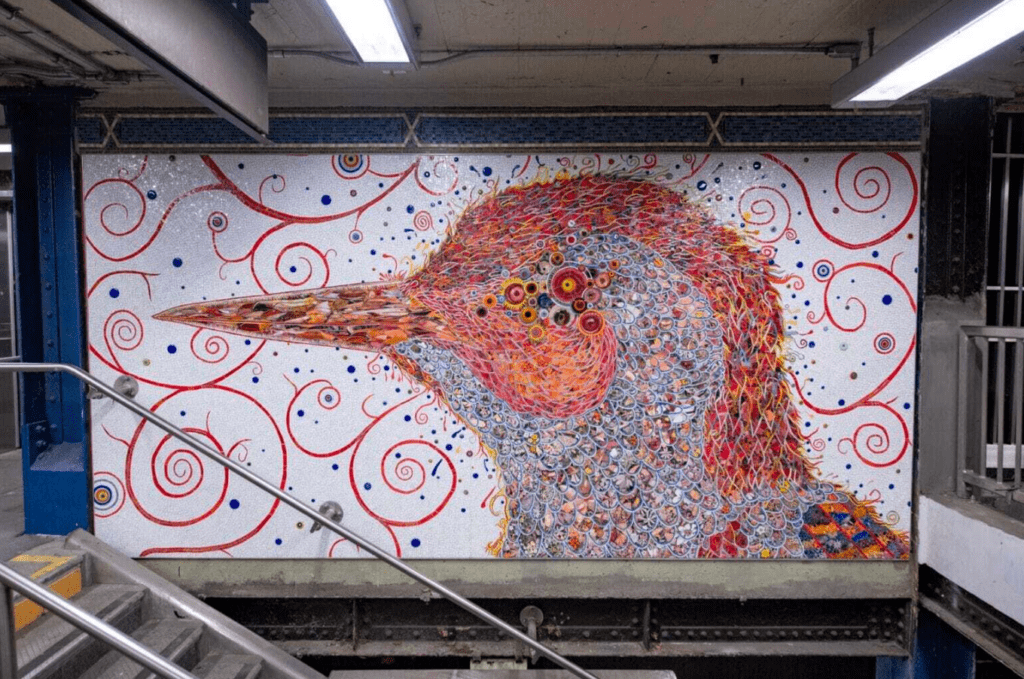
Fred Tomaselli, Wild Things, 2024, glass and ceramic mosaics, MTA NYC
Eolo, the Ruler of the Winds in Greek mythology, is seen surrounded by a large flock of birds. Peter Paul Rubens painted this rich indexical painting depicting a wide array of winged friends – a young Eolo, is seen in the company of a Woodpecker, a Kingfisher, a large Pheasant, a Raggi Bird of Paradise, two Golden Orioles, a Barn Owl, a Small Owl, a Red Macaw, two Magpies, a Guinea Fowl and a Swallow.
Falconry, dates back thousands of years to places like ancient Mesopotamia and the Eurasian steppe, falcons were trained to return to the falconer’s fist and work alongside dogs to secure food.
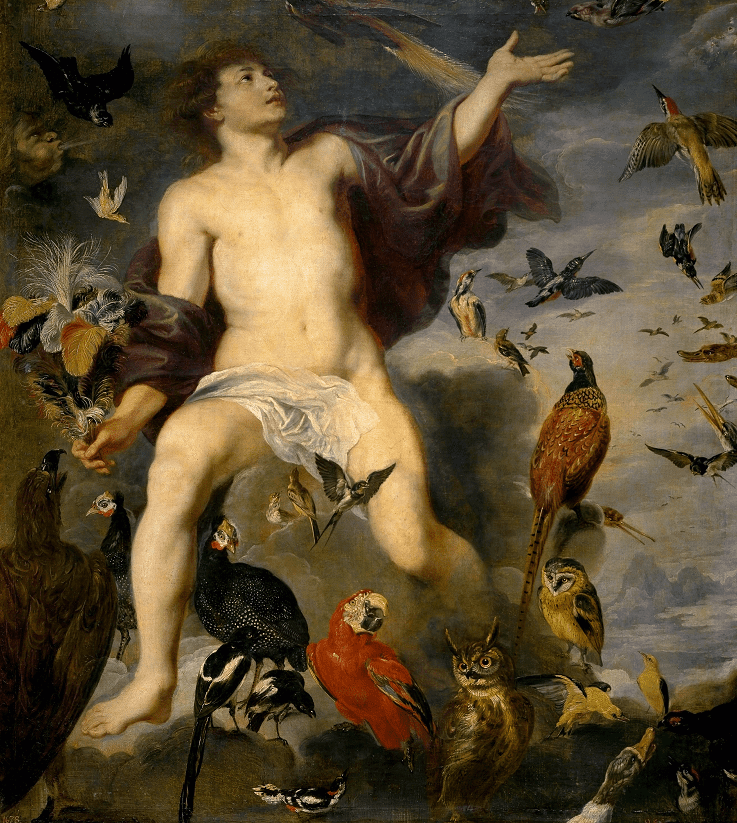
Peter Paul Rubens, Eolo, 1600, oil on canvas, Museo Prado
In Quebec based artist Emile Brunet’s Girl with Falcon, 2025, we view a bold Renaissance style portrait, a carefully painted view into the past with pink touches of the present.
The young woman is presented dead centre, her gaze almost meets ours while the falcon with its wing spread, perches comfortably on her head. The noble bird is gazing sharply in the opposite direction. The yellow hue of the bird’s claws contrasts with the black hood and the pink of the young woman’s hair, in the background an idealized pastoral landscape appears inaccessible given the position of the falcon and falconer.
Birds are viewed as representatives and symbols of the natural world, allowing people to feel close to nature even in urban environments.
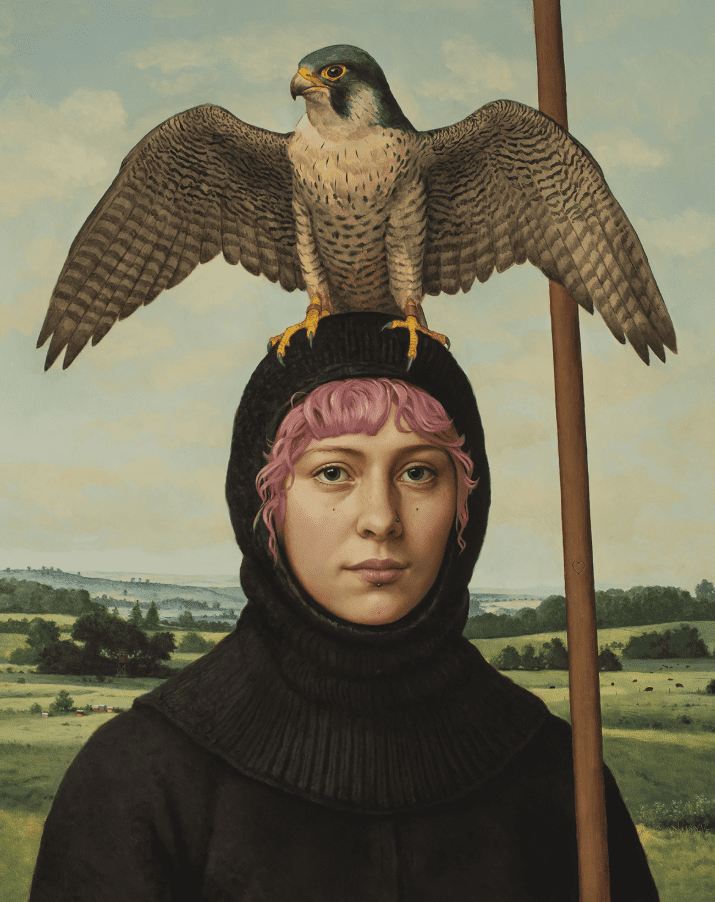
Emile Brunet, Girl with Falcon, 2025, oil on panel, courtesy of the artist
Kenojuak Ashevak’s 1960 print The Enchanted Owl is widely considered a supreme symbol of modern Inuit art and one of Canada’s most iconic images. The work features signature radiating, plumes that blend Arctic wildlife with spiritual themes.
It has appeared on a 1970 Canada Post stamp, in national exhibitions, and as a mural at the Iqaluit Airport. The owl represents wisdom, truth-seeking, and, for Ashevak, a personal
expression of happiness, often described as a “dancing owl” that “drives away the darkness.”
Is this the bird that will drive away the darkness of winter and dance us into the light of spring?
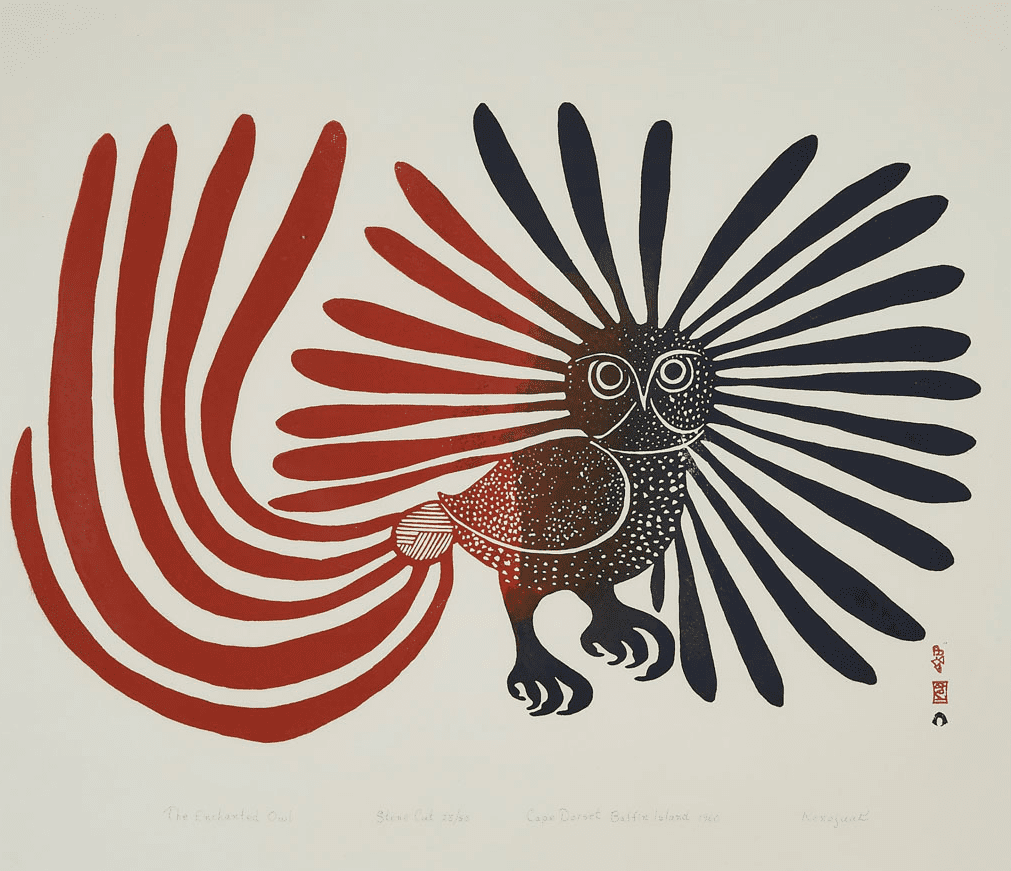
Kenojuak Ashevak, The Enchanted Owl, 1960, stonecut print on paper, courtesy of the National Gallery of Canada
About the Author