

For centuries the St. Lawrence River has been Cornwall’s highway to the world. And from the mid 19th century until World War II, dozens of pleasure and cargo steam powered paddle-wheelers sailed daily from Cornwall and points in between, east to Montreal and west to Kingston and beyond.
For many people, the River was their life. Journalist George Wilson in his “Down the Lane Column,” (Vol. 1) recorded 85 year old Captain Alexander Anderson, from Dickinson’s Landing saying:
“That at the age of 11 years old (ca. 1860) I drove my father’s horses along the ‘tow path’ down the Cornwall Canal hauling barges, for boats in those days were not equipped with steam and oil burners as they are today and had to be towed through the canal. At the age of 15 I started my boating career…out of Oswego, and in June, 1866, with the Fenian Raid in progress we were warned not to try to navigate the Welland canal, as we would never get through alive, but we did. In 1867, myself, my brother James Anderson and Dan McMillan of Dickinson’s Landing, shipped on the Belle Sheridan, of Oswego and in Toronto in 1874, I secured my captain’s papers. In my 60 year experience on the water I had but one exciting experience. We were going into Georgian Bay on the steamer Saturn … bound from Fort William to Owen Sound with a load of wheat, we ran on a shoal…in Lake Huron. We were stalled for 5 days, but after the cargo was partly lightened we were released…In later years I piloted vessels and commanded the Filgate and Britannic, ….”
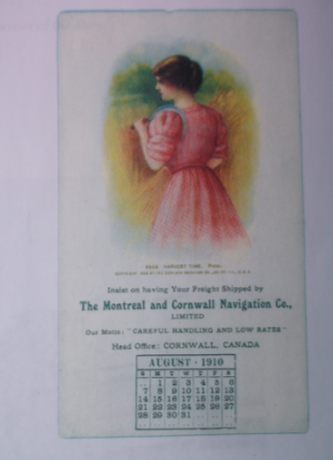
Anderson might have added that these last two vessels were part of the river boat fleet owned by The Montreal and Cornwall Navigation Co., incorporated in 1896, which also ran the steamers Emerald, City of Toronto (I am not sure about this vessel) and ferry Triton, managed from the Company’s office and wharf at the foot of Pitt St.
Headed by local entrepreneur Arnold Neilson Smith, one time president of the Cornwall Board of Trade (Chamber of Commerce), and Cornwall Community Hotel Ltd. (Cornwallis), around 1908, A. Clark became general manager. In 1926, Smith, still acting as the company’s president was elected M.P. for Stormont. After losing the 1930 election to the Conservatives, he was awarded a patronage plum as Deputy Commissioner of the Liquor Board of Ontario, leading him to relocate to Toronto.
The Company’s fleet was comprised of older ships, such as the Filgate, built in Montreal in 1879. Eventually acquired by Smith, to ply the waters between Cornwall and Montreal, on October 30, 1908, the Cornwall “Freeholder,” reported that she “…went aground in the fog about 1 ½ miles east of Lancaster on Wednesday last week, was released on Sunday and came to Cornwall. Her cargo, over 100 tons was moved to Lancaster by the steamer Chaffey, and the Filgate was thereby floated. She sprung a leak, which was repaired in the local drydock.”
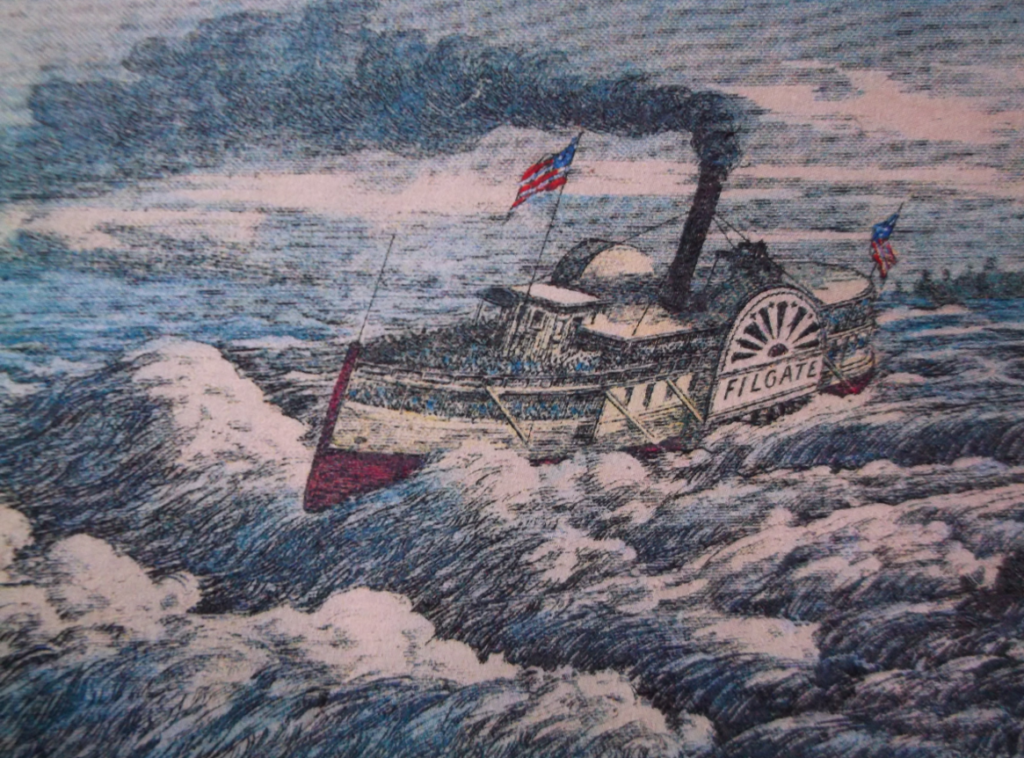
Also captained by Henry Caza of Cornwall, the Filgate’s days were numbered, and she burned in Valleyfield. Even then all was not lost, as the hull was towed to Cornwall, and then taken to Brockville to end its day’s as a sand scow.
The S.S. Britannic, was the Company’s most famous steamer. Built in Glasgow, in 1866, as a St. Lawrence River tug-boat for the Allan Lines, it was originally called the Rocket. In 1892 she was converted into a yacht, and then a steamship for the Montreal and Cornwall Navigation Company around 1898, and piloted by no less than six captains.
The Britannic’s last voyage between Montreal and Kingston was described in the November 19, 1937 edition of “The Standard Freeholder.”
The reporter wrote: “When the Britannic left Cornwall for the last time today (19th), she was but a skeleton of her former self. She was stripped of everything from bedding to dishes and only ‘the four walls’ were left as she steamed up the canal,” as one of “the last remaining sidewheelers.”
“Russel F. Snetsinger, of Cornwall, is making his last roundup as purser,” for 19 years.
“Walter V. Silmser, local agent of the boat since 1929.”
“Mrs. Alice Hill, of Cornwall acted as stewardess on this boat this season, and Mrs. Ross Munro of Lancaster was cook…”
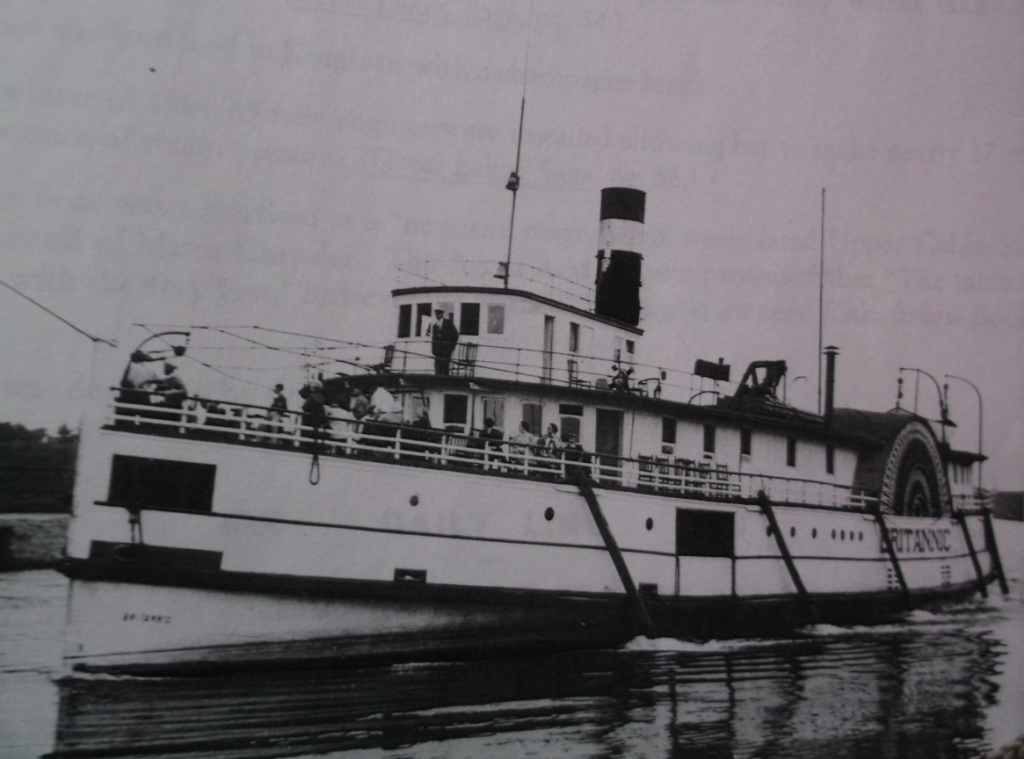
The 151 foot long “Britannic generally carried a crew of 18,” which was sometimes increased to 24.
The vessel, which had never had a written complaint “entered against her,” was now sold for scrap.
The 117 foot long and 20 foot wide S.S. Emerald was constructed in Valleyfield to carry 260 passengers as the Garnet, in 1885. Two years later she was sold at auction to Captain Oliver Gillespie for $8,000. Making daily trips between Montreal and Cornwall, she stopped at St. Regis, Summerstown, Lancaster, St. Anicet, Port Lewis, St. Zotique, Valleyfied, Coteau Landing, Cedars, Melocheville and Lachine, picking-up passengers and freight. During the winter she was drydocked in Cornwall.
In 1907, she was renamed the Emerald by new owners. A year later, she sailed for The Montreal and Cornwall Navigation Co., and every Friday, throughout the sailing season would leave Montreal at noon, “…remaining at Valleyfield overnight. Leave Valleyfield at 7 a.m., arriving in Cornwall Saturday noon. Starting again at 1 o’clock and reaching Morrisburg at 7 p.m.,” to return to Montreal on Monday morning. The vessel was condemned in 1944.
I have only been able to discover that the company’s ferry Triton, was built in Massena in 1882 and transported horses and wagons between Cornwall and Massena around 1900, to be eventually condemned. Any additional information would be appreciated!
About the Author