


With multinational corporations dominating the home appliance industry, it is amazing to learn that Benson C. Beach, of Winchester became one of Canada’s leading stove manufacturers.
A son of successful business man M.F. Beach, Benson first ventured into business as the publisher of the “St. Lawrence News,” in Iroquois.
Brought-up in Dundas County’s leading industrial family, publishing did not suit Benson and at age 24, believing that he “…could design and manufacture a better and cheaper stove,” he returned to Winchester to open a foundry, in 1894.
Here according Dave Alliston’s online history of the Beach Foundry, “…with two assistants he created patterns in wood and metal and then using a small cupola (a small vertical cylindrical furnace used to melt iron) successfully produced the first Beach stove ,” dubbed the Longwood box stove.

A beach stove advertisement, circa 1904
His kitchen stove was so popular that within a year the foundry was fabricating its “signature” Maple Leaf stove, “replete with fancy…scrollwork gleaming with it is blackened polish.”
Initially, only capable of turning-out two stoves a week, the foundry was consumed by fire in 1901, causing $3,000 damage, (a very low $115,000., today). Even though Beach only had $1,475 worth of insurance, he rebuilt and a year later was making steel ranges fueled by coal or wood.
In 1903 Beach incorporated his business. Recovery was quick and within a year he employed 30 people.
The Company came to be seen as a world leader in the production of heating and cooking appliances, leading Beach to relocate to Ottawa’s LeBreton Flats in 1914, where the factory’s output increased by 50%. Wartime restrictions now restricted future growth until 1921. Now reorganized, as Beach Foundry Ltd., Benson built a four building industrial complex in Hintonburg (Ottawa) that within two years was turning-out 150 stoves a day, along with ranges, heaters and furnaces.
Growth was continuous, and during World War II, the foundry produced steel tank tracks, shell castings and other War materials.
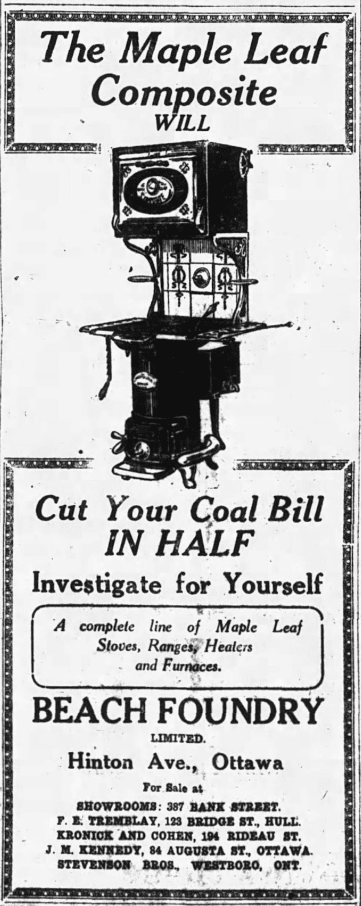
An ad for the “Maple Leaf,” composite stove, 1921. (Courtesy, Dave Allston, “The Beach Foundry,” The Kitchissippi Museum. (Left)
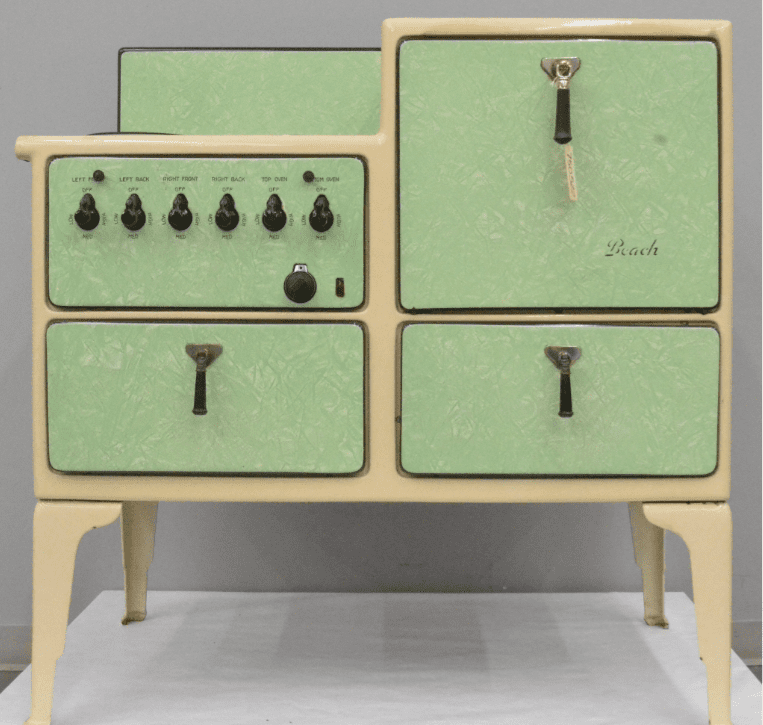
An electric buffet range produced by Beach Foundry Ltd., ca. 1937. (Courtesy, Ingenium, 1976.0463)
Benson Clothier Beach died in 1949, leading to a number of corporate mergers and name changes to eventually become a subsidiary of Canadian Admiral, trading under the name Beach Appliances International. Several decades later the Federal and Quebec provincial governments introduced incentives to Quebec based York Lambton Ltd., to purchases Canadian Admiral and move to Quebec. As a result of this acquisition the Ottawa plant closed in 1980, at the loss of 275 local jobs and relocated to Montmagny Quebec.
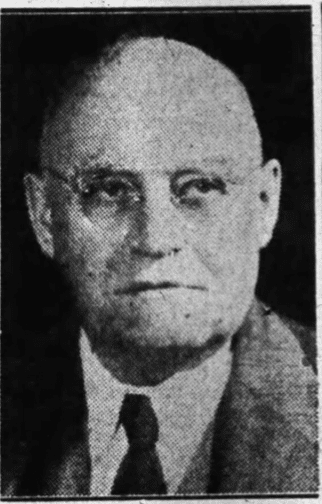
An ad for the “Maple Leaf,” composite stove, Benson C. Beach, 1870-1949, photo, ca. 1944. Beach was married to Anna May Johnston, the couple had “at least” six sons and two daughters. (Courtesy, Dave Allston, “The Beach
Curious about history? Have a topic you’d like us to cover? Send an email to [email protected] and we’ll do our best to bring you answers!
About the Author